Enclosures
ABS vs ASA on a Bambu Lab printer
They print the same way and they age completely differently. For most parts the choice is decided by where the part will live.
By Michael W. · Published October 5, 2026
Some links here are Amazon affiliate links, so a purchase may earn this site a commission at no cost to you. It does not change what gets recommended or the order it appears in — how that works.
The verdict
Printing it, they are nearly the same. Same enclosure requirement, same warping tendency, same need for dry filament and low part cooling, similar temperatures.
Living with it, they are not. ASA is the UV-stable one. If the part goes outdoors or sits in sunlight, ASA. If it lives indoors, ABS is fine and usually cheaper and more widely stocked.
If you are choosing one material to learn: ASA, because it covers both cases and the printing experience is close enough that you lose nothing.
Side by side
| ABS | ASA | |
|---|---|---|
| UV stability | Poor — yellows and becomes brittle in sunlight | Good — the reason it exists |
| Enclosure needed | Yes | Yes |
| Warping tendency | High | High, broadly comparable |
| Part cooling | Low — cooling causes splitting | Low, same reason |
| Moisture sensitivity | Moderate — dry it | Moderate — dry it |
| Fumes | Noticeable styrene smell; ventilate | Similar; ventilate |
| Availability | Very widely stocked | Less widely stocked |
| Best for | Indoor functional parts | Anything outdoors or in sunlight |
What both of them need from your setup
An enclosure, and a warm one
Non-negotiable. Both materials contract significantly as they cool, and if the lower layers cool while the upper ones are still printing, the part either lifts from the plate or splits between layers. Warm air around the whole part is the fix. Chamber temperature.
Part cooling turned down
The counterintuitive one, and the mistake most people make. If you fitted a better cooling duct or auxiliary fan to fix PLA overhangs, it is working against you here. Chilling each layer before the next bonds to it is precisely what causes layer splitting.
Dry filament
Both absorb moisture, and wet engineering filament gives you a rough surface and weak parts on top of the warping you are already fighting. Drying guide.
Ventilation
Both produce a noticeable styrene smell. An air filter helps with particulates inside the chamber and is not a substitute for ventilating the room. I have no measurements of what any filter captures, so I will not tell you a filter makes it safe — open a window.
Where ASA earns its place
Anything outdoors. ABS yellows and embrittles in sunlight over months, and a functional part that becomes brittle is a part that fails. ASA was formulated for UV stability, and for brackets, mounts, enclosures, automotive interior parts and garden hardware it is the correct choice rather than a premium one.
The cost is availability. ASA is less widely stocked than ABS, so check you can reliably buy more of the color you commit to before you start a multi-part project.
Where ABS is the right call
Indoor functional parts where UV never enters the picture: jigs, tool holders, enclosures for electronics, replacement parts for appliances. It is cheaper, more widely available in more colors, and there is nothing wrong with it in the environment it was designed for.
Which printers handle these
Any enclosed Bambu machine can attempt both: P1S, P2S, X1C, X2D and the H-series. The A1 and A1 mini cannot without an enclosure, and not reliably even then. Printers for ASA ranks them properly.
The two machines, side by side

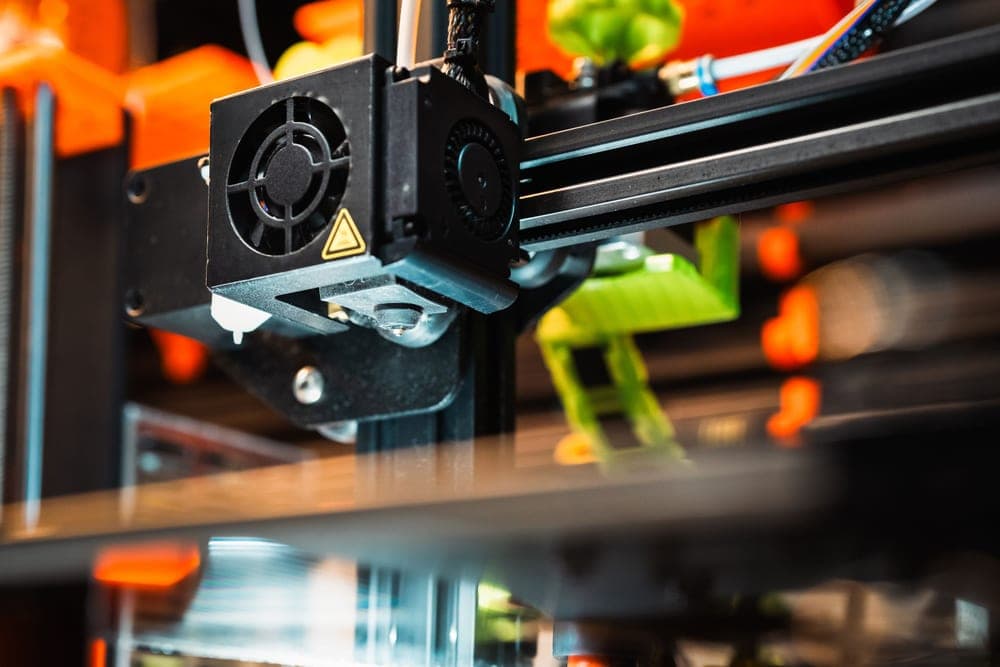
Stock photograph of this product class, not of this specific unit.
#ad We earn a commission · live price shown on Amazon
1. Best printer for either material
Bambu Lab X2D
A reported 65 C actively heated chamber, which is what both materials actually want.
Both materials want warm air around the whole part for the duration of the print. A passive enclosure approximates that; an actively heated chamber provides it. The X2D is reported to heat its chamber to 65 C, which is the difference between these materials usually working and reliably working.
Listed here because the honest answer to "why does my ASA keep splitting" is sometimes the machine. It is only the right purchase if those materials are central to what you print.
What it gets right
- Dual nozzle without stepping up to the H2 footprint — two materials on a desk-sized machine
- A reported 65 C heated chamber is a real capability jump over any passive P-series enclosure
- Newest filtration and thermal hardware in the smaller form factor
What it does not
- Released April 2026, so third-party part support is thin compared with the P1S
- Same reported 256 mm build volume as a P1S — this is a capability upgrade, not a size one
- I have not run one. What follows anywhere on this site about the X2D is specification and reasoning, not observation
| Released | April 14, 2026 |
|---|---|
| Type | Enclosed CoreXY, dual nozzle |
| Improvements cited | Air filtration, thermal management and speed |
| Build volume (reported) | 256 mm cube |
| Chamber (reported) | Heated to 65 C |
Stock photograph of this product class, not of this specific unit.
#ad We earn a commission · live price shown on Amazon
2. Cheapest route to attempting either
Comgrow 3D Printer Enclosure
Flame-retardant and temperature-stabilizing, which gets an open machine into the game for small parts.
If you own an open-frame machine and want to try either material, this is the entry point. A flame-retardant aluminum-lined fabric enclosure on an iron frame, with stated temperature stabilization.
Set expectations accordingly: small parts become feasible, tall parts remain difficult. The physics of a passive enclosure does not change because the material is more demanding.
What it gets right
- A flame-retardant lining on a machine that runs unattended overnight is the kind of upgrade you do not regret
- Stabilizes temperature enough to cut warping on large PETG parts, which is the realistic win here
- Collapses and stores, unlike an acrylic box
What it does not
- It reduces noise; it does not soundproof. Expect a difference, not silence
- Fabric and a passive frame will never give you a 60 C chamber — this is not an ABS solution
- Listed compatibility is written around Creality-sized machines, so measure your printer and your AMS before buying
| Type | Fabric enclosure tent with an iron frame |
|---|---|
| Interior | Flame-retardant aluminum lining |
| Outer shell | 600D Oxford fabric, waterproof and dustproof |
| Features cited | Dust reduction, noise reduction, temperature stabilization, tool pockets |
Questions people actually ask
What is the difference between ABS and ASA?
UV stability, mostly. ASA resists sunlight where ABS yellows and becomes brittle over months of exposure. Printing them is very similar - both need an enclosure, low part cooling and dry filament, at broadly comparable temperatures.
Should I print ABS or ASA?
ASA if the part will be outdoors or in sunlight, which is what it was formulated for. ABS if the part lives indoors, where it is cheaper and more widely stocked. If you are picking one material to learn, ASA covers both cases for very little extra difficulty.
Can I print ASA without an enclosure?
Not reliably. ASA contracts significantly as it cools, so without warm air around the whole part the lower layers pull away from the upper ones and the part warps or splits. A passive fabric enclosure makes small parts feasible; tall parts need a genuinely warm chamber.
Why does my ASA print split between layers?
Usually too much part cooling, a chamber that was not up to temperature when the print started, or both. Layer splitting happens when each layer chills before the next bonds to it. If you added a cooling fan to fix PLA overhangs, turn it down for ASA.
Are ABS and ASA fumes dangerous?
Both give off a noticeable styrene smell and should be printed with room ventilation. An air filter in the chamber helps with particulates and is not a substitute for ventilating the space. We publish no capture figures for any filter because we have measured none.
Sources
Read this next
- How to print ABS on a Bambu Lab printerThe four real causes of ABS failure in order, the warm-up step most people skip, and the cooling setting that works against you.
- Why your prints keep warpingHow to distinguish corner lift from layer splitting, and the four causes behind warping with the cheapest fixes first.
- The best Bambu Lab printer for ASAWhich machines handle ASA and ABS, why passive and active chambers differ, and the free technique to try before buying.
- Chamber temperature on a passive enclosureHow passive chamber heating works, the safe ways to raise it, the modifications to avoid, and when an actively heated machine is the real answer.
- How to dry filamentFour drying methods compared, the temperature each material wants, and the one method that does not work despite being widely suggested.