Enclosures
Why your prints keep warping
Corner lift and layer splitting look similar and need almost opposite responses. Identify which one you have before changing anything.
By Michael W. · Published October 5, 2026
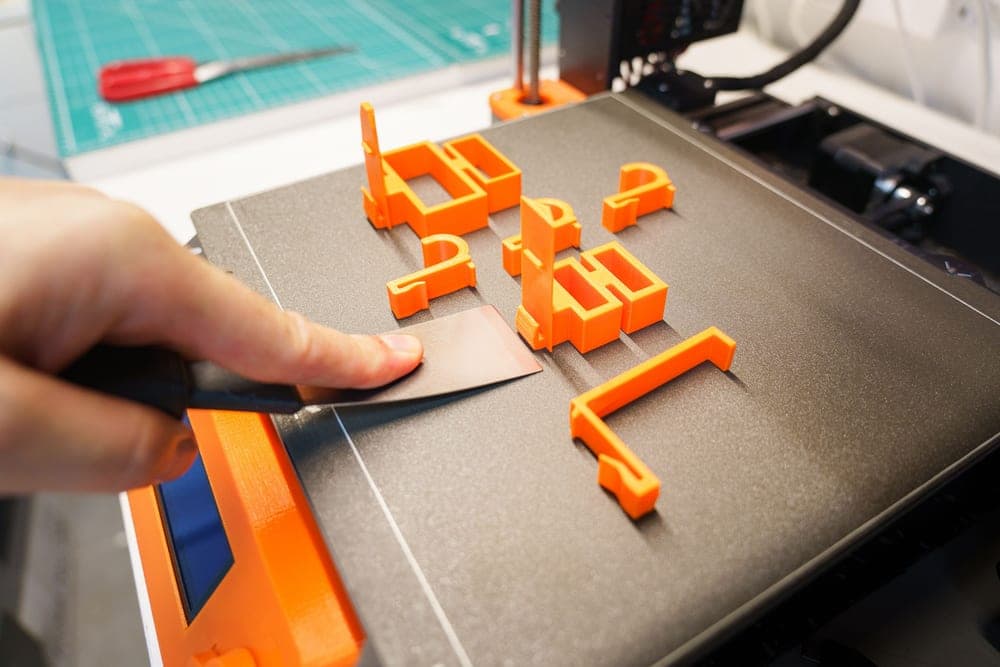
Which fault do you have?
Corner lift: the bottom corners of the part curl up off the plate. This is an adhesion and bed problem.
Layer splitting: the part stays stuck but cracks horizontally partway up, often on a tall thin section. This is a chamber and cooling problem.
They look alike in a photograph and the fixes are nearly opposite: corner lift wants better grip and a hotter bed; splitting wants warmer air and less cooling. Changing both at once is how people spend a weekend going nowhere.
Corner lift: the four causes in order
1. A contaminated plate
Skin oils, overwhelmingly. Wash the plate with dish soap and hot water — not isopropyl alcohol, which tends to spread oil around rather than lift it off. This is free and it is the most common cause. Adhesion in full.
2. Too little contact area
A tall part on a small footprint has very little holding it down against contraction. Add a brim. On ABS and ASA, add a generous one.
3. Bed temperature too low for the material
A hot bed keeps the lowest layers soft enough not to pull. Use the filament profile rather than a number you remember.
4. A worn plate
PEI is a consumable. If a proper wash does not restore adhesion, the surface is done and a new plate is the fix — which is also the argument for keeping a second one on the shelf.
Layer splitting: the four causes in order
1. Too much part cooling
The big one, and the counterintuitive one. Chilling a layer before the next bonds to it produces a weak joint, and contraction then pulls it apart. If you fitted a cooling upgrade to fix PLA overhangs, turn it down for ABS and ASA.
2. A cold chamber at print start
A passive chamber needs the bed hot for 15-20 minutes before it is doing anything. Start immediately and the early layers go into cool air. Chamber temperature.
3. No chamber at all
On an open machine with ABS or ASA, this is simply the material being used outside its requirements. An enclosure is the fix, with the honest caveat that a passive one has limits.
4. Wet filament
Moisture weakens layer bonding, which makes a marginal case fail. Dry it before concluding anything else. How to tell.
By material
| Material | Warping tendency | First thing to check |
|---|---|---|
| PLA | Low | Plate cleanliness — if PLA warps, the plate is the cause |
| PETG | Low to moderate on large flat parts | Bed temperature and brim; an enclosure helps on big parts |
| TPU | Low | Usually an adhesion or over-grip problem, not warping |
| ABS | High | Chamber warm-up and part cooling |
| ASA | High, comparable to ABS | Same as ABS |
| PC / nylon | High | Chamber, plus drying — these absorb moisture fast |
The useful diagnostic here: if PLA is warping, it is not a temperature problem. PLA barely contracts. A warped PLA part means the plate was dirty or the first layer was wrong, every time.
Where to go next
ABS or ASA specifically: how to print ABS. Adhesion generally: print not sticking. Anything else wrong with the print: print quality triage, which sorts symptoms by cause across the whole site.
What to buy
Stock photograph of this product class, not of this specific unit.
#ad We earn a commission · live price shown on Amazon
1. Best fix for corner lift
Bambu Lab Textured PEI Plate
Powder-coated texture grips harder than smooth, which is what a lifting corner needs.
Corner lift is an adhesion failure. A textured PEI plate with a 0.5 mm stainless base grips hard without glue and is cited as resisting warping on large models in ABS, PC and nylon — which is exactly the failure mode here.
Before buying: wash the plate you own with dish soap and hot water. Contamination is the usual cause and the wash is free.
What it gets right
- Powder-coated texture grips hard without glue stick and releases when cool, which is the whole job
- The 0.5 mm steel base is stiff enough that it does not lift at the corners under a hot bed
- Hides first-layer imperfections, so a slightly off Z offset is forgiving rather than a failure
What it does not
- The texture transfers to your first layer — wrong plate for anything whose bottom face is a show surface
- PEI surfaces are consumable; skin oils and over-aggressive scraping both shorten their life
- TPU can grip hard enough on textured PEI to tear the surface on removal
| Surface | Powder-coated textured PEI |
|---|---|
| Base | 0.5 mm stainless steel with enhanced magnetic adhesion |
| Stated strength | Resists warping on large models in ABS, PC and nylon |
Stock photograph of this product class, not of this specific unit.
#ad We earn a commission · live price shown on Amazon
2. Best fix for an open machine
Comgrow 3D Printer Enclosure
Stabilizes chamber temperature, which is the root cause when the whole part is contracting.
On an open-frame machine, warping is largely a temperature-gradient problem: the bottom of the part is near a hot bed and the top is in room air. A flame-retardant fabric enclosure with stated temperature stabilization narrows that gradient.
It helps most on large PETG, which is where open-machine warping shows up most often. It does not make ABS reliable.
What it gets right
- A flame-retardant lining on a machine that runs unattended overnight is the kind of upgrade you do not regret
- Stabilizes temperature enough to cut warping on large PETG parts, which is the realistic win here
- Collapses and stores, unlike an acrylic box
What it does not
- It reduces noise; it does not soundproof. Expect a difference, not silence
- Fabric and a passive frame will never give you a 60 C chamber — this is not an ABS solution
- Listed compatibility is written around Creality-sized machines, so measure your printer and your AMS before buying
| Type | Fabric enclosure tent with an iron frame |
|---|---|
| Interior | Flame-retardant aluminum lining |
| Outer shell | 600D Oxford fabric, waterproof and dustproof |
| Features cited | Dust reduction, noise reduction, temperature stabilization, tool pockets |
Questions people actually ask
Why do my prints keep warping?
First work out which fault it is. Corner lift - bottom corners curling off the plate - is an adhesion problem, usually a contaminated plate, too little contact area, or a bed that is not hot enough. Layer splitting partway up a part is a chamber and cooling problem, usually too much part cooling or a chamber that had not warmed up.
What is the difference between warping and layer splitting?
Warping, in the corner-lift sense, means the part pulls away from the plate at its edges. Layer splitting means the part stays stuck but cracks horizontally partway up. They look similar and need nearly opposite fixes: lift wants better grip and a hotter bed, splitting wants warmer air and less cooling.
Why is my ABS print splitting between layers?
Almost always too much part cooling, a chamber that was not pre-heated, or both. ABS contracts as it cools, so chilling each layer before the next bonds to it produces a weak joint that contraction then pulls apart. Wet filament makes a marginal case fail.
Why is my PLA warping?
Not temperature - PLA barely contracts. A warped PLA part means the plate was contaminated or the first layer was wrong. Wash the plate with dish soap and hot water rather than alcohol, and check the first layer is actually squashing into the surface.
Will a brim stop warping?
It helps with corner lift by giving the part more area to resist contraction, and it is nearly free to try. It does nothing for layer splitting further up the part, because that is a chamber and cooling fault rather than an adhesion one.
Sources
Read this next
- How to print ABS on a Bambu Lab printerThe four real causes of ABS failure in order, the warm-up step most people skip, and the cooling setting that works against you.
- When prints will not stick to the plateAdhesion failures in diagnostic order, starting with the free fix that resolves most of them, and the material-specific exceptions.
- Chamber temperature on a passive enclosureHow passive chamber heating works, the safe ways to raise it, the modifications to avoid, and when an actively heated machine is the real answer.
- Print quality triageThe central symptom-to-cause table for the whole site, with the two free checks that resolve most problems before any purchase.
- How to tell if your filament is wetThe three near-conclusive signs of wet filament, the ambiguous ones, and the free test that settles it in one print.