Printers
The best Bambu Lab printer for ASA
One specification decides this: whether the chamber makes heat or merely keeps it. Everything else is technique.
By Michael W. · Published October 5, 2026
Some links here are Amazon affiliate links, so a purchase may earn this site a commission at no cost to you. It does not change what gets recommended or the order it appears in — how that works.
The short answer
Best for ASA: the X2D, because it is reported to heat its chamber actively to 65 C. That is the specification that separates "usually works" from "works".
Best value: the P1S, which is enclosed with an auxiliary fan and handles small and medium ABS well with correct technique.
Largest parts: the H2D, at a reported 350 x 320 x 325 mm.
Open-frame A1 or A1 mini: no, not reliably. An enclosure brings small parts into reach and will not make tall ones work.
Why the chamber is the whole specification
ABS and ASA contract significantly as they cool. If the bottom of a part cools and contracts while the top is still printing, the part either lifts off the plate or cracks between layers. Warm air around the whole part for the whole print is the fix.
A passive chamber — P1S, P2S, X1C — retains heat the bed produces. It settles somewhere above ambient and that is the end of your control. It is enough most of the time, and it loses on tall parts, because air near the top of a tall print is cooler than air near the bed.
An actively heated chamber sets a temperature and holds it, which removes that gradient. There is no upgrade path from one to the other. Chamber temperature in detail.
Try the free technique before you buy
Most ABS and ASA failures on an already-enclosed machine are one of four things, and all four are free to fix:
- Pre-heat the chamber. Bed at temperature, door shut, 15-20 minutes before you start. A passive chamber is useless until the bed has been hot for a while.
- Turn part cooling down. The counterintuitive one. Chilling each layer before the next bonds to it causes splitting, and the fan you fitted for PLA overhangs is doing it.
- Dry the filament. Wet ABS is rough and weak on top of the warping.
- Wash the plate with dish soap and hot water. ABS is far less forgiving of a contaminated plate than PLA.
The full technique guide. Do this before buying a machine, because it resolves a surprising share of cases.
Machine by machine
| Machine | ABS / ASA | Why |
|---|---|---|
| A1 / A1 mini | No, not reliably | Open frame, no chamber at all |
| A1 + fabric enclosure | Small parts sometimes | Passive, bed-heated only |
| A2L | No | Larger open frame — same ceiling |
| P1P | No until enclosed | Open; official enclosure kit available |
| P1S / P2S | Yes, with technique | Enclosed, passive chamber, auxiliary fan |
| X1C | Yes, slightly better | Aluminum enclosure retains heat better; hardened nozzle standard |
| X2D | Best | Reported actively heated to 65 C |
| H2S / H2D / H2C | Yes, and large | Enclosed large format |
ABS or ASA?
They print almost identically and need the same things from the printer. The difference is UV stability: ASA resists sunlight, ABS yellows and embrittles in it. If the part lives outdoors, ASA; indoors, ABS is cheaper and more widely stocked. The full comparison.
What else these materials need from you
Ventilation. Both give off a noticeable styrene smell. An air filter helps with particulates inside the chamber and is not a substitute for ventilating the room. This site publishes no capture figures because it has measured none.
Dry filament. Both absorb moisture, and ABS and ASA sit in the moderate band — a 70 C dryer is marginal and a higher-temperature unit is better. Dryers.
A brim on tall or narrow parts. More area resisting corner lift, nearly free.
Where to go next
The technique guide, P2S vs X2D if you are replacing a P1S for materials, and warping diagnosis if something is failing right now.
What to buy

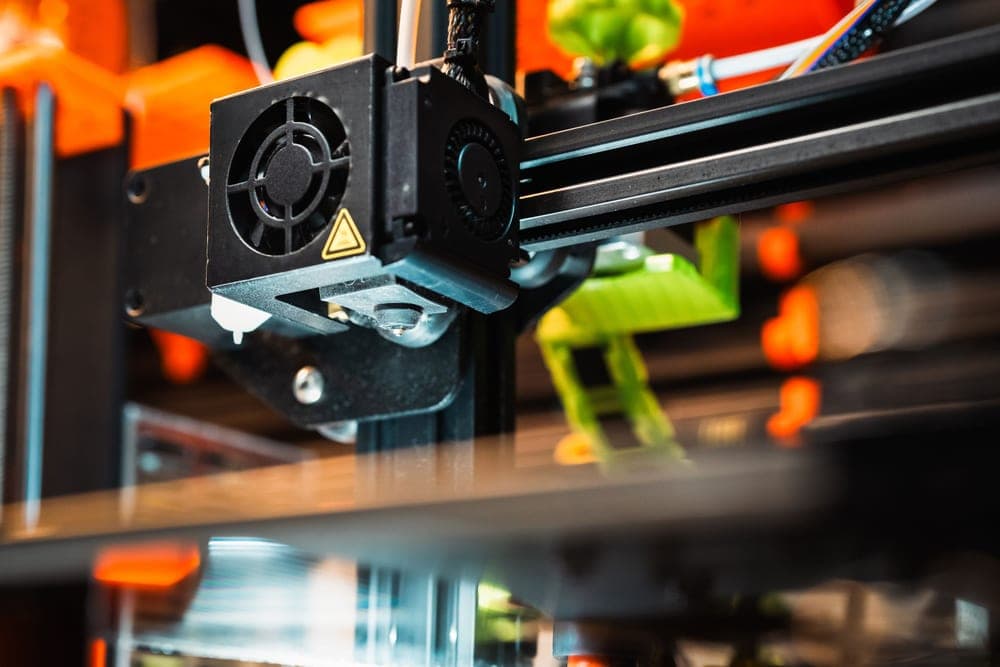
Stock photograph of this product class, not of this specific unit.
#ad We earn a commission · live price shown on Amazon
1. Best for ASA
Bambu Lab X2D
A reported 65 C actively heated chamber in a desk-sized machine - the specification that matters here.
For ASA and ABS specifically, this is the machine. A passive chamber retains heat the bed produces; an actively heated chamber sets and holds a temperature, and that is what stops tall parts splitting partway up.
Reported at 65 C chamber heating with a 256 mm cube build volume, plus cited improvements to air filtration and thermal management.
I have not run one. This is specification and reasoning rather than observation, and the accessory market for an April 2026 machine is thin.
What it gets right
- Dual nozzle without stepping up to the H2 footprint — two materials on a desk-sized machine
- A reported 65 C heated chamber is a real capability jump over any passive P-series enclosure
- Newest filtration and thermal hardware in the smaller form factor
What it does not
- Released April 2026, so third-party part support is thin compared with the P1S
- Same reported 256 mm build volume as a P1S — this is a capability upgrade, not a size one
- I have not run one. What follows anywhere on this site about the X2D is specification and reasoning, not observation
| Released | April 14, 2026 |
|---|---|
| Type | Enclosed CoreXY, dual nozzle |
| Improvements cited | Air filtration, thermal management and speed |
| Build volume (reported) | 256 mm cube |
| Chamber (reported) | Heated to 65 C |
Stock photograph of this product class, not of this specific unit.
#ad We earn a commission · live price shown on Amazon
2. Best value for ABS
Bambu Lab P1S
Enclosed with an auxiliary fan and air filter, which is the floor for these materials.
The cheapest machine in the range that can genuinely attempt ABS and ASA, because it is enclosed as standard and came with the auxiliary cooling fan and air filter.
For small and medium ABS parts, with the chamber pre-heated and part cooling turned down, it works well. Tall ASA is where the passive chamber shows its limit.
What it gets right
- The enclosure plus auxiliary fan is what makes ABS and ASA realistic rather than aspirational
- Still the best-supported machine in the range for third-party upgrades — screens, hotends, plates, ducts
- Fast enough that the P2S's speed gain is not the reason to replace it
What it does not
- No touchscreen as shipped, which is why the Panda Touch exists
- No quick-swap nozzle: a nozzle change is a hotend job, not a 30-second one
- Passive chamber only — it holds heat, it does not make heat
| Released | July 13, 2023 |
|---|---|
| Type | Enclosed CoreXY |
| Over the P1P | Enclosure, auxiliary cooling fan and air filter |
| Multi-color | AMS and AMS 2 Pro (4 spools, expandable) |
Stock photograph of this product class, not of this specific unit.
#ad We earn a commission · live price shown on Amazon
3. Best used option
Bambu Lab X1-Carbon
An aluminum enclosure holds chamber heat better than panels, plus a hardened nozzle as standard.
For engineering materials the X1-Carbon has a real advantage over a P1S: an aluminum enclosure retains chamber heat better than the P1S's panels, and it ships with a hardened steel nozzle, which matters because so much engineering filament is filled.
Still a passive chamber, so it does not reach what the X2D is reported to do. At used prices, good value for this use case.
What it gets right
- Ships with a hardened steel nozzle, so abrasive filament is a day-one capability rather than a purchase
- Lidar bed leveling and first-layer inspection, which the P-series does not have
- An aluminum enclosure holds chamber heat better than the P1S's panels
What it does not
- It is not the current flagship and has not been since March 2025 — buying it new at flagship money is a mistake
- The H2D and X2D both exceed it, so resale value is on a downward path
- Single nozzle, where the current top of the range is dual
| Series | X1, released May 24, 2022 |
|---|---|
| Type | Enclosed CoreXY with lidar-based bed leveling |
| X1-Carbon spec | Aluminum enclosure, hardened steel nozzle, auxiliary cooling fan |
| Screen | 5-inch touchscreen |
| Superseded by | H2D (March 2025) and X2D (April 2026) |
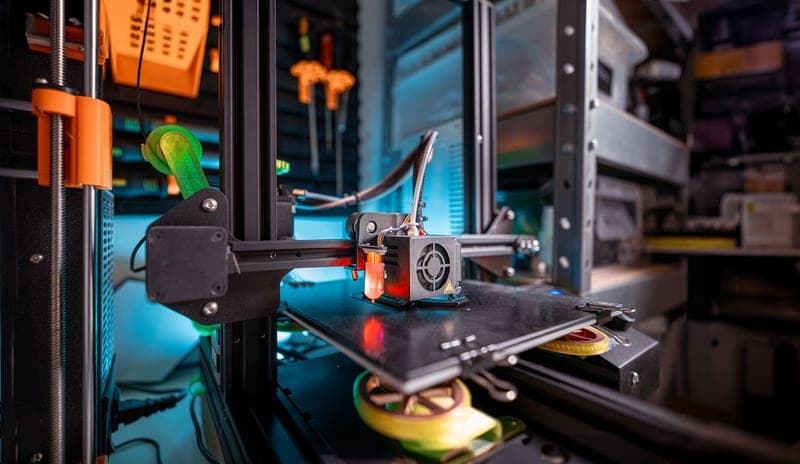
Stock photograph of this product class, not of this specific unit.
#ad We earn a commission · live price shown on Amazon
4. Best for large ASA parts
Bambu Lab H2D
A reported 350 x 320 x 325 mm enclosed bed, for the parts that would not fit anything smaller.
Large ASA parts are the hardest case in this whole category, because warping scales with part size. If you need both the volume and the material, this is the machine — enclosed, large format, direct-drive dual nozzle.
Our sources do not report an actively heated chamber on it, so this site does not claim one. Buy it for size; buy the X2D for chamber control.
What it gets right
- Direct-drive dual nozzle is a different kind of machine, not a faster version of the one you own
- The largest reported build area of the models an enthusiast realistically buys
- Two hotends means dissolvable or contrast material without an AMS color-change purge every layer
What it does not
- This is the biggest single jump in money in the whole lineup — it has to replace a workflow, not a wish
- Two nozzles is two of every maintenance task
- If multi-color is the actual goal, an AMS 2 Pro on your existing printer gets you most of the way for a fraction of it
| Released | March 25, 2025 |
|---|---|
| Type | Large-format enclosed, direct-drive dual nozzle |
| Build volume (reported) | 350 x 320 x 325 mm |
| Laser Edition (reported) | Adds laser, blade and pen toolheads |
Stock photograph of this product class, not of this specific unit.
#ad We earn a commission · live price shown on Amazon
5. Cheapest way to attempt it on an open machine
Comgrow 3D Printer Enclosure
Flame-retardant and temperature-stabilizing, which gets small ABS parts into reach.
If you own an A1 or A1 mini and want to try these materials, this is the entry point rather than a solution. Flame-retardant aluminum lining on an iron frame with a 600D Oxford shell, with cited temperature stabilization.
Small parts become feasible; tall parts do not. The physics of a passive enclosure does not change because the material is more demanding.
What it gets right
- A flame-retardant lining on a machine that runs unattended overnight is the kind of upgrade you do not regret
- Stabilizes temperature enough to cut warping on large PETG parts, which is the realistic win here
- Collapses and stores, unlike an acrylic box
What it does not
- It reduces noise; it does not soundproof. Expect a difference, not silence
- Fabric and a passive frame will never give you a 60 C chamber — this is not an ABS solution
- Listed compatibility is written around Creality-sized machines, so measure your printer and your AMS before buying
| Type | Fabric enclosure tent with an iron frame |
|---|---|
| Interior | Flame-retardant aluminum lining |
| Outer shell | 600D Oxford fabric, waterproof and dustproof |
| Features cited | Dust reduction, noise reduction, temperature stabilization, tool pockets |
Questions people actually ask
Which Bambu Lab printer is best for ASA?
The X2D, because it is reported to heat its chamber actively to 65 C - and chamber control is the specification that decides ASA reliability. A P1S is enclosed and handles small and medium parts well with correct technique; tall ASA is where its passive chamber shows its limit.
Can the A1 print ASA?
Not reliably. It is open-frame with no chamber, and ASA contracts enough while cooling that the lower layers pull away from the upper ones. A fabric enclosure brings small parts into reach; tall parts remain the hard case regardless.
What is the difference between a passive and an actively heated chamber for ASA?
A passive chamber retains heat the bed produces and settles wherever that takes it. An actively heated chamber sets and holds a temperature, which removes the gradient between warm air near the bed and cooler air near the top of a tall print - and that gradient is what causes layer splitting.
Why does my ASA print split even in an enclosed printer?
Usually too much part cooling, or a chamber that had not warmed up before the print started. ASA splits when each layer is chilled before the next bonds to it, so the cooling fan you fitted to improve PLA overhangs is working against you. Pre-heat for 15-20 minutes and turn cooling down.
Do I need a hardened nozzle for ASA?
No - plain ASA is not abrasive, so a stainless nozzle handles it. Filled variants with carbon fiber or glass do need hardened steel, as does any filled filament regardless of base polymer.
Sources
- Bambu Lab model list, release dates and descriptions - Wikipedia
- Reported build volumes, chamber temperatures and nozzle hardness - third-party lineup roundups captured October 2026
- Bambu Lab A1 enclosure options - All3DP
Read this next
- How to print ABS on a Bambu Lab printerThe four real causes of ABS failure in order, the warm-up step most people skip, and the cooling setting that works against you.
- ABS vs ASA on a Bambu Lab printerABS and ASA need the same things from a printer and differ in UV stability. Which to use, and what both demand from your setup.
- Bambu Lab P2S vs X2DP2S for workflow, X2D for materials. Both reported at a 256 mm cube, so neither is a size upgrade over a P1S.
- Chamber temperature on a passive enclosureHow passive chamber heating works, the safe ways to raise it, the modifications to avoid, and when an actively heated machine is the real answer.
- Why your prints keep warpingHow to distinguish corner lift from layer splitting, and the four causes behind warping with the cheapest fixes first.
- Bambu Lab X2DWhat a reported 65 C actively heated chamber fixes that a P1S cannot, and the two honest caveats on a machine released in April 2026.