Nozzles & Plates
Replacing a Bambu Lab hotend
Bambu sells hotends as complete assemblies, which makes this a module swap rather than surgery. That one design decision changes how you should maintain the machine.
By Michael W. · Published October 5, 2026
Some links here are Amazon affiliate links, so a purchase may earn this site a commission at no cost to you. It does not change what gets recommended or the order it appears in — how that works.
The procedure
- Check fitment first. P-series, A-series and H-series hotends are different parts. This is the only step that can waste a purchase.
- Unload the filament through the normal routine, so there is nothing in the path.
- Power down and let it cool. A hotend at print temperature will burn you and the heater wires are easier to handle cold.
- Remove the toolhead cover and disconnect the hotend connector. Note the routing before you disturb it.
- Release the hotend and withdraw it as a module.
- Fit the new assembly, reconnect, and check the cable is clear of moving parts.
- Re-run calibration. Z offset and flow at minimum. Treat the first print afterwards as a test print.
Follow your printer's own documentation for the exact release mechanism, which differs between models. The sequence above is the shape of the job, not a substitute for the manual.
Why the complete-assembly format matters
On many printers, changing a nozzle means heating the block, holding it with one wrench, turning the nozzle with another, and getting the torque right while everything is at 250 C. It is the job people put off.
Bambu supplies hotends as complete assemblies, so the whole hot zone comes out as one module, cold. That has a consequence worth acting on: a spare hotend on the shelf converts a clog or a worn nozzle from an evening's work into a five-minute swap. You deal with the removed one at your leisure, or not at all.
That is why a spare hotend is near the top of what to keep on the shelf.
The fitment rule
P1P and P1S share hotends. The A1 and A1 mini are a different part. The H-series is different again, and the P2S has a quick-swap arrangement of its own. Brand does not imply fitment, and a part that physically inserts is not necessarily the right part.
Check the listing against your exact model. This is the whole of the diligence required and the only way to waste money here.
The silicone sock
A small silicone cover over the heater block. Two jobs: it keeps molten plastic off the block, which otherwise bakes into a carbonized crust that drops debris into prints, and it insulates the block so temperature holds more steadily.
It is a consumable. They tear, they harden, they get plastic-welded to a blob of ABS. A torn or missing sock is worth replacing and is one of the cheapest parts on the machine. If yours is coated in a hard brown crust, that crust is a future clog source.
After replacement, what to recalibrate
- Z offset. A new assembly sits slightly differently. Skip this and your first layer will be wrong.
- Flow. Especially if nozzle material or diameter changed, and always if you moved to a third-party hotend.
- Temperature, if the material changed. Hardened steel conducts heat slightly less well than stainless, so very high-flow printing may want a few degrees more.
Where to go next
Which hotend to buy, whether yours is actually worn, and the rest of the maintenance that matters.
What to buy
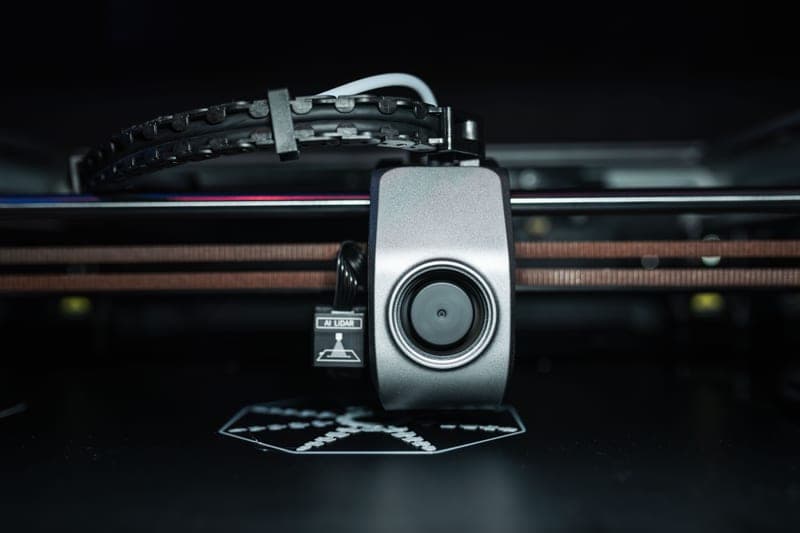
Stock photograph of this product class, not of this specific unit.
#ad We earn a commission · live price shown on Amazon
1. The P-series replacement
Bambu Lab Hotend with Hardened Steel Nozzle, 0.4 mm
Complete assembly, 0.4 mm hardened, model FAH001-N-1 for the P1P and P1S.
The part most P1S owners should keep on the shelf. Complete hotend assembly with a 0.4 mm hardened steel nozzle, which means replacement is a module swap rather than extracting a nozzle from a hot block.
If you print any filled filament, buy the hardened version regardless of what is in the machine now. If you print only plain materials, the stainless equivalent as a spare is the cheaper right answer.
What it gets right
- Abrasive filament rounds a stainless nozzle fast — with the worst materials, a single print can do it
- Comes as a complete assembly, so the swap is a module change rather than a nozzle extraction
- 0.4 mm keeps your existing print profiles valid
What it does not
- Hardened steel conducts heat slightly worse than stainless, so very high-flow PLA needs a small temperature bump
- Pointless if you only ever print plain PLA and PETG — stainless lasts for years on those
- P1P and P1S only; the A-series and H-series need their own part
| Nozzle | Hardened steel, 0.4 mm |
|---|---|
| Fits | P1P and P1S (model FAH001-N-1) |
| Hardness reference | Hardened steel is cited at HRA 74 |
| Supplied as | Complete hotend assembly |
Stock photograph of this product class, not of this specific unit.
#ad We earn a commission · live price shown on Amazon
2. The A-series replacement
BIQU Panda Juicer Hotend
0.4 mm hardened steel for an A1, A1 mini or H2D, at standard flow.
The A-series and H2D option. 0.4 mm hardened steel at standard flow, so existing profiles stay close to right.
Check the fitment list against your exact model before ordering. The BIQU Panda range spans several generations and machines, and brand familiarity is not fitment.
What it gets right
- Hardened steel at 0.4 mm covers abrasive filament on the A-series, which the stock stainless nozzle does not
- Cheap enough to keep a spare on the shelf, which is the actual answer to a clog at 2 a.m.
- Standard flow means your existing profiles stay close to right
What it does not
- Standard flow, so it is not a speed upgrade — do not buy it expecting one
- A third-party hotend on a machine under warranty is a decision, not a free lunch
- A-series and H2D fitment only; it will not fit a P1S
| Nozzle | 0.4 mm hardened steel |
|---|---|
| Fits | Bambu Lab A1, A1 mini and H2D |
| Positioning | Standard flow, for daily printing and maintenance |
Stock photograph of this product class, not of this specific unit.
#ad We earn a commission · live price shown on Amazon
3. The upgrade-while-you-are-in-there option
BIQU Panda Revo Hotend
Quick-change nozzles and high flow, if you are replacing the hotend anyway.
If the hotend is coming off anyway, this is the moment to decide whether you want quick nozzle changes permanently. The E3D Revo system changes nozzles by hand in seconds, on the P1S, P1P and X1C, and it is high-flow.
Re-run flow calibration afterwards. Do not assume existing profiles carry over exactly.
What it gets right
- Revo nozzles change by hand in seconds — this is the single feature people buy a P2S for
- High-flow geometry is a genuine throughput gain on large single-color prints
- Turns nozzle diameter into a per-print choice instead of a maintenance decision
What it does not
- You are now off the official hotend, so a Bambu support conversation gets harder
- Revo nozzles cost more per nozzle than Bambu's own
- Flow calibration has to be redone; do not expect your old profiles to be exactly right
| System | E3D Revo quick-change nozzle |
|---|---|
| Fits | Bambu Lab P1S, P1P and X1C |
| Positioning | High-flow, high-speed |
Questions people actually ask
How do I replace a Bambu Lab hotend?
Unload the filament, power down and let it cool, remove the toolhead cover, disconnect the hotend connector, release and withdraw the hotend as a module, then fit the new assembly and reconnect. Re-run Z offset and flow calibration afterwards. Follow your printer's own documentation for the exact release mechanism, which differs between models.
Is replacing a Bambu hotend difficult?
Less than on most printers, because Bambu supplies hotends as complete assemblies - the whole hot zone comes out cold as one module rather than requiring you to unscrew a nozzle from a block at 250 C. That is also why keeping a spare makes a clog a five-minute job.
Will a P1S hotend fit an A1?
No. P1P and P1S share hotends; the A1 and A1 mini take a different part, and the H-series is different again. Check the listing against your exact model - brand familiarity is not fitment, and a part that physically inserts is not necessarily correct.
What does the hotend silicone sock do?
It keeps molten plastic off the heater block, which otherwise bakes into a carbonized crust that later drops debris into prints, and it insulates the block so temperature holds more steadily. It is a cheap consumable and a torn or crusted one is worth replacing.
Do I need to recalibrate after replacing a hotend?
Yes - Z offset at minimum, because a new assembly sits slightly differently, and flow if the nozzle material or diameter changed or you moved to a third-party hotend. Treat the first print afterwards as a test print rather than a real one.
Sources
Read this next
- Clearing a clogged nozzleThe procedure for clearing a clog, plus the four causes behind it - because clearing without diagnosing gets you a repeat.
- How long a nozzle lasts, and how to tell when it is doneThe difference between a worn nozzle and a clogged one, what actually wears a nozzle, and when to replace rather than clean.
- The best nozzles and hotends for a Bambu LabHardened steel, quick-change or a second diameter - which nozzle upgrade matches your filament and your machine, with who each is wrong for.
- Spare parts worth having before you need themWhich spares to stock before a failure and which to order after, judged by how long the machine sits idle waiting.
- Maintenance that actually mattersThe five maintenance jobs that change print quality, in priority order, plus the consumables worth stocking before you need them.