Printers
Bambu Lab P1P
CoreXY motion in the cheapest frame Bambu ever shipped it in, plus an official path to becoming a P1S.
By Michael W. · Published October 5, 2026
Some links here are Amazon affiliate links, so a purchase may earn this site a commission at no cost to you. It does not change what gets recommended or the order it appears in — how that works.
What to do with a P1P in 2026
Fit the official enclosure kit if you want to print ABS or ASA. It is the one upgrade in this whole section where the manufacturer designed the part, and it converts the machine's single real limitation.
Do not replace a working P1P with a P1S — that is paying full price for panels you can buy as a kit. Replace it only if you want size (H-series) or active chamber heat (X2D), neither of which any P-series machine has.
What the P1P is
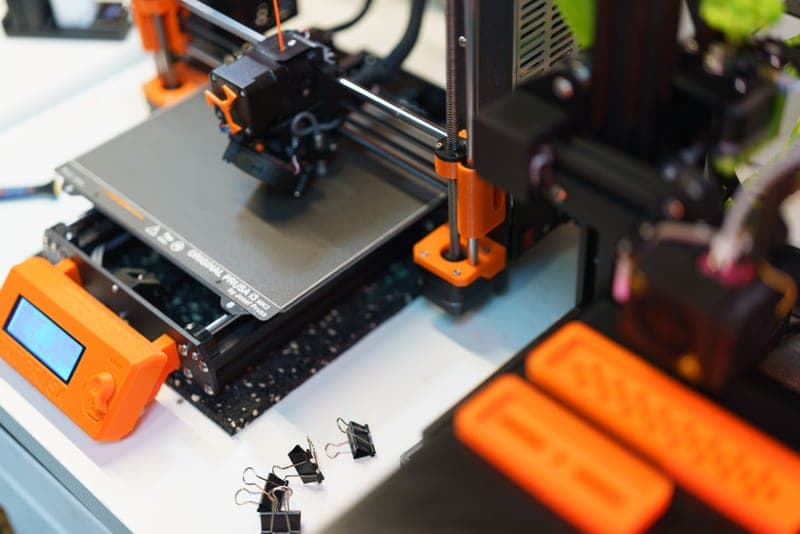
Released November 2022 as the non-enclosed P-series machine, omitting the touchscreen and the lidar sensor. What it kept is the important part: CoreXY motion, where the toolhead moves and the bed only travels in Z. That is why a P1P handles tall fast prints better than any bed slinger, panels or no panels.
The panel-less frame is also the easiest machine in the lineup to work on. Every maintenance job — rails, belts, extruder — is simply accessible, which is not true once the panels are on.
The honest limits
Open by default. Until the kit is fitted, ABS and ASA are out, for the same reason as on any open machine.
No touchscreen, no lidar. You are running it from the app, and you do not get lidar first-layer inspection. A third-party touchscreen fixes the first for not much money. Nothing adds lidar.
Check what your kit includes. A P1S ships with an auxiliary cooling fan and an air filter as well as the enclosure. An enclosure kit may not include both, and the auxiliary fan matters for PLA overhangs inside a now-warmer chamber.
Hard to buy new. The P1S and P2S have replaced it on most shelves, so this page is mostly for people who already own one.
How it compares
A P1P with the kit fitted is effectively the machine discussed on the P1S page, so read that for what you are converting into. If you are weighing a conversion against a new machine, P1S vs P2S covers what the next generation adds, and upgrading from a P1S applies to you the moment the panels are on.
What to buy
Stock photograph of this product class, not of this specific unit.
#ad We earn a commission · live price shown on Amazon
1. The upgrade the P1P was designed for
Bambu Lab P1P Enclosure Kit
Cheaper than selling a P1P and buying a P1S, and the only enclosure Bambu designed itself.
Bambu Lab sells a P1P enclosure kit, marketed as the P1P-to-P1S upgrade. That makes the P1P unusual in this lineup: its main limitation has a first-party fix rather than an aftermarket workaround, so fit and airflow are not your problem to solve.
Do the arithmetic before you commit. If the kit plus your P1P is close to the price of a used P1S, selling and rebuying may be simpler. If it is clearly cheaper, converting is the better move — and it keeps the official support path intact, which a third-party box does not.
What it gets right
- The only enclosure for a Bambu printer that the manufacturer designed, which means fit and airflow are not your problem to solve
- Cheaper than selling a P1P and buying a P1S
- Keeps the official support path intact, unlike a third-party box
What it does not
- P1P only. It does not fit an A1, an A1 mini or anything else
- The enclosure alone does not add the auxiliary fan and filter a P1S ships with — check what your kit includes
- Installation is an afternoon, not a minute
| Fits | P1P |
|---|---|
| Effect | Converts a P1P toward P1S specification |
| Source | Sold by Bambu Lab as the P1P-to-P1S upgrade kit |
Questions people actually ask
Is the P1P enclosure kit worth it?
If you want to print ABS or ASA, yes - it is the only enclosure for a Bambu machine that the manufacturer designed, so fit and airflow are handled, and it is cheaper than selling the P1P and buying a P1S. If you only print PLA and PETG, the kit buys you dust exclusion and a little quiet, which is a smaller argument.
Does the P1P enclosure kit make it identical to a P1S?
Not necessarily. A P1S also ships with an auxiliary cooling fan and an air filter, and an enclosure kit may not include both - check your specific kit contents. The touchscreen and lidar that the P1P omits are not part of any enclosure kit either.
Can I add a touchscreen to a P1P?
Yes. Third-party screens such as the Panda Touch line are designed to fit the P1P and P1S screen cutout and power from the printer's own USB port, and vendors state installation does not void the printer warranty. It is one of the cheaper quality-of-life upgrades available for the machine.
Should I replace my P1P with a P1S?
No. That is paying full machine price for panels you can buy as a kit. Replace a P1P only if you want something no P-series machine offers: the H-series build volume, or the X2D's reported actively heated chamber.
Sources
Read this next
- Bambu Lab P1SWhat the P1S already does well, the three things it genuinely cannot do, and which cheap part fixes each complaint instead of a new machine.
- Bambu Lab P1S vs P2SThe P2S adds a touchscreen and a quick-swap nozzle and no build volume. When that is worth a new machine and when a far cheaper part does the same job.
- Upgrading from a P1SThe two reasons to replace a P1S and the four cheaper parts that cover everything else, with the arithmetic laid out.
- The best Bambu Lab enclosuresOne pick per reason - ABS capability, noise, dust, or fixing a hazy P1S door - because a box that is good at one is mediocre at the others.
- BIQU Panda TouchWhat the Panda Touch adds to a P1P or P1S, the ten-printer capability nobody mentions, and the honest trade of third-party firmware.