Printers
Bambu Lab A1 vs P1S
One is open, one is enclosed, and one question decides it. Everything else between them is detail.
By Michael W. · Published October 5, 2026

Some links here are Amazon affiliate links, so a purchase may earn this site a commission at no cost to you. It does not change what gets recommended or the order it appears in — how that works.
The verdict
Do you print ABS, ASA, nylon or polycarbonate? If yes, the P1S, and the rest of this page is detail. If no, the A1 is cheaper, quieter, cools better for fast PLA, and gives up nothing you will use.
That is genuinely the whole decision. Build volume is the same 256 mm class on both. Both do four colors via their respective AMS. The enclosure is the difference.
Side by side
| A1 | P1S | |
|---|---|---|
| Released | December 2023 | July 2023 |
| Frame | Open, bed slinger, two-tower gantry | Enclosed CoreXY |
| Chamber | None | Passive (bed-heated) |
| ABS / ASA | Not reliably | Yes |
| Multi-color | AMS Lite (open air) | AMS / AMS 2 Pro (sealed) |
| Noise | Quieter — no enclosure to resonate | Louder — chamber fan and panels |
| Motion | Bed moves in Y | Toolhead moves; bed only in Z |
| Auxiliary cooling | No | Yes |
Why the AMS difference matters more than the color count
Both machines do four colors, so this is not a capability gap on paper. The real difference is the environment. AMS Lite holds spools in open air; the sealed AMS and AMS 2 Pro hold them in a controlled box, with humidity monitoring and — on the 2 Pro — active drying.
For PLA in a dry room that is a non-issue. For PETG, TPU, or anything in a humid climate, it is the difference between consistent prints and a slow mysterious decline in quality over months. If you buy an A1, budget for a dryer and sealed storage alongside it — that is the honest total cost.
The noise point, which gets left out
The A1 is quieter. No enclosure acting as a sounding box, no chamber fan. This is the most consistently under-weighted factor in this comparison, because it does not appear on a feature list and it is the thing that determines whether you can run a print overnight in a flat. I will not quote decibel figures — there is no measurement rig behind this site — but the mechanism is straightforward and the direction is not in dispute.
If noise is your main concern and you want the P1S for materials, noise reduction covers what actually works, which starts with what the machine stands on rather than with the machine.
Choose the A1 if
- PLA and PETG cover what you print
- The printer shares a room with people
- You want four colors for the least money
- You want a second machine alongside something enclosed
Choose the P1S if
- ABS, ASA, nylon or polycarbonate are on your list
- You want sealed, humidity-controlled filament storage via a real AMS
- You print tall parts fast
- You want the deepest third-party upgrade catalog in the range
The two machines, side by side
Stock photograph of this product class, not of this specific unit.
#ad We earn a commission · live price shown on Amazon
1. Best if you print ABS or ASA
Bambu Lab P1S
The enclosure plus auxiliary fan is what makes engineering materials realistic.
The P1S is the enclosed CoreXY machine: panels, auxiliary cooling fan and air filter. For ABS and ASA that combination is the difference between a warped mess and a usable part, and for a sealed AMS it is the difference between controlled humidity and a spool sitting in room air.
CoreXY motion also handles tall fast prints better, because the toolhead moves and the bed only travels in Z. On an A1 the bed itself is the moving mass, which puts a ceiling on speed for tall thin objects regardless of frame stiffness.
What it gets right
- The enclosure plus auxiliary fan is what makes ABS and ASA realistic rather than aspirational
- Still the best-supported machine in the range for third-party upgrades — screens, hotends, plates, ducts
- Fast enough that the P2S's speed gain is not the reason to replace it
What it does not
- No touchscreen as shipped, which is why the Panda Touch exists
- No quick-swap nozzle: a nozzle change is a hotend job, not a 30-second one
- Passive chamber only — it holds heat, it does not make heat
| Released | July 13, 2023 |
|---|---|
| Type | Enclosed CoreXY |
| Over the P1P | Enclosure, auxiliary cooling fan and air filter |
| Multi-color | AMS and AMS 2 Pro (4 spools, expandable) |
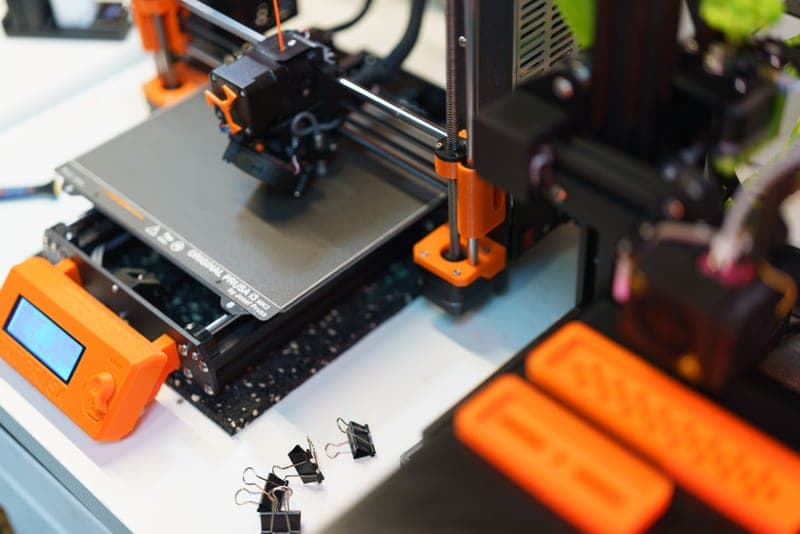
Stock photograph of this product class, not of this specific unit.
#ad We earn a commission · live price shown on Amazon
2. Best if you print PLA and PETG
Bambu Lab A1
Cheaper, quieter, cools better for fast PLA, and permanently unable to do ABS.
The A1 is the open-frame machine with a two-tower gantry and AMS Lite support. For PLA and PETG it is excellent, and the open frame is part of why: there is no trapped heat to fight, so fast PLA cools well.
It is also materially quieter, because there is no enclosure acting as a resonant box and no chamber fan. If the printer lives in a room you occupy, that is worth more than a spec comparison implies.
What it gets right
- Larger build area than the A1 mini for very little extra money or desk space
- The two-tower gantry is noticeably more rigid than a single-upright bed slinger
- AMS Lite in the combo makes four-color PLA and PETG genuinely practical
What it does not
- Still open-frame — this is the single thing that will eventually make you upgrade
- Bed slinger kinematics mean it will never match a CoreXY machine on tall, fast prints
- No active chamber heating, so ABS and ASA warp without an aftermarket enclosure
| Released | December 14, 2023 |
|---|---|
| Type | Open-frame bed slinger, two-tower gantry |
| Multi-color | AMS Lite (4 spools, open air) |
Questions people actually ask
Is the P1S better than the A1?
More capable, not better. The P1S can print ABS and ASA and takes a sealed AMS; the A1 is cheaper, quieter and cools better for fast PLA. If you only print PLA and PETG, the P1S's advantages are ones you will not use.
Can the A1 do everything the P1S can?
No. ABS, ASA, nylon and polycarbonate all want a warm chamber, and the A1 has no chamber at all. It also uses AMS Lite rather than a sealed AMS, so loaded spools get no humidity protection. Everything else - speed on normal parts, four-color printing, print quality in PLA - is closely comparable.
Which is quieter, the A1 or the P1S?
The A1, and the reason is structural: no enclosure acting as a resonant box and no chamber fan. We do not publish decibel figures because there is no measurement rig behind this site, but the mechanism is straightforward. If the printer shares a room with people, this matters more than most feature comparisons admit.
Should I buy an A1 and an enclosure instead of a P1S?
It is a reasonable middle option and it costs less. You get dust exclusion, flame retardancy, some noise reduction and fewer warped large PETG parts. You do not get P1S-level ABS capability, because a passive fabric enclosure cannot match an engineered chamber with an auxiliary cooling fan.
Sources
Read this next
- Bambu Lab A1What the A1 does well, the open-frame limit that defines every upgrade decision from here, and the two routes past it.
- Bambu Lab P1SWhat the P1S already does well, the three things it genuinely cannot do, and which cheap part fixes each complaint instead of a new machine.
- Upgrading from an A1 or A1 miniThe A1's one real limit, the two routes past it, and why a bigger open-frame machine is the wrong direction.
- Enclosures for the A1 and A1 miniFabric, purpose-built and DIY enclosure options for an A1, what each realistically delivers, and the measurement people get wrong.
- AMS 2 Pro vs AMS LiteThe AMS 2 Pro fits enclosed machines and the AMS Lite fits the A-series. What each does, and the gap you have to fill on an A1.