Printers
Bambu Lab A1
A larger bed, a more rigid gantry and four-color printing, with exactly one ceiling: the open frame.
By Michael W. · Published October 5, 2026
Some links here are Amazon affiliate links, so a purchase may earn this site a commission at no cost to you. It does not change what gets recommended or the order it appears in — how that works.
Where the A1 stands in 2026
The A1 is still the right machine for fast PLA and PETG in four colors, and the open frame that limits it is also what makes it good at those — it cools well and it is cheap.
There are only two upgrade paths worth considering. Add an enclosure, which is cheap and imperfect, or move to an enclosed machine, which is expensive and complete. Buying a different open-frame printer solves nothing.
What the two-tower gantry actually buys you
Rigidity, and therefore fewer artefacts at speed. A single-upright bed slinger flexes at the top of the Z axis, which shows up as ringing and wobble on tall prints. Two towers largely remove that, which is why the A1 handles tall parts better than its class usually does.
It still moves the bed, which puts a ceiling on how fast you can print a tall thin object regardless of frame stiffness. That is the structural difference between this and a CoreXY machine like the P1S, and no amount of tuning closes it — A1 vs P1S.
The honest limits
Open frame. ABS, ASA, polycarbonate and nylon all want a chamber. A fabric enclosure helps with warping on large PETG parts and is worth having for dust and fire safety, but it does not reach the temperature those materials need.
AMS Lite has no moisture protection. Four spools sitting in open air is exactly the condition PETG and TPU degrade in. If your prints have got worse over months rather than suddenly, this is the reason — whether a dryer is worth it.
It takes over the desk. An A1 with AMS Lite on top has a footprint people underestimate. A vertical rack is the real fix — accessories that help.
No hardened nozzle as standard. If you want carbon-filled filament, budget for a hardened hotend first. Abrasive filament through a stainless nozzle is a short story with an expensive ending.
How it compares
Against the A1 mini it is bed size and rigidity. Against the P1S it is the enclosure, which is the decision that matters. Against the A2L it is size without a change in capability. The full decision tree is on upgrading from an A1.
What to buy
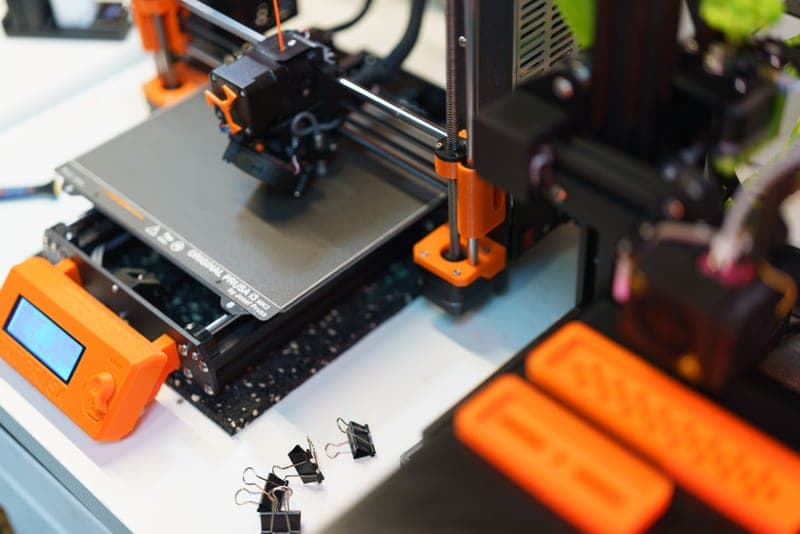
Stock photograph of this product class, not of this specific unit.
#ad We earn a commission · live price shown on Amazon
1. Best open-frame machine
Bambu Lab A1
The right machine until the day you want ABS, and then permanently the wrong one.
Released December 2023 as the larger A1 mini with a two-tower gantry, the A1 is the best-value multi-color machine in the lineup. The larger bed costs very little extra desk space over the mini, the two-tower gantry is noticeably more rigid than a single upright, and AMS Lite in the combo makes four-color PLA and PETG genuinely practical rather than a party trick.
Everything limiting about it comes back to one thing: there is no enclosure. That rules out ABS and ASA, and it means no chamber temperature at all.
What it gets right
- Larger build area than the A1 mini for very little extra money or desk space
- The two-tower gantry is noticeably more rigid than a single-upright bed slinger
- AMS Lite in the combo makes four-color PLA and PETG genuinely practical
What it does not
- Still open-frame — this is the single thing that will eventually make you upgrade
- Bed slinger kinematics mean it will never match a CoreXY machine on tall, fast prints
- No active chamber heating, so ABS and ASA warp without an aftermarket enclosure
| Released | December 14, 2023 |
|---|---|
| Type | Open-frame bed slinger, two-tower gantry |
| Multi-color | AMS Lite (4 spools, open air) |
Questions people actually ask
Does the Bambu Lab A1 need an enclosure?
Not for PLA and PETG, which is what most A1 owners print. You need one for ABS and ASA, and it is worth having regardless for dust exclusion and fire safety on a machine that runs unattended. Understand what it does and does not deliver: a passive fabric box traps bed heat, it does not create chamber heat.
What filament can the A1 print?
PLA, PETG, TPU and the filled variants of those given a hardened nozzle. ABS, ASA, polycarbonate and nylon are all technically loadable and practically unreliable without a warm chamber, which the open frame cannot provide. Treat those four as out of scope rather than difficult.
Is the A1 better than the A1 mini?
Bigger and more rigid, not more capable. The larger bed and two-tower gantry are real improvements, but both machines are open-frame with AMS Lite, so they share the same material ceiling. If you own an A1 mini and want more capability rather than more size, the upgrade is an enclosure or an enclosed machine.
Can the A1 use a hardened nozzle?
Yes, and you should fit one before running any filled filament. Both official and third-party hardened hotends are made for the A-series - note that A-series parts are a different catalog from P-series parts, so check the fitment list against your exact model.
Sources
Read this next
- Bambu Lab A1 vs P1SThe A1 and P1S differ in one way that matters and several that do not. Which materials you print settles it in a sentence.
- Bambu Lab A1 vs A1 miniWhat the A1's larger bed and two-tower gantry buy over the A1 mini, and why neither machine solves the limit that actually matters.
- Bambu Lab A1 vs A2LThe A2L adds bed size and a blade cutter over the A1 and shares its material ceiling. Who that suits and who it does not.
- Upgrading from an A1 or A1 miniThe A1's one real limit, the two routes past it, and why a bigger open-frame machine is the wrong direction.
- Enclosures for the A1 and A1 miniFabric, purpose-built and DIY enclosure options for an A1, what each realistically delivers, and the measurement people get wrong.
- A1 and A1 mini mods worth doingA-series mods ordered by the problem each solves, why P-series parts do not fit, and the two problems specific to an open machine.