Nozzles & Plates
The Bambu Lab hardened steel nozzle
Supplied as a complete hotend assembly, which makes it one of the easiest and highest-value jobs on the machine.
By Michael W. · Published October 5, 2026
Some links here are Amazon affiliate links, so a purchase may earn this site a commission at no cost to you. It does not change what gets recommended or the order it appears in — how that works.
What it is and when you need it
A complete hotend assembly with a hardened steel nozzle, sold by Bambu Lab for the P1P and P1S in 0.4 mm and 0.6 mm. Hardened steel is cited at HRA 74.
You need it for: carbon-fiber and glass-fiber filled filament, metal-filled, wood-filled, glow-in-the-dark, glitter silks and marble-effect PLA.
You do not need it for: plain PLA, PETG, ABS, ASA or unfilled TPU. None of those is abrasive, and stainless handles them for years.
Why abrasive filament destroys stainless
A nozzle's job depends on a precise bore. Abrasive filler — chopped carbon fiber, glass, metal powder, mineral filler, strontium aluminate glow pigment — is harder than the stainless it passes through, so every centimeter widens and rounds the orifice slightly.
The result is a nozzle that extrudes wider lines than the slicer expects, with soft detail and poor dimensional accuracy. It is a gradual, uniform decline rather than a sudden failure, which is why people chase it through six other settings before checking the nozzle.
With the worst materials the timescale is startling. A single print in a heavily filled filament can do visible damage to a stainless nozzle. That is why hardened steel is a prerequisite rather than an improvement for those materials.
The complete-assembly format, and why it helps
Bambu supplies this as a full hotend rather than a bare nozzle. That has a practical consequence worth stating: fitting it is a module swap, not an operation involving a hot block and a wrench.
It makes this one of the least intimidating jobs on the machine, and it means a spare hotend on the shelf is a genuine five-minute fix for a clog rather than an evening's work. Hotend replacement.
0.4 or 0.6?
| 0.4 mm hardened | 0.6 mm hardened | |
|---|---|---|
| Your existing profiles | Still valid | All need re-slicing |
| Carbon fiber | Works, but clogs more readily | The standard choice — bore is the fix |
| Surface finish | Finer layer lines | Visibly coarser |
| Speed on functional parts | Baseline | Meaningfully faster |
| Fine detail | Good | Poor |
| Best for | General abrasive printing | Carbon fiber and functional bulk |
What changes after fitting
Possibly a small temperature increase. Hardened steel conducts heat slightly less well than stainless, so very high-flow printing may want a few degrees more. Not dramatic, and worth knowing if your first print after fitting under-extrudes slightly.
Re-run flow calibration. Any hotend change is a reason to recalibrate rather than assume.
Nothing else. It is not faster, not more precise and not better at PLA. It survives materials the other nozzle does not.
Where to go next
The per-material question if you are unsure about a specific filament. Hardened vs stainless for the materials-science version, including carbide. Nozzle lifespan for when to replace one.
What to buy
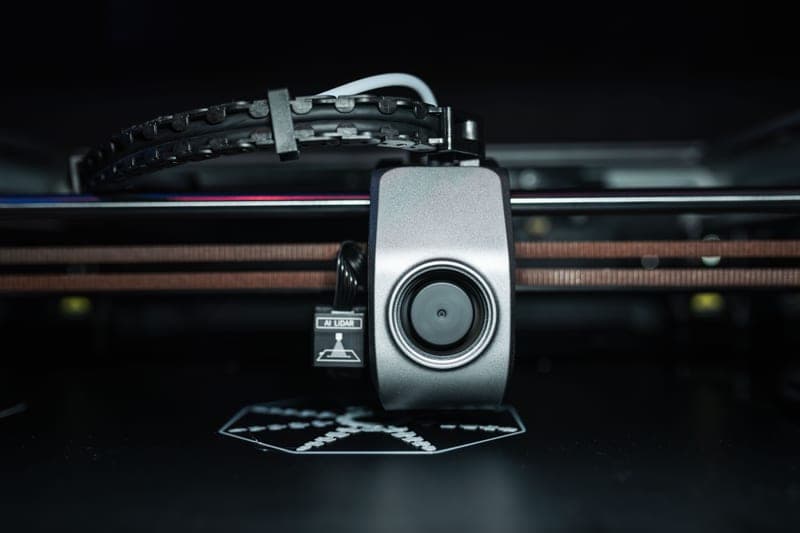
Stock photograph of this product class, not of this specific unit.
#ad We earn a commission · live price shown on Amazon
1. The default choice
Bambu Lab Hotend with Hardened Steel Nozzle, 0.4 mm
0.4 mm hardened steel, which covers abrasive filament without invalidating your profiles.
Complete hotend assembly with a 0.4 mm hardened steel nozzle, for the P1P and P1S (model FAH001-N-1). Hardened steel is cited at HRA 74.
The default because 0.4 mm keeps your existing profiles valid. Buying the hardened version of the diameter you already run is the lowest-friction way to add abrasive filament capability.
What it gets right
- Abrasive filament rounds a stainless nozzle fast — with the worst materials, a single print can do it
- Comes as a complete assembly, so the swap is a module change rather than a nozzle extraction
- 0.4 mm keeps your existing print profiles valid
What it does not
- Hardened steel conducts heat slightly worse than stainless, so very high-flow PLA needs a small temperature bump
- Pointless if you only ever print plain PLA and PETG — stainless lasts for years on those
- P1P and P1S only; the A-series and H-series need their own part
| Nozzle | Hardened steel, 0.4 mm |
|---|---|
| Fits | P1P and P1S (model FAH001-N-1) |
| Hardness reference | Hardened steel is cited at HRA 74 |
| Supplied as | Complete hotend assembly |
Stock photograph of this product class, not of this specific unit.
#ad We earn a commission · live price shown on Amazon
2. For carbon fiber
Bambu Lab Hotend with Hardened Steel Nozzle, 0.6 mm
0.6 mm hardened steel - the bore size is the clog fix, the material is the wear fix.
Same complete-assembly format in 0.6 mm. For carbon-fiber filament this is the right combination: hardened steel for the abrasion, and a wider bore so chopped fibers do not bridge and block it.
Also meaningfully faster on functional parts. Plan to re-slice everything.
What it gets right
- The larger bore is the real fix for carbon-fiber clogging, not just a faster nozzle
- Hardened steel plus 0.6 mm is the combination for chopped-fiber filament
- Noticeably faster on functional parts where layer lines do not matter
What it does not
- Every profile has to be re-sliced; a 0.6 mm nozzle is not a drop-in for 0.4 mm settings
- Visible layer lines and softer detail on anything decorative
- You will end up wanting both sizes, which is the argument for a quick-swap machine
| Nozzle | Hardened steel, 0.6 mm |
|---|---|
| Fits | P1P and P1S |
| Supplied as | Complete hotend assembly |
Questions people actually ask
What is a hardened steel nozzle for?
Printing abrasive filament - carbon-fiber and glass-fiber filled, metal-filled, wood-filled, glow-in-the-dark, glitter silks and marble-effect PLA. Those fillers are harder than stainless steel and widen the nozzle bore, which shows up as over-wide lines and lost detail.
How hard is a Bambu hardened steel nozzle?
Hardened steel is cited at HRA 74 on the Rockwell A scale. For comparison, the tungsten carbide nozzle on the H2D Pro is cited at HRA 90, which is substantially harder and correspondingly more brittle.
Do I need a hardened nozzle for PETG?
No. PETG is not abrasive and a stainless nozzle runs it for years. The requirement comes from fillers, not from the base polymer - so PETG-CF does need hardened steel while plain PETG does not.
Is fitting a hardened hotend difficult?
Less than people expect, because Bambu supplies it as a complete hotend assembly rather than a bare nozzle. It is a module swap rather than extracting a nozzle from a hot block, which also means a spare hotend on the shelf turns a clog into a five-minute fix.
Should I get the 0.4 mm or the 0.6 mm?
0.4 mm unless you print carbon fiber, because it keeps all your existing profiles valid. 0.6 mm for carbon fiber specifically, where the wider bore is the real fix for chopped fibers bridging and blocking the orifice - and expect to re-slice everything.
Sources
- Bambu Lab hardened steel nozzle and hotend upgrade for the P1S - Bambu Lab wiki
- Hardened steel (HRA 74) and tungsten carbide (HRA 90) hardness figures - third-party lineup roundups captured October 2026
Read this next
- Do I need a hardened nozzle for this filament?The one rule that answers this for every filament, plus a per-material table covering PETG, ABS, CF, silk, wood, marble and glow.
- Hardened steel vs stainless steel nozzlesHardened steel at HRA 74 versus stainless versus carbide at HRA 90 - which material your filament requires, and what each costs you.
- Replacing a Bambu Lab hotendHow the complete-assembly hotend format works, the replacement procedure, what the silicone sock does, and the fitment rule to check first.
- How long a nozzle lasts, and how to tell when it is doneThe difference between a worn nozzle and a clogged one, what actually wears a nozzle, and when to replace rather than clean.
- The best nozzles and hotends for a Bambu LabHardened steel, quick-change or a second diameter - which nozzle upgrade matches your filament and your machine, with who each is wrong for.