Printers
Bambu Lab A1 mini
The smallest machine Bambu sells, the quietest by a wide margin, and the one most people should keep rather than sell.
By Michael W. · Published October 5, 2026
Some links here are Amazon affiliate links, so a purchase may earn this site a commission at no cost to you. It does not change what gets recommended or the order it appears in — how that works.
Who the A1 mini is right for now
Keep it if it is your second machine, or if you print small PLA and PETG parts and care about noise. Upgrade from it if you want to print ABS or ASA, which the open frame rules out, or if you are regularly splitting models to fit the bed.
The honest upgrade target is not the A1. It is an enclosed machine — the P2S for the same desk footprint, or an aftermarket enclosure if you want to keep this printer and widen what it can do.
What it is genuinely good at
Three things, and the first one gets undersold constantly. It is quiet. There is no enclosure acting as a resonant box and no chamber fan, so it is the one machine in the lineup that can live in a room where someone sleeps. If you have ever canceled a print because of the noise, that is worth more than a spec sheet line.
It does four colors. AMS Lite support means multi-color printing on the cheapest printer Bambu sells, and for PLA that works well. The open-air design also makes a jam visible and reachable rather than a teardown — see AMS Lite in detail.
It fits. On a desk, in a cupboard, on a shelf next to a bigger machine. For small functional parts and prototyping it is more useful than its price implies, and it is a genuinely good second printer to put alongside something enclosed — two machines printing beats one machine printing faster.
The honest limits
No enclosure means no chamber heat. ABS and ASA warp and delaminate in open air, and the fix is not a slicer setting. Either enclose it or use a different machine for those materials. A fabric enclosure gets you dust exclusion, some noise reduction and better large-PETG results; it does not turn an A1 mini into a P1S.
The build area is the smallest in the range. This is the limit that actually drives upgrades. If you are splitting and gluing regularly, it is costing you more time than the machine saves.
Bed slinger kinematics. The bed moves, so tall thin prints at high speed are harder than on a CoreXY machine. In practice this matters less than people expect for small parts, which is what this printer is for.
No moisture protection with AMS Lite. Open-air spools in a humid room absorb water, which shows up as stringing and brittle parts. The fix is a dryer and sealed storage, not a printer.
How it compares
Against the A1, the difference is bed size and gantry rigidity, not capability — A1 vs A1 mini. Against the P1S, the difference is the enclosure, which is the whole argument — A1 vs P1S. If you are working through the upgrade decision properly, start at upgrading from an A-series machine.
What to buy
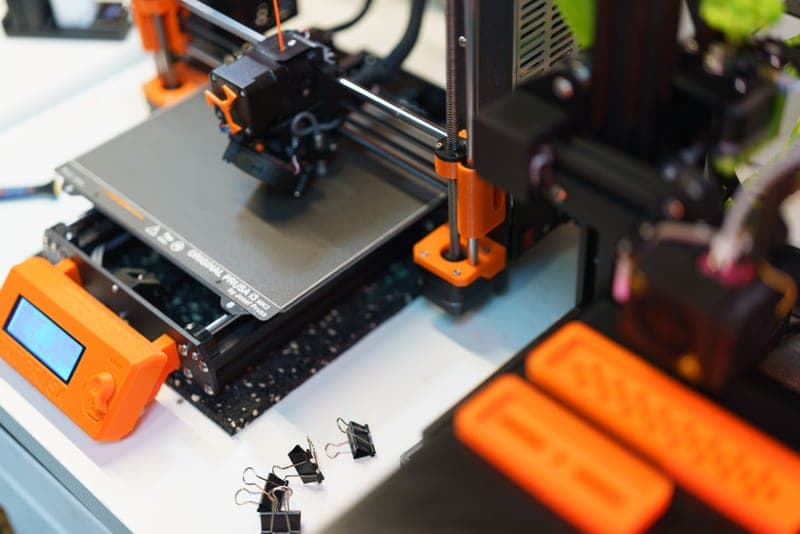
Stock photograph of this product class, not of this specific unit.
#ad We earn a commission · live price shown on Amazon
1. Best small second machine
Bambu Lab A1 mini
Quiet, cheap, four-color capable, and permanently limited to PLA and PETG.
Released September 2023 as an open-frame bed slinger aimed at small objects, the A1 mini is the machine people apologize for owning and then keep for years. It runs AMS Lite for four-color work, it is small enough to sit on a desk you also work at, and with no enclosure to resonate it is the quietest thing in the range.
Its limits are structural rather than tuning problems. The open frame rules out ABS and ASA. The build area is the smallest Bambu makes, so large single-piece prints need splitting. And a bed slinger will never match a CoreXY machine on tall fast prints, because the bed itself is the moving mass.
What it gets right
- The quietest machine in the lineup by a wide margin, because there is no enclosure resonating
- AMS Lite support means four-color printing on the cheapest printer Bambu sells
- Small enough to sit on a desk you also work at
What it does not
- Open frame, so ABS and ASA are off the table without an aftermarket enclosure
- The smallest build area in the range — large single-piece prints need splitting
- No enclosure means no chamber temperature, so warping on anything but PLA and PETG
| Released | September 20, 2023 |
|---|---|
| Type | Open-frame bed slinger |
| Intended use | Printing small objects |
| Multi-color | AMS Lite (4 spools, open air) |
Questions people actually ask
Can the Bambu Lab A1 mini print ABS?
Not reliably. It is open-frame, and ABS needs a warm chamber to avoid warping and layer splitting. An aftermarket fabric enclosure improves things and is worth having for dust and safety reasons anyway, but it will not reach the chamber temperature ABS really wants. If ABS matters to you, an enclosed machine is the right purchase.
Is the A1 mini worth keeping if I buy a bigger printer?
Usually yes. It is the quietest machine in the lineup and it makes a good second printer for small parts, which means a long job on your main machine stops blocking a short one. Selling it recovers little and costs you throughput.
Does the A1 mini work with the AMS 2 Pro?
No. The A1 and A1 mini use the AMS Lite, which is a separate open-air unit. The sealed AMS and AMS 2 Pro are for the enclosed P-series and X-series machines. Check the unit against your exact printer before ordering, because this is the most common wrong purchase in the category.
Why are my A1 mini prints stringing?
Most likely wet filament, because AMS Lite spools sit in open air with no moisture protection. Listen for popping from the nozzle and try bending a length of filament - if it snaps rather than flexing, it has absorbed water. Dry the spool before changing any slicer settings.
Sources
Read this next
- Bambu Lab A1 vs A1 miniWhat the A1's larger bed and two-tower gantry buy over the A1 mini, and why neither machine solves the limit that actually matters.
- Bambu Lab A1 vs P1SThe A1 and P1S differ in one way that matters and several that do not. Which materials you print settles it in a sentence.
- Upgrading from an A1 or A1 miniThe A1's one real limit, the two routes past it, and why a bigger open-frame machine is the wrong direction.
- Bambu Lab AMS LiteWhat the AMS Lite does well on an A1 or A1 mini, the moisture gap it leaves open, and the two things to buy alongside it.
- Enclosures for the A1 and A1 miniFabric, purpose-built and DIY enclosure options for an A1, what each realistically delivers, and the measurement people get wrong.