Printers
Bambu Lab H2C
Automatic hotend swapping on the large-format chassis. A behavior change rather than a convenience, for the narrow set of people who mix fine detail and bulk.
By Michael W. · Published October 5, 2026
Some links here are Amazon affiliate links, so a purchase may earn this site a commission at no cost to you. It does not change what gets recommended or the order it appears in — how that works.
Who the H2C is actually for
A narrow group: people whose print mix genuinely spans fine detail and functional bulk, who would use two or three nozzle diameters if switching were free, and who want large-format capability as well.
If you have run one nozzle size happily for years, this is engineering you will admire and not use. The H2S or H2D is the better buy.
Why nozzle swapping friction matters more than it sounds
Nozzle diameter is one of the few settings with no universally right answer. 0.2 mm gives detail at a large cost in time and clog risk. 0.6 mm gives speed and strength on functional parts at a cost in surface finish. 0.4 mm is the compromise everyone runs because it is the one that is already installed.
On a P1S, changing nozzle means changing the hotend. The P2S made it quick. The H2C makes it automatic, which removes the decision point entirely — the slicer can select the nozzle. For anyone who prints miniatures one week and brackets the next, that is the difference between owning the capability and using it. Nozzle sizes and what each is for.
The honest limits
Complexity. An automatic swapping mechanism is more to go wrong than a fixed hotend, and when it does go wrong it is not a part you keep spare.
Short service history. November 2025. Nobody has run one long enough to know how the mechanism wears.
Minimal third-party support. Compared with the P1S, nothing exists for this machine yet.
Narrow benefit. If your print mix is uniform, you are paying for a mechanism you will not exercise.
Not observed here. I have not run an H2C. This page is specification and reasoning.
How it compares
Against the H2D, this trades a continuously available second material for automatic diameter changes — two different ideas about what a toolhead is for. Against the H2S, it is the same bed class with a mechanism most people will not need. Dual nozzles explained covers how these approaches differ.
What to buy
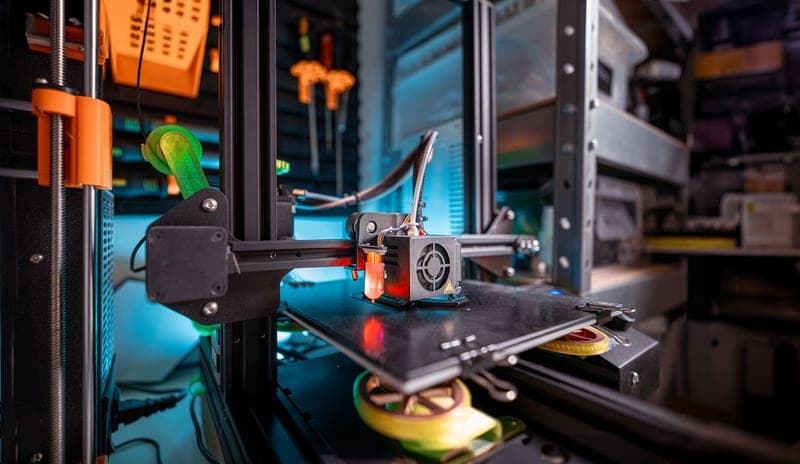
Stock photograph of this product class, not of this specific unit.
#ad We earn a commission · live price shown on Amazon
1. Best for mixed detail and bulk
Bambu Lab H2C
Removes the one step that stops people using a fine nozzle, on a large-format chassis.
Released November 2025, with automatic hotend swapping as the headline feature, on the H2 large-format chassis.
The interesting part is behavioral. The reason most owners never use a 0.2 mm nozzle for detail or a 0.6 mm for bulk is not that they do not own them — it is that changing is a job. Automate the change and nozzle diameter becomes a per-print decision, which is a genuinely different way to use a printer.
The caution is the usual one for a new mechanism: more moving parts means more to go wrong, the service history is a year short, and third-party accessory support is minimal.
What it gets right
- Automatic hotend swapping removes the one manual step that stops people using a 0.2 mm nozzle for detail
- Large-format H2 chassis, so build area is not the compromise
- The most interesting engineering in the current lineup if your prints mix fine detail and bulk
What it does not
- A newer, more complex mechanism means more to go wrong and a thinner service history
- Released November 2025 — third-party accessory support is minimal
- Only pays off if you genuinely swap nozzle sizes often; most owners do not
| Released | November 13, 2025 |
|---|---|
| Headline feature | Automatic hotend swapping |
| Series | H2 large format |
Questions people actually ask
What does automatic hotend swapping do on the H2C?
It changes the hotend without you touching the machine, which means the slicer can pick the nozzle diameter per print or even per feature. The practical effect is that running a 0.2 mm nozzle for detail and a 0.6 mm for bulk becomes something you actually do rather than something you could do.
Is the H2C better than the H2D?
Different, not better. The H2D's dual nozzle holds two materials continuously, which is what makes soluble supports and two-material parts work. The H2C swaps hotends instead, which is about nozzle diameter rather than material count. Which is better depends entirely on whether you want two materials or two diameters.
Should I buy an H2C?
Only if your print mix genuinely spans fine detail and functional bulk and you would use several nozzle diameters if switching were free. For most owners a quick-change hotend on the printer they already have delivers most of the same behavior change for a tiny fraction of the cost.
Is the H2C mechanism reliable?
Unknown, honestly. It was released in November 2025, so there is no long-term service history to point at, and we have not run one. A more complex mechanism has more to go wrong in principle; whether it does in practice is not something anyone can answer yet.
Sources
- Bambu Lab model list, release dates and model descriptions - Wikipedia
- Reported build volumes, chamber temperatures and positioning - third-party lineup roundups captured October 2026 (3dprinting.com, precwise.com, innoaddi.com)
Read this next
- Bambu Lab H2DWhat the H2D's dual nozzle and large bed genuinely change, the size of the price jump, and the test for whether you need it.
- Bambu Lab H2SWhy the H2S is usually the right large-format buy, what the single nozzle costs you, and what the saving pays for instead.
- Dual nozzles, AMS and hotend swapping explainedDual nozzle, AMS and automatic hotend swapping compared - what each actually does and which models have which.
- Bambu Lab nozzle sizes explainedWhat 0.2, 0.4, 0.6 and 0.8 mm nozzles are each for, what changing costs in re-slicing, and why friction stops most people switching.
- The best nozzles and hotends for a Bambu LabHardened steel, quick-change or a second diameter - which nozzle upgrade matches your filament and your machine, with who each is wrong for.