Printers
Bambu Lab H2S
Reported at 325 x 320 x 325 mm with a single nozzle. For most people who think they want an H2D, this is the better buy.
By Michael W. · Published October 5, 2026
Some links here are Amazon affiliate links, so a purchase may earn this site a commission at no cost to you. It does not change what gets recommended or the order it appears in — how that works.
H2S or H2D?
Buy the H2S unless you specifically want soluble supports or two-material parts. Those are the only things the H2D's second nozzle gives you, and the beds are reported within 25 mm of each other on the long axis.
The saving covers a good filament dryer, a spare build plate and a hardened hotend — all of which you will use more often than a second nozzle.
What the build volume actually buys
The one capability no accessory can fake. If you have spent a year splitting models and gluing them, this removes a recurring cost in time and in alignment error. Helmets, enclosures for other projects, large functional brackets, single-piece organizers — all become one print instead of four plus assembly.
Be honest about frequency, though. Count the prints in the last six months that actually needed it. Splitting a model is unglamorous and free, and a large-format machine that mostly prints small parts is money spent on air.
The honest limits
Single nozzle. No support material in a different polymer, no two-color single-head workflow. For complex geometry with overhangs you would otherwise support solubly, that is a genuine capability gap.
It needs floor or shelf space, not desk space. Large-format machines are physically large, and the practical constraint for most people is where it goes rather than what it costs.
Large prints consume filament and time in proportion. A failure twenty hours in is a much more expensive failure. Drying your filament and keeping a spare plate stop being optional at this size.
If your prints fit in 256 mm, you are paying for nothing. Stated plainly because it is the most common version of this mistake.
How it compares
H2D vs H2S is the decision page, and it is the comparison that saves the most money on this site. Printers for a print farm covers the case where you want several machines instead of one big one.
What to buy
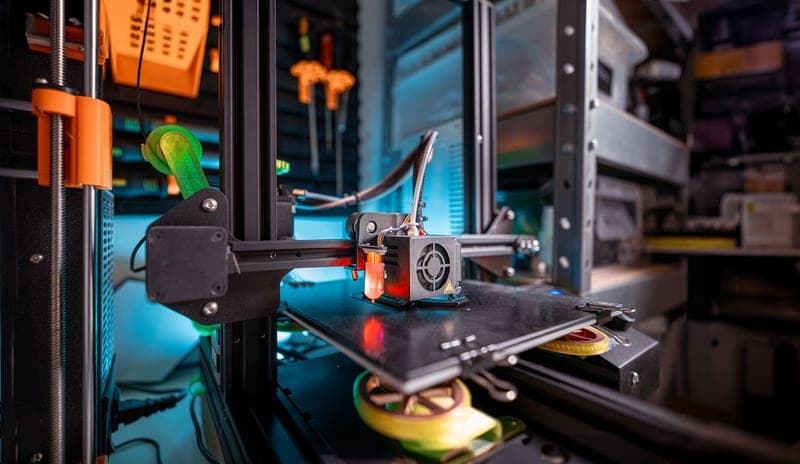
Stock photograph of this product class, not of this specific unit.
#ad We earn a commission · live price shown on Amazon
1. Best value for build volume
Bambu Lab H2S
Nearly the H2D's bed for less money, with one hotend to maintain instead of two.
Released August 2026 as the single-nozzle variant of the H2 chassis, with a reported 325 x 320 x 325 mm build volume against the H2D's reported 350 x 320 x 325 mm. In practice that is the same shelf, the same class of large print, and a smaller bill.
I would steer most people considering an H2D here, because size is almost always the real motivation and the second nozzle is usually the part that goes unused. One hotend also means one of every maintenance task, which matters more than it sounds once abrasive filament is involved.
What it gets right
- The large-format build area is the only thing a P1S genuinely cannot give you
- Single nozzle means one hotend to maintain instead of two
- Costs less than the H2D for the same reported footprint and near-identical bed size
What it does not
- No dual nozzle, so no support material in a different polymer and no two-color single-head workflow
- Large-format machines want floor or shelf space, not desk space
- If your prints all fit in 256 mm, you are paying for air
| Released | August 26, 2025 |
|---|---|
| Type | Large-format enclosed, single nozzle |
| Build volume (reported) | 325 x 320 x 325 mm |
Questions people actually ask
What is the difference between the H2S and the H2D?
The nozzle count, and a small difference in reported build volume. The H2S is the single-nozzle variant at a reported 325 x 320 x 325 mm; the H2D has a direct-drive dual nozzle at a reported 350 x 320 x 325 mm. If you do not need soluble supports or two-material prints, the H2S is the better buy.
Is the H2S worth it over a P1S?
Only for build volume. It is the one capability a P1S cannot be upgraded into, so if you are regularly splitting models to fit, it is a genuine fix. If your prints fit in a 256 mm cube, the H2S buys you space you will not use and a larger machine to find room for.
Can the H2S print multiple colors?
Yes, via an AMS, the same as any other enclosed Bambu machine. The single nozzle limits you on two-material prints and soluble supports, not on color count - color changes come from the AMS feeding one nozzle in sequence.
How much space does an H2S need?
More than a desk comfortably gives you. Treat large-format machines as floor or dedicated-shelf equipment, and allow clearance for the door, the plate coming out, and an AMS if you plan to run one. Getting this wrong is the most common regret with large printers.
Sources
- Bambu Lab model list, release dates and model descriptions - Wikipedia
- Reported build volumes, chamber temperatures and positioning - third-party lineup roundups captured October 2026 (3dprinting.com, precwise.com, innoaddi.com)
Read this next
- Bambu Lab H2D vs H2STwo machines on one chassis. The beds are nearly the same; the difference is one nozzle, and most people will not use the second.
- Bambu Lab H2DWhat the H2D's dual nozzle and large bed genuinely change, the size of the price jump, and the test for whether you need it.
- The best Bambu Lab printer to step up to in 2026One pick per upgrade situation, from the P1S owner who should keep their machine to the owner who genuinely needs the H2 build volume.
- Printers for a print farm or small businessOne big machine or several cheap ones, what actually matters at volume, and the fleet-control part nobody mentions.
- Bambu Lab AMS 2 ProWhy active drying makes the AMS 2 Pro a different product from the original AMS, and the case for buying it instead of a new printer.