Printers
Dual nozzles, AMS and hotend swapping explained
Three different mechanisms get described as 'multi-material' and they do completely different jobs. Here is which is which.
By Michael W. · Published October 5, 2026
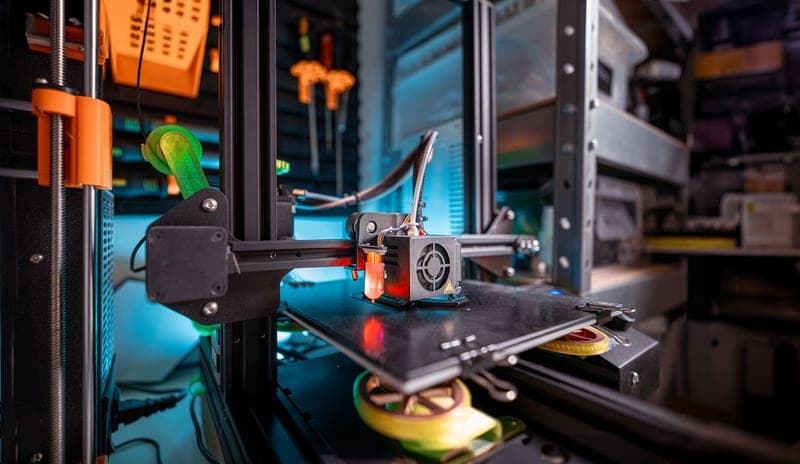
Some links here are Amazon affiliate links, so a purchase may earn this site a commission at no cost to you. It does not change what gets recommended or the order it appears in — how that works.
Three mechanisms, three different jobs
| Mechanism | How it works | What it is for |
|---|---|---|
| AMS | Several filaments feed into ONE nozzle, in sequence, purging between each | Color count. Four colors in one print. |
| Dual nozzle | TWO hotends, each holding a material continuously | Two materials at once. Soluble supports, rigid plus flexible. |
| Automatic hotend swapping | The machine changes hotends between features | Nozzle diameter. Fine detail and bulk in one job. |
Most confusion in this category comes from treating these as versions of the same thing. They are not substitutes for each other in either direction.
Which models have what
| Model | Mechanism |
|---|---|
| A1 / A1 mini | AMS Lite (color only) |
| P1P / P1S / P2S | AMS or AMS 2 Pro (color only), single nozzle |
| X1C | AMS (color only), single nozzle |
| X2D | Reported dual nozzle, plus AMS for color |
| H2S | Single nozzle, plus AMS for color |
| H2D / H2D Pro | Direct-drive dual nozzle, plus AMS for color |
| H2C | Automatic hotend swapping |
Note that dual nozzle and AMS are not alternatives — an H2D can run both, giving you two continuously-loaded materials and color changes within each.
What a dual nozzle enables that nothing else does
Soluble supports
The main argument. Normal supports print in the model material and have to be snapped off, leaving marks and unable to reach fully enclosed voids. A soluble support material dissolves away, which makes internal channels and captured geometry printable.
You cannot do this on a single nozzle, because the support material would have to share the nozzle and purge at every transition — which would be slower, wasteful and poorly bonded.
Two-material parts
A rigid body with a flexible seal or grip, printed as one object. Again not possible through one nozzle, because the two materials want different temperatures.
What an AMS does better
Color count. Four colors with one nozzle, and chainable for more on the original AMS. A dual nozzle gives you two materials, not four colors.
Price. It bolts onto the machine you own. Buying a dual-nozzle printer for color is the most expensive version of a mistake this site keeps returning to.
Drying. The AMS 2 Pro dries filament actively and feeds the printer from inside the sealed box, which no nozzle arrangement does. The AMS 2 Pro.
What hotend swapping is really about
Nozzle diameter, not material count. The reason most owners never use a 0.2 mm nozzle for detail or a 0.6 mm for bulk is the friction of changing it. Automate the change and diameter becomes a per-print or even per-feature decision.
That is genuinely interesting for anyone whose print mix spans fine detail and functional bulk, and irrelevant for anyone who has happily run 0.4 mm for years. The cheap version is a quick-change hotend. Nozzle sizes.
Which do you actually need?
- Four colors: an AMS. On the printer you own.
- Soluble supports or two-material parts: a dual nozzle. H2D, H2D Pro, or the reported X2D.
- Several nozzle diameters without the chore: a quick-change hotend first; the H2C if you want it automated.
- None of the above: a single nozzle plus an AMS covers almost everything people actually print.
Where to go next
H2D vs H2S for whether the second nozzle is worth it. AMS options if color is the goal. The H2C for the swapping mechanism in detail.
What to buy
Stock photograph of this product class, not of this specific unit.
#ad We earn a commission · live price shown on Amazon
1. The dual-nozzle machine
Bambu Lab H2D
Two hotends holding two materials continuously, which is what makes soluble supports work.
A direct-drive dual nozzle on a large-format chassis, with a reported 350 x 320 x 325 mm build volume. Two hotends means two materials loaded at once, each with its own nozzle.
What that enables specifically: soluble supports, and genuine two-material parts such as rigid plus flexible. Neither is possible on a single nozzle.
What it gets right
- Direct-drive dual nozzle is a different kind of machine, not a faster version of the one you own
- The largest reported build area of the models an enthusiast realistically buys
- Two hotends means dissolvable or contrast material without an AMS color-change purge every layer
What it does not
- This is the biggest single jump in money in the whole lineup — it has to replace a workflow, not a wish
- Two nozzles is two of every maintenance task
- If multi-color is the actual goal, an AMS 2 Pro on your existing printer gets you most of the way for a fraction of it
| Released | March 25, 2025 |
|---|---|
| Type | Large-format enclosed, direct-drive dual nozzle |
| Build volume (reported) | 350 x 320 x 325 mm |
| Laser Edition (reported) | Adds laser, blade and pen toolheads |
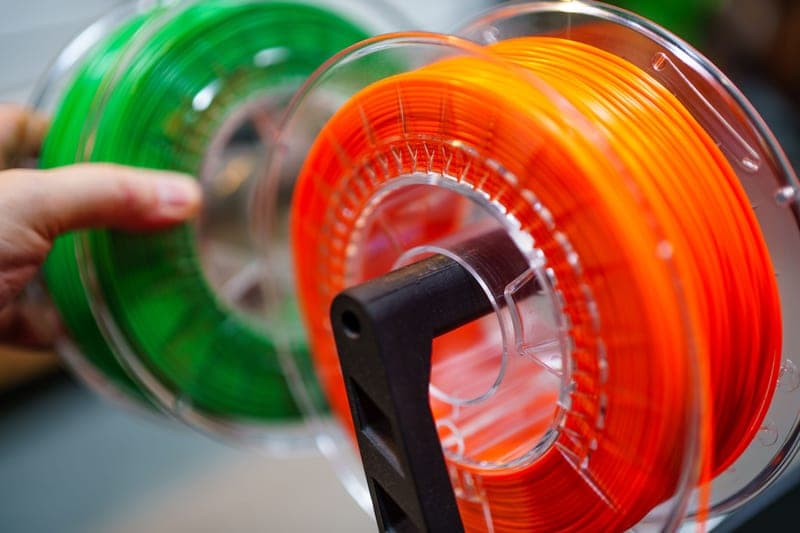
Stock photograph of this product class, not of this specific unit.
#ad We earn a commission · live price shown on Amazon
2. The multi-color answer
Bambu Lab AMS 2 Pro
Four filaments into one nozzle, in sequence - which is color, not materials.
The mechanism people conflate with a dual nozzle. An AMS feeds several filaments into a single nozzle in sequence, purging between each change — which is where the purge tower comes from.
For color count it is the right answer and far cheaper than a dual-nozzle machine. For a second material held continuously, it is the wrong mechanism entirely.
What it gets right
- Active drying means the spool you print from is the spool you dried — no transfer step, no re-absorption window
- Four colors on a machine you already own, for a fraction of a new printer
- RFID logging removes the single most common cause of a ruined multi-color print: the wrong material profile
What it does not
- Four-color printing wastes filament on every tool change; the purge tower is real and it is not small
- If you only print single-color PLA, you are buying a dryer with a filament changer attached
- Needs the space beside or above the printer that your shelf may not have
| Type | Four-spool automatic material system |
|---|---|
| Headline feature | Active filament drying |
| Inherits | Humidity monitoring and RFID logging from the original AMS |
Stock photograph of this product class, not of this specific unit.
#ad We earn a commission · live price shown on Amazon
3. The hotend-swapping machine
Bambu Lab H2C
Automatic hotend changes, which is about nozzle diameter rather than material count.
The third mechanism, and the most misunderstood. The H2C swaps hotends automatically rather than carrying two at once, which is a different idea: it is about using different nozzle diameters in one job rather than different materials simultaneously.
Released November 2025, so the mechanism has a short service history and almost no third-party support.
What it gets right
- Automatic hotend swapping removes the one manual step that stops people using a 0.2 mm nozzle for detail
- Large-format H2 chassis, so build area is not the compromise
- The most interesting engineering in the current lineup if your prints mix fine detail and bulk
What it does not
- A newer, more complex mechanism means more to go wrong and a thinner service history
- Released November 2025 — third-party accessory support is minimal
- Only pays off if you genuinely swap nozzle sizes often; most owners do not
| Released | November 13, 2025 |
|---|---|
| Headline feature | Automatic hotend swapping |
| Series | H2 large format |

Stock photograph of this product class, not of this specific unit.
#ad We earn a commission · live price shown on Amazon
4. Dual nozzle on a desk
Bambu Lab X2D
Reported dual nozzle at a 256 mm cube, plus a reported 65 C actively heated chamber.
If you want dual-nozzle capability without the H2 footprint, this is the machine — reported as dual nozzle at a 256 mm cube, with a reported actively heated chamber at 65 C.
Released April 2026, so accessory support is thin. I have not run one; this is specification and reasoning.
What it gets right
- Dual nozzle without stepping up to the H2 footprint — two materials on a desk-sized machine
- A reported 65 C heated chamber is a real capability jump over any passive P-series enclosure
- Newest filtration and thermal hardware in the smaller form factor
What it does not
- Released April 2026, so third-party part support is thin compared with the P1S
- Same reported 256 mm build volume as a P1S — this is a capability upgrade, not a size one
- I have not run one. What follows anywhere on this site about the X2D is specification and reasoning, not observation
| Released | April 14, 2026 |
|---|---|
| Type | Enclosed CoreXY, dual nozzle |
| Improvements cited | Air filtration, thermal management and speed |
| Build volume (reported) | 256 mm cube |
| Chamber (reported) | Heated to 65 C |
Questions people actually ask
Which Bambu Lab printers have dual nozzles?
The H2D and H2D Pro have a direct-drive dual nozzle, and the X2D is reported as dual nozzle in a smaller footprint. The H2S is the single-nozzle variant of the H2 chassis, and the H2C takes a different approach by swapping hotends automatically rather than carrying two at once.
Is a dual nozzle the same as an AMS?
No, and this is the most common confusion in the category. An AMS feeds several filaments into one nozzle in sequence, purging between changes - that is color count. A dual nozzle holds two materials continuously in two hotends, which is what makes soluble supports and two-material parts possible.
Do I need a dual nozzle for multi-color printing?
No. Multi-color comes from an AMS, which fits the printer you already own for a fraction of a dual-nozzle machine. Buying a dual-nozzle printer to get four colors is the most expensive version of a common mistake.
What does the H2C's automatic hotend swapping do?
It changes the hotend without you touching the machine, which means the slicer can select nozzle diameter per print or per feature. It is about diameter rather than material count - different from a dual nozzle, which holds two materials at once.
What are soluble supports and why do they need two nozzles?
Support material that dissolves away instead of being snapped off, which makes internal channels and captured geometry printable. It needs a second nozzle because sharing one nozzle would mean purging at every transition between model and support - slow, wasteful and poorly bonded.
Sources
- Bambu Lab model list, release dates and descriptions - Wikipedia
- Reported build volumes, chamber temperatures and nozzle hardness - third-party lineup roundups captured October 2026
Read this next
- Bambu Lab H2D vs H2STwo machines on one chassis. The beds are nearly the same; the difference is one nozzle, and most people will not use the second.
- Bambu Lab H2CWhy automatic hotend swapping changes how you print rather than just how fast, and why it is still the wrong machine for most owners.
- Bambu Lab H2DWhat the H2D's dual nozzle and large bed genuinely change, the size of the price jump, and the test for whether you need it.
- The best Bambu Lab AMS accessoriesWhich AMS to buy for your printer, plus the accessories that fix feeding problems and desk space - ranked by the problem each solves.
- Bambu Lab nozzle sizes explainedWhat 0.2, 0.4, 0.6 and 0.8 mm nozzles are each for, what changing costs in re-slicing, and why friction stops most people switching.
- Bambu Lab X2DWhat a reported 65 C actively heated chamber fixes that a P1S cannot, and the two honest caveats on a machine released in April 2026.