Printers
Bambu Lab H2D vs H2S
Reported beds within 25 mm of each other on the long axis. The real question is whether you will ever use a second nozzle.
By Michael W. · Published October 5, 2026
Some links here are Amazon affiliate links, so a purchase may earn this site a commission at no cost to you. It does not change what gets recommended or the order it appears in — how that works.
The verdict
Buy the H2S unless you specifically want soluble supports or two-material parts. The reported beds are 325 x 320 x 325 mm and 350 x 320 x 325 mm — identical in two of three axes.
Buy the H2D if a second continuously-loaded material changes how you work. For complex geometry with soluble support, it does.
The saving on the H2S covers a dryer, a spare plate and a hardened hotend, all of which you will use more often than a second nozzle.
Side by side
| H2S | H2D | |
|---|---|---|
| Released | August 2026 | March 2025 |
| Build volume (reported) | 325 x 320 x 325 mm | 350 x 320 x 325 mm |
| Nozzles | Single | Direct-drive dual |
| Soluble supports | No | Yes |
| Two-material parts | No | Yes |
| Maintenance | One hotend | Two hotends |
| Toolhead options (reported) | — | Laser Edition adds laser, blade, pen |
What soluble supports actually change
This is the capability worth paying for, so it deserves a straight explanation. Normal supports are printed in the same material as the model and have to be snapped off, which leaves marks and cannot reach fully enclosed internal voids.
A soluble support material dissolves away. That means internal channels, captured geometry and overhangs with no accessible break-off point all become printable. On a single-nozzle machine you cannot do it, because the support material would have to share the nozzle and purge on every layer transition.
If none of your parts have that geometry, this paragraph describes a capability you will not use, and the H2S is your machine.
The maintenance point, which is underrated
Two nozzles is two of everything. Two hotends to clear when one clogs, two nozzles wearing against abrasive filament, two sets of calibration to keep valid. On a machine running filled filament daily, that is a doubled recurring cost and a doubled chance that something is wrong when a print fails.
Not a reason to avoid the H2D if you need it. A reason not to buy it speculatively.
Choose the H2S if
- Build volume is why you are upgrading
- You print one material at a time
- You would rather spend the difference on consumables and spares
Choose the H2D if
- Soluble supports would unlock geometry you currently cannot print
- You want rigid-plus-flexible parts in one job
- The Laser Edition toolheads are genuinely part of your work
The two machines, side by side
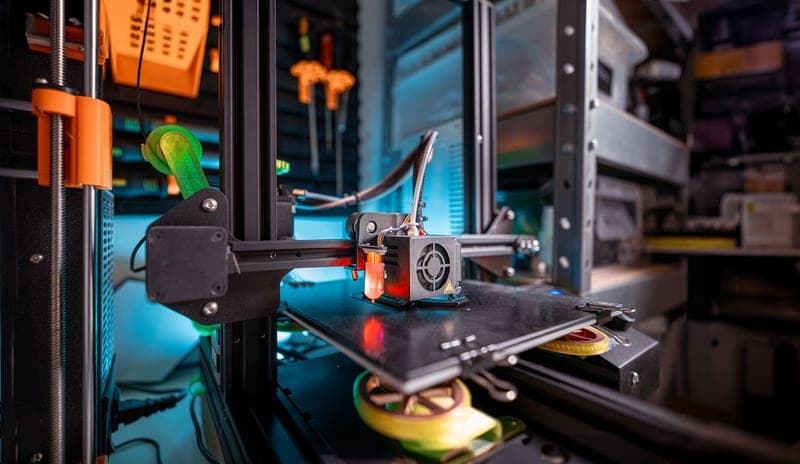
Stock photograph of this product class, not of this specific unit.
#ad We earn a commission · live price shown on Amazon
1. Best value for build volume
Bambu Lab H2S
Nearly the same bed, one hotend to maintain, meaningfully less money.
Reported at 325 x 320 x 325 mm against the H2D's 350 x 320 x 325 mm. On the two axes most prints are constrained by, these are the same machine.
One hotend also means one of every maintenance task: one nozzle to wear out, one set of calibrations, one thing to unclog. With abrasive filament that is a recurring saving, not a one-time one.
This is the pick I would steer most people toward, because size is almost always the real motivation and the second nozzle is usually the part that goes unused.
What it gets right
- The large-format build area is the only thing a P1S genuinely cannot give you
- Single nozzle means one hotend to maintain instead of two
- Costs less than the H2D for the same reported footprint and near-identical bed size
What it does not
- No dual nozzle, so no support material in a different polymer and no two-color single-head workflow
- Large-format machines want floor or shelf space, not desk space
- If your prints all fit in 256 mm, you are paying for air
| Released | August 26, 2025 |
|---|---|
| Type | Large-format enclosed, single nozzle |
| Build volume (reported) | 325 x 320 x 325 mm |
Stock photograph of this product class, not of this specific unit.
#ad We earn a commission · live price shown on Amazon
2. Best if you need two materials
Bambu Lab H2D
A direct-drive dual nozzle, which is what makes soluble supports actually practical.
The H2D adds a direct-drive dual nozzle and a slightly larger reported bed at 350 x 320 x 325 mm. A Laser Edition is reported to add laser, blade and pen toolheads.
The dual nozzle is the real argument, and it is a genuine one for a specific workflow: soluble supports on complex geometry, or parts combining a rigid and a flexible material. Both become practical rather than theoretical when the second material has its own hotend.
What it gets right
- Direct-drive dual nozzle is a different kind of machine, not a faster version of the one you own
- The largest reported build area of the models an enthusiast realistically buys
- Two hotends means dissolvable or contrast material without an AMS color-change purge every layer
What it does not
- This is the biggest single jump in money in the whole lineup — it has to replace a workflow, not a wish
- Two nozzles is two of every maintenance task
- If multi-color is the actual goal, an AMS 2 Pro on your existing printer gets you most of the way for a fraction of it
| Released | March 25, 2025 |
|---|---|
| Type | Large-format enclosed, direct-drive dual nozzle |
| Build volume (reported) | 350 x 320 x 325 mm |
| Laser Edition (reported) | Adds laser, blade and pen toolheads |
Questions people actually ask
Is the H2D worth the extra over the H2S?
Only for soluble supports or two-material parts. The reported build volumes are 350 x 320 x 325 mm and 325 x 320 x 325 mm, which is the same machine in two of three axes. If you print one material at a time, the H2S is the better buy and the saving covers a dryer, a spare plate and a hardened hotend.
What can a dual nozzle do that a single nozzle cannot?
Hold two materials continuously, which makes soluble supports and two-material parts practical. Soluble support dissolves away instead of being snapped off, so internal channels and captured geometry become printable. On a single nozzle the support material would have to share the nozzle and purge at every transition.
Does the H2S print multiple colors?
Yes, through an AMS, like any other enclosed Bambu machine. The single nozzle limits two-material printing and soluble supports, not color count - color changes come from the AMS feeding one nozzle in sequence.
Is two nozzles twice the maintenance?
Close to it in practice. Two hotends to clear, two nozzles wearing against abrasive filament, and two sets of calibration to keep valid. It is not a reason to avoid the H2D if you need the capability, but it is a reason not to buy it speculatively.
Sources
- Bambu Lab model list, release dates and model descriptions - Wikipedia
- Reported build volumes, chamber temperatures, nozzle hardness and positioning - third-party lineup roundups captured October 2026 (3dprinting.com, precwise.com, innoaddi.com)
Read this next
- Bambu Lab H2SWhy the H2S is usually the right large-format buy, what the single nozzle costs you, and what the saving pays for instead.
- Bambu Lab H2DWhat the H2D's dual nozzle and large bed genuinely change, the size of the price jump, and the test for whether you need it.
- Bambu Lab H2D vs X2DH2D for build volume, X2D for an actively heated chamber in a desk footprint. Both reported dual nozzle, so that is not the deciding factor.
- Printers for a print farm or small businessOne big machine or several cheap ones, what actually matters at volume, and the fleet-control part nobody mentions.
- Dual nozzles, AMS and hotend swapping explainedDual nozzle, AMS and automatic hotend swapping compared - what each actually does and which models have which.