Printers
Bambu Lab X1C vs P2S
An ex-flagship against a current mid-range machine. The X1C still wins two specific arguments, and both of them matter less than people expect.
By Michael W. · Published October 17, 2026
Some links here are Amazon affiliate links, so a purchase may earn this site a commission at no cost to you. It does not change what gets recommended or the order it appears in — how that works.
The verdict
Buying new, buy the P2S. It is the current generation, 3DJake lists it at a 256 x 256 x 256 mm cube with a 300 C nozzle and a 110 C bed, and the quick-swap nozzle changes how much of the machine you actually use. The X1C has not been the flagship since March 2025.
Buying used, the X1C is a strong buy. The registry lists lidar bed levelling, an aluminum enclosure, a hardened steel nozzle and an auxiliary fan as standard. For abrasive filament and tall ABS, that package is still ahead.
Neither is a build-volume decision. Both are in the same 256 mm class. If you came here hoping one of them prints bigger parts, the answer is that you want a different page.
Side by side
| X1-Carbon | P2S | |
|---|---|---|
| Released | May 24, 2022 | Current P-series generation |
| Motion | Enclosed CoreXY | Enclosed CoreXY |
| Bed levelling | Lidar-based, with first-layer inspection | No lidar |
| Nozzle included | Hardened steel | Separate purchase |
| Nozzle change | A job | Quick-swap |
| Enclosure | Aluminum | Panels, no active chamber heater |
| Screen | 5-inch touchscreen | Touchscreen |
| Auxiliary cooling | Fan included | Not listed by a source we fetched |
| Build volume | 256 mm class | 256 x 256 x 256 mm |
| Bed temperature | Not published by a source we fetched | 110 C |
| Position in range | Superseded by H2D (2025) and X2D (2026) | Current |
What lidar actually does, and what it does not
Lidar on the X1C does two things: it measures the bed and it inspects the first layer. Both are useful, and neither is the reason to buy or skip a machine in 2026. Automatic bed levelling without lidar is good enough on every current Bambu Lab printer that first-layer failures are usually a dirty plate or a wrong Z offset rather than an unmeasured bed.
Where it genuinely earns its place is unattended printing. First-layer inspection catches a failure in the first few minutes instead of the fourth hour, which matters if you start prints and leave. If you sit with the machine for the first layer anyway — and most people do — you are the inspection system. When prints will not stick to the plate covers the causes lidar cannot fix.
The aluminum enclosure argument
This is the X1C advantage most worth taking seriously, and it is the least discussed. The registry notes the aluminum enclosure holds chamber heat better than the P1S's panels. Neither machine heats its chamber actively — 3DJake states that plainly for the P2S — so how well the box retains the heat the bed and hotend put into it is the entire mechanism by which a tall ABS part avoids splitting.
In practice that shows up as a shorter soak and a more forgiving ABS workflow rather than a different set of achievable materials. It is a real edge and a narrow one. Chamber temperature covers what a passive enclosure actually reaches, and how to print ABS is the technique page.
Used-market risk, stated honestly
A used X1C is the best value in this comparison and it carries risks a new machine does not. A machine that has run abrasive filament has a worn nozzle and possibly a worn extruder; a machine that has been moved badly has a bent or out-of-true frame; and an out-of-warranty printer is one where every part is your problem.
None of that is a reason to avoid used. It is a reason to budget for a hotend and a plate on top of the purchase price, and to check print quality before you hand over money. How long a nozzle lasts tells you what to look for, and spare parts worth having is the shopping list.
What this page is and is not based on
P2S build volume, machine dimensions, net weight, nozzle and bed ceilings and the absence of an active chamber heater come from the 3DJake P2S listing retrieved 11 October 2026. The P1S bed figure comes from the Makerpoint P1S listing, same date. X1C release date, motion system, lidar, enclosure material, included nozzle, screen size and its position in the range are registry spec rows whose provenance is documented in content/products.ts. We have not run these two machines side by side; there is no test lab here and how we review says so. No price appears in prose.
The two machines, side by side
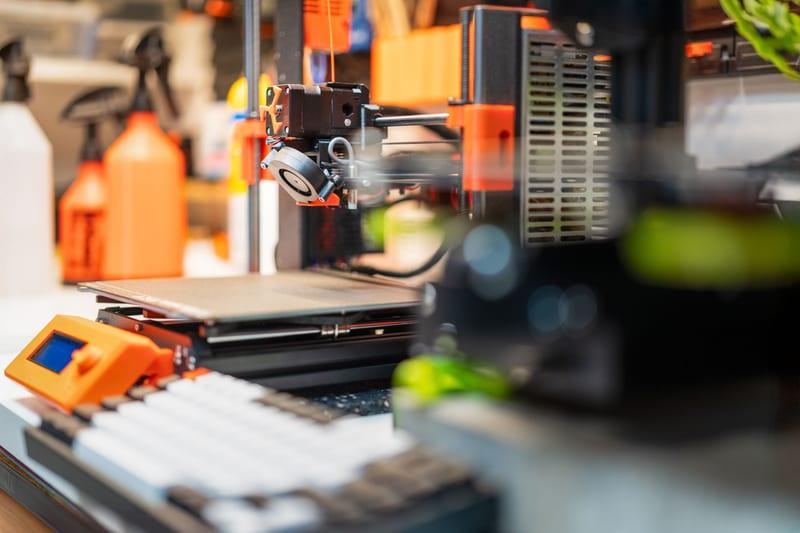
Stock photograph of this product class, not of this specific unit.
#ad We earn a commission · price as of November 20, 2026
1. Best on the used market, for abrasive filament
Bambu Lab X1-Carbon
Ships with a hardened steel nozzle and lidar first-layer inspection, in an aluminum enclosure that holds chamber heat better than panels do.
The X1C's remaining arguments are specific and real. The registry lists it as an enclosed CoreXY with lidar-based bed levelling, released May 24, 2022, with an aluminum enclosure, a hardened steel nozzle and an auxiliary cooling fan as standard, and a 5-inch touchscreen.
Two of those matter more than the spec line suggests. A hardened nozzle out of the box means abrasive filament is a day-one capability rather than a purchase — and on a P-series machine it is a purchase. The aluminum enclosure holds chamber heat better than the P1S's panels, which is the thing that actually decides whether a tall ABS part survives.
Lidar first-layer inspection is the feature people cite most and value least in practice. It is genuinely useful and it is genuinely not the reason to pick a machine. Set against that, the registry records the honest position: superseded by the H2D in March 2025 and the X2D in April 2026, single-nozzle where the top of the range is now dual. Used, it is a strong buy. New at flagship pricing, it is a mistake. X1C versus H2C and X1C versus H2D cover the machines above it.
What it gets right
- Ships with a hardened steel nozzle, so abrasive filament is a day-one capability rather than a purchase
- Lidar bed leveling and first-layer inspection, which the P-series does not have
- An aluminum enclosure holds chamber heat better than the P1S's panels
What it does not
- It is not the current flagship and has not been since March 2025 — buying it new at flagship money is a mistake
- The H2D and X2D both exceed it, so resale value is on a downward path
- Single nozzle, where the current top of the range is dual
| Series | X1, released May 24, 2022 |
|---|---|
| Type | Enclosed CoreXY with lidar-based bed leveling |
| X1-Carbon spec | Aluminum enclosure, hardened steel nozzle, auxiliary cooling fan |
| Screen | 5-inch touchscreen |
| Superseded by | H2D (March 2025) and X2D (April 2026) |

2. Best if you are buying new
Bambu Lab P2S
A current-generation enclosed CoreXY at a 256 x 256 x 256 mm cube, with a 300 C nozzle, a 110 C bed, a touchscreen and a nozzle you can swap in a minute.
Buying new, the P2S is the better decision and the reason is support life rather than specification. 3DJake lists it at 256 x 256 x 256 mm, 392 x 406 x 478 mm overall, 14.9 kg, a 300 C nozzle and a 110 C bed — a 110 C bed being slightly above the 100 C figure Makerpoint lists for the P1S.
The quick-swap nozzle is the feature that changes behavior. On an X1C a nozzle change is a job; on a P2S it is a minute. That is the difference between owning a 0.2 mm nozzle and using one, and it quietly makes the machine more capable than its spec sheet reads.
The honest gaps: no lidar, no hardened nozzle included, and 3DJake notes the absence of an active chamber heater with one reviewer observing the chamber takes time to warm. The first two are a purchase; the third is a technique. P1S versus P2S is the comparison if you already own the P1S, and H2D versus P2S is the one above it.
What it gets right
- Quick-swap nozzle turns a 0.4-to-0.6 change from a maintenance task into a between-prints decision
- A real touchscreen on the machine, so you are not opening an app to start a print
- Same footprint and roughly the same build area as the P1S, so your enclosure and shelf still work
What it does not
- If you have never once wished your P1S had a screen, this is not the upgrade you need
- Reported build volume is a 256 mm cube — the same class as the P1S, so it buys you nothing in size
- Your P1S-specific third-party parts may not carry over; check fitment per part, not per brand
| Released | October 9, 2025 |
|---|---|
| Type | Enclosed CoreXY, P1S successor |
| Over the P1S | Touchscreen and quick-swap nozzle |
| Build volume (reported) | 256 mm cube |

3. The part that closes the gap
Bambu Lab Hotend with Hardened Steel Nozzle, 0.4 mm
A complete hotend assembly with a hardened steel nozzle cited at HRA 74. It gives a P2S the one capability the X1C ships with as standard.
This pick is here because it prices the comparison honestly. Half of the X1C's edge over a P-series machine is a part you can buy. The registry lists this as a complete hotend assembly with a hardened steel nozzle at HRA 74, for the P1S, P1P, X1C and X1 Carbon.
It is a module swap rather than a soldering job, which is the point: fitting it is a short bench task, not a project. And abrasive filament rounds a stainless nozzle off fast — with the worst materials a single print can do it — so if your filament shelf has anything carbon-filled on it, this is not optional on either machine.
What it does not buy you is lidar or an aluminum chamber. Those stay on the X1C side of the ledger. Hardened steel versus stainless is the detail, and do I need one for this filament answers it material by material.
What it gets right
- Abrasive filament rounds a stainless nozzle fast — with the worst materials, a single print can do it
- Comes as a complete assembly, so the swap is a module change rather than a nozzle extraction
- 0.4 mm keeps your existing print profiles valid
What it does not
- Hardened steel conducts heat slightly worse than stainless, so very high-flow PLA needs a small temperature bump
- Pointless if you only ever print plain PLA and PETG — stainless lasts for years on those
- P-series and X1 only; the A-series and H-series need their own part
| Nozzle | Hardened steel, 0.4 mm |
|---|---|
| Fits | P1S, P1P, X1C and X1 Carbon (model FAH001-N-1) |
| Hardness reference | Hardened steel is cited at HRA 74 |
| Supplied as | Complete hotend assembly |
Questions people actually ask
Is the X1C still worth buying in 2026?
Used, yes. The registry lists lidar bed levelling, an aluminum enclosure, a hardened steel nozzle and an auxiliary cooling fan as standard, which is a strong package for abrasive filament and tall ABS. New at flagship money, no - it has not been the flagship since the H2D arrived in March 2025, and the X2D followed in April 2026.
Does the P2S have lidar?
No. Lidar bed levelling and first-layer inspection are X1-series features. In practice that matters most for unattended printing, where lidar catches a failed first layer in the first few minutes rather than the fourth hour. If you watch the first layer yourself, you are the inspection system.
Which has the bigger build volume, the X1C or the P2S?
Neither, meaningfully - both are in the same 256 mm class, and 3DJake lists the P2S at 256 x 256 x 256 mm exactly. If you need a bigger bed, this comparison is not the one to read.
Does the P2S come with a hardened nozzle?
No source we fetched lists a hardened nozzle as included with the P2S, whereas the registry records one as standard on the X1C. If your filament shelf includes anything carbon-filled or otherwise abrasive, budget for a hardened hotend assembly on top of a P2S - the registry cites hardened steel at HRA 74.
Which has the better enclosure, the X1C or the P2S?
The X1C, on the registry's own reading: its aluminum enclosure holds chamber heat better than panels do. Neither machine heats its chamber actively - 3DJake states that explicitly for the P2S - so heat retention is the whole mechanism. Expect a shorter soak and a more forgiving ABS workflow on the X1C, not a different set of achievable materials.
Sources
- P2S build volume (256 x 256 x 256 mm), printer dimensions (392 x 406 x 478 mm), net weight 14.9 kg, 300 C nozzle, 110 C bed and the absence of an active chamber heater - 3DJake P2S listing, retrieved 2026-10-11
- P1S build volume (256 x 256 x 256 mm), machine dimensions (389 x 389 x 458 mm), net weight 12.95 kg, 300 C nozzle and 100 C bed - Makerpoint P1S listing, retrieved 2026-10-11
- Bambu Lab model list and release dates - Wikipedia, retrieved 2026-10-11
- Build volumes and feature rows for the X1-Carbon, X2D, H2S, H2D, H2D Pro, H2C and A2L, and for every AMS unit, come from this site's product registry, whose spec provenance is documented in content/products.ts - no figure is asserted that a manufacturer or a cited third party did not publish
Read this next
- Bambu Lab P1S vs P2SThe P2S adds a touchscreen and a quick-swap nozzle and no build volume. When that is worth a new machine and when a far cheaper part does the same job.
- Bambu Lab X1C vs P1SLidar, an aluminum enclosure, a hardened nozzle and a touchscreen separate the X1C from the P1S. Worth it used; not worth it at old flagship prices.
- Bambu Lab X1C vs H2CThe H2C automates hotend swapping on the large H2 chassis. The X1C gives lidar, aluminum and a hardened nozzle in a 256 mm box. Different jobs entirely.
- Bambu Lab H2D vs P2SThe H2D buys a 350 x 320 x 325 mm bed and a dual nozzle. The P2S buys a screen, a quick nozzle swap and a 256 mm cube. Different problems, not two price points.
- Hardened steel vs stainless steel nozzlesHardened steel at HRA 74 versus stainless versus carbide at HRA 90 - which material your filament requires, and what each costs you.
- Chamber temperature on a passive enclosureHow passive chamber heating works, the safe ways to raise it, the modifications to avoid, and when an actively heated machine is the real answer.