Filament Drying
How to dry filament in an oven
Bambu Lab's own drying settings name a blast drying oven, not a kitchen one, and the difference is the whole reason oven drying goes wrong. Here are the published figures and the honest risks.
By Michael W. · Published October 17, 2026
Some links here are Amazon affiliate links, so a purchase may earn this site a commission at no cost to you. It does not change what gets recommended or the order it appears in — how that works.
The short answer
Bambu Lab publishes an oven setting for every material it sells, and they are lower than people guess. PLA Basic is 50 C for 8 hours. PETG HF is 65 C for 8 hours. TPU 95A HF is 70 C for 8 hours. ABS, ASA and PC are 80 C for 8 hours, and PA6-CF is 80 C for 8 to 12 hours.
Those figures assume a blast drying oven, not a kitchen oven. The Bambu Lab wiki states the requirement directly: use an oven that provides even temperature distribution, such as a blast (forced-air) drying oven, and keep the filament away from the heater. A domestic oven fails the first part and often cannot hold the second.
If you only have a kitchen oven, treat it as a last resort. Most will not hold 50 C at all, their thermostats swing by tens of degrees, and PLA softens well inside that swing. A spool that deforms on its hub is scrap, not wet filament.
Bambu Lab’s published oven settings
These are reproduced verbatim from the Bambu Lab filament guide and the TPU 95A HF product page, both retrieved 17 October 2026. Nothing in this table was measured here, and no material absent from it has been given an estimated figure.
| Material | Blast drying oven | X1 series heatbed |
|---|---|---|
| PLA Basic | 50 C, 8 h | 60-70 C, 12 h |
| PLA Wood | 55 C, 8 h | 65-75 C, 12 h |
| PETG HF | 65 C, 8 h | 75-85 C, 12 h |
| TPU 95A HF | 70 C, 8 h | 80-90 C, 12 h |
| ABS | 80 C, 8 h | 90-100 C, 12 h |
| ASA | 80 C, 8 h | 90-100 C, 12 h |
| PA6-CF | 80 C, 8-12 h | 90-100 C, 12 h |
| PC | 80 C, 8 h | 100 C, 12 h |
Why a kitchen oven is the wrong oven
The phrase in Bambu's wiki is doing a lot of work: an oven that provides even temperature distribution, such as a blast drying oven. A blast oven circulates air with a fan so every part of the chamber is at the set temperature. That evenness is the requirement, not the heat.
A domestic oven is the opposite design. It heats from one or two elements and relies on the food being cooked, not held at a precise low temperature. Three specific problems follow.
The lowest setting is usually too high
Many ovens do not go below about 70 C, and plenty start at 90 C or 100 C. PLA's published figure is 50 C. There is no dial position that corresponds to the setting you need, and the gap is not small.
The thermostat swings
Domestic thermostats cycle the element on and off around a target, and the swing can be tens of degrees. Even if the average sat at 50 C, the peaks would not, and PLA does not care about your average.
Radiant heat finds the spool
The wiki's second instruction — keep the filament away from the heater — is hard to satisfy in a small chamber with an element in the floor. A spool with one face exposed to radiant heat has a hot side and a cool side regardless of what the air temperature reads.
What goes wrong, specifically
The failure people expect is melting, and that is the least likely one. The common failures are subtler and worse.
The first is spool deformation. PLA softens below its melting point, and a 1 kg coil under its own tension on a softened spool will tighten, bind, or weld adjacent windings together. The filament then refuses to unwind mid-print, which reads as a feed fault days later.
The second is tangling from the same cause: windings that fused and then separated unevenly. The third is a cardboard spool scorching, which is a fire question rather than a print-quality one. None of these is reversible.
If you are going to do it anyway
There are situations with no better option — one wet spool, no dryer, a print due. The following keeps the risk as low as it can be, and it is risk reduction rather than a recommendation.
Use the published figure for your material from the table above and no more. Put an independent thermometer in the oven and read the actual air temperature rather than the dial. Keep the spool off the floor of the oven and away from any element, on a rack in the middle. Leave the door very slightly ajar if the oven cannot hold a low setting — it vents the moisture you are driving off, which otherwise just re-condenses. Stay in the room.
And do not oven-dry a cardboard spool, or a spool you cannot see. If you cannot verify the temperature, the honest answer is that the printer's own heated bed is a more controlled environment than the oven — drying filament in the printer has Bambu's published heatbed figures and the ceiling each machine can actually reach.
How to tell whether it worked
Drying has no visible endpoint, which is why people over-dry and under-dry in roughly equal numbers. The test is a print, not a look: wet filament pops and hisses at the nozzle, strings between features, and prints with a rough or foggy surface that a dry spool does not.
How to tell if your filament is wet covers the symptoms in order of reliability, and how to dry filament is the general page if you have not settled on a method yet.
What this page is and is not based on
Every oven and heatbed temperature and time above is a manufacturer-published drying setting, reproduced verbatim from the Bambu Lab filament guide and the Bambu Lab TPU 95A HF product page, both retrieved 17 October 2026. The requirement for an oven with even temperature distribution — specifically a blast drying oven — and the instruction to keep filament away from the heater come from the Bambu Lab wiki's dry filament page, same date. The failure modes described are mechanisms, not measurements: we have not deliberately deformed spools to document it, there is no test lab behind this site, and how we review says so. No material absent from the table has been given an estimated figure, and no price appears in prose.
What to buy

1. The cheapest way to stop using the oven
SUNLU FilaDryer S2
The cheapest dryer worth owning if the problem is PETG and TPU misbehaving. It holds a set temperature on one spool, which a kitchen oven does not.
Almost everyone searching for oven drying is really asking how to avoid buying a dryer. The honest answer is that the cheapest purpose-built unit costs less than the spool it saves, and it does the one thing a kitchen oven cannot: hold a low temperature steadily without hot spots.
The registry positions this as the cheapest dryer worth owning if you just need PETG and TPU to behave, which is exactly the material pair that drives most drying searches. Bambu Lab's own published figures put PETG HF at 65 C and TPU 95A HF at 70 C for 8 hours — both inside the range a standalone dryer is built for and both below the lowest setting many domestic ovens will hold.
Where it stops is engineering filament. Bambu publishes 80 C oven settings for ABS, ASA, PA6-CF and PC, and a standard-temperature dryer is not the right tool for those. The dryer roundup ranks the options and is a filament dryer worth it answers the question underneath this one.
What it gets right
- 35-70 C covers PLA, PETG and TPU, which is most of what actually goes wet in a hobby workshop
- Quiet enough to run overnight in a room you sleep in
- The cheapest entry point that is still a real dryer rather than a warm box
What it does not
- 70 C ceiling means nylon, PC and PA-CF are out of range
- One spool at a time, which does not fit a four-color job
- No printing from the unit, so a dried spool starts re-absorbing the moment it comes out
| Temperature range (cited) | 35-70 C |
|---|---|
| Capacity | One spool |
| Diameters | Supports all common filament diameters |
| Noted | Quiet enough for overnight drying |
2. If your materials want 80 C
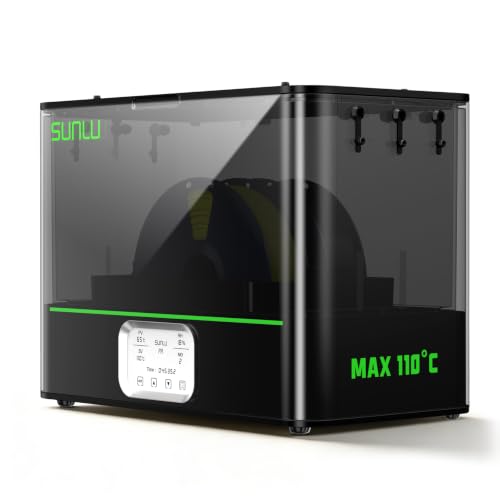
SUNLU E2 FilaDryer
Built for engineering filament - PA6-CF, PA12-CF, PC, ABS and ASA - plus annealing finished parts. These are the materials whose published oven setting is 80 C.
The materials that genuinely tempt people into an oven are the engineering ones, because their published drying settings sit above what a basic dryer reaches. Bambu publishes 80 C for 8 hours for ABS, ASA and PC, and 80 C for 8 to 12 hours for PA6-CF.
The registry positions this unit for exactly that set — PA6-CF, PA12-CF, PC, ABS and ASA — and the cited review records a temperature range and a 500 W PTC heater, plus an annealing function. Annealing matters here because it is the other job people reach for an oven to do.
If your filament shelf is PLA and PETG, this is more unit than you need and the cheaper one covers you. The best filament dryer for nylon and PA6-CF is the detailed page for this end of the range.
What it gets right
- 110 C is the first number on this page that is genuinely enough for nylon and PC
- A 500 W PTC heater gets to temperature fast instead of creeping there over an hour
- Doubles as an annealing oven, which is a second real use rather than a marketing bullet
What it does not
- Overkill and over-priced if PLA and PETG are all you print
- A 500 W heater is not a quiet, low-draw appliance
- Annealing shrinks and distorts parts — it is a technique to learn, not a button to press
| Temperature range (cited) | 35-110 C |
|---|---|
| Heater (cited) | 500 W PTC |
| Second function | Annealing as well as drying |
| Materials cited | PA6-CF, PA12-CF, PC, ABS, ASA |

3. So you do not have to dry it again
Polymaker PolyDryer
Sealed per-spool storage with active drying, at a cited 10-20% RH. Drying once and storing properly is cheaper than drying repeatedly.
Oven drying is a repair, and repairs repeat. A spool dried today and returned to room air is wet again in weeks, which is how people end up drying the same filament three times and concluding that drying does not work.
The registry lists the PolyDryer as passive sealed storage combined with active drying, with a cited 10-20% RH, bought box by box so you can start with one. Sealed storage is the part that stops the cycle.
The limit is scale: enough boxes for a full shelf adds up past a four-spool dryer, and per-box storage uses more shelf area than a stacked rack. Filament dryer boxes compares the two approaches.
What it gets right
- The modular box system means every spool lives sealed, which prevents the problem instead of fixing it
- A cited 10-20% RH is the number that matters, and it is a good one
- Cheap to start with one box and add more, instead of one large purchase
What it does not
- Buying enough boxes for a full filament shelf adds up past the price of a four-spool dryer
- Standard-temperature drying — not an engineering-filament answer
- Per-box storage takes more total shelf area than a stacked rack
| Approach (cited) | Passive sealed storage plus active drying |
|---|---|
| Humidity reached (cited) | 10-20% RH |
| Entry point (cited) | From a per-box price, boxes bought individually |
Questions people actually ask
What temperature should I dry filament in an oven?
Use the manufacturer's published figure for the material. Bambu Lab's filament guide gives PLA Basic 50 C for 8 hours, PLA Wood 55 C for 8 hours, PETG HF 65 C for 8 hours, TPU 95A HF 70 C for 8 hours, ABS, ASA and PC 80 C for 8 hours, and PA6-CF 80 C for 8 to 12 hours. Those figures assume a blast drying oven, not a kitchen oven.
Can I dry filament in a kitchen oven?
Only as a last resort. The Bambu Lab wiki specifies an oven with even temperature distribution, such as a blast or forced-air drying oven, with the filament kept away from the heater. A domestic oven heats from one or two elements, its thermostat swings by tens of degrees, and many will not hold 50 C at all - which is PLA's published setting.
Will drying filament in the oven ruin it?
It can, and not by melting. PLA softens well below its melting point, so a 1 kg coil under its own tension can tighten, bind or weld windings together on a softened spool - which shows up as a feed failure days later. Cardboard spools are a scorching risk. None of that is reversible, which is why the published figures and an independent thermometer matter.
How long should filament dry in an oven?
Bambu Lab's published oven times are 8 hours for PLA Basic, PLA Wood, PETG HF, TPU 95A HF, ABS, ASA and PC, and 8 to 12 hours for PA6-CF. Longer is not better - once the moisture is out, additional hours at temperature only add risk of softening and spool deformation.
Is it better to dry filament in an oven or a filament dryer?
A dryer, for almost everyone. The thing a purpose-built dryer does that a kitchen oven cannot is hold a low temperature steadily with even air, which is exactly what Bambu's instructions require. The cheapest unit worth owning covers PETG and TPU - the pair that drives most drying searches - and costs less than the spool an oven mishap destroys.
Should I leave the oven door open when drying filament?
If the oven cannot hold a low setting, a slightly ajar door both reduces the temperature and vents the moisture you are driving off, which otherwise re-condenses in the chamber. It is a mitigation for the wrong tool rather than a technique - and it means the oven is open and hot in a room you should not leave.
Sources
- Published drying settings reproduced verbatim: PLA Basic blast drying oven 50 C / 8 h, AMS 2 Pro and AMS HT 55 C / 8 h, X1 series heatbed 60-70 C / 12 h; PLA Wood oven 55 C / 8 h, heatbed 65-75 C / 12 h; PETG HF oven 65 C / 8 h, X1 heatbed 75-85 C / 12 h; ABS and ASA oven 80 C / 8 h, X1 heatbed 90-100 C / 12 h; PA6-CF oven 80 C / 8-12 h, X1 heatbed 90-100 C / 12 h; PC oven 80 C / 8 h, heatbed 100 C / 12 h - Bambu Lab filament guide, retrieved 2026-10-17
- The requirement to use an oven with even temperature distribution, such as a blast (forced-air) drying oven, and to keep the filament away from the heater - Bambu Lab wiki, dry filament, retrieved 2026-10-17
- TPU 95A HF drying settings - blast drying oven 70 C / 8 h and X1 series heatbed 80-90 C / 12 h - and the note that the material is highly sensitive to humidity - Bambu Lab TPU 95A HF product page, retrieved 2026-10-17
- Dryer capabilities, hotend fitment and AMS behavior rows come from this site's product registry, whose spec provenance is documented in content/products.ts - no figure is asserted that a manufacturer or a cited third party did not publish
Read this next
- How to dry filamentFour drying methods compared, the temperature each material wants, and the one method that does not work despite being widely suggested.
- Drying filament in the printerPublished heatbed figures are 60-70 C for PLA up to 100 C for PC. The P1S bed tops out at 100 C and an A1 mini at 80 C, which decides what each machine can dry.
- Drying filament in an AMSWhich AMS units actually dry, what that gets you over a standalone dryer, and the material ceiling that still applies.
- How to tell if your filament is wetThe three near-conclusive signs of wet filament, the ambiguous ones, and the free test that settles it in one print.
- The best filament dryers in 2026Dryer picks split by temperature range and capacity, because a 70 C unit and a 110 C unit are different products for different materials.
- Is a filament dryer worth it?Who a dryer genuinely pays for, who should buy sealed storage instead, and the free test that settles it before you spend.