Filament Drying
SUNLU FilaDryer E2
One number justifies this unit and one number limits it. The 110 C ceiling is the reason to buy it; the spool capacity is the reason most people should not.
By Michael W. · Published October 24, 2026
Some links here are Amazon affiliate links, so a purchase may earn this site a commission at no cost to you. It does not change what gets recommended or the order it appears in — how that works.
The verdict
Buy the E2 if you print nylon, PC, PA-CF or ASA. West3D publishes a 35-110 C working range, and 110 C is the first figure on this site's dryer shelf that genuinely covers engineering filament. Every other standalone unit here tops out below it.
Skip it if you print PLA and PETG. Those materials dry far below this ceiling, and the published capacity is one 3 kg spool or two 1 kg spools. A four-spool standard-temperature box serves that workflow better and costs less.
The second function is real but is not a button. The unit is sold as a dryer and an annealer. Annealing changes a finished part's dimensions - it is a technique to learn, not a setting to switch on.
Two published specs disagree. SUNLU lists 325 W rated power and 7.6 kg net; the retailer listing says 500 W PTC and 6.1 kg net. We have not opened one, so both are reported rather than resolved.
Published specifications
| Published figure | Source | |
|---|---|---|
| Maximum temperature | 110 C | SUNLU and West3D |
| Working range | 35-110 C | West3D |
| Heating | 325 W rated power / 500 W PTC | SUNLU / West3D - they differ |
| Heat-up time | 20 min to 50 C; 30 min to 70 C from room temperature | West3D |
| Timer | 0-99 hours | West3D |
| Humidity readout | 10-90%, stated accuracy +/-10% | West3D |
| Maximum spool size | 250 mm diameter x 153 mm | West3D |
| Capacity | Two 1 kg spools, two 2 kg spools, or one 3 kg spool | West3D |
| External dimensions | 400 x 220 x 307 mm | SUNLU |
| Internal dimensions | 372 x 192 x 255 mm | West3D |
| Net weight | 7.6 kg / 6.1 kg | SUNLU / West3D - they differ |
| Chamber | All-round dual-chamber design, top, middle and bottom | West3D |
| Sealing | One-piece silicone plug over the line hole; silicone strips and magnetic block on the cover | West3D |
| Print from the unit | Filament outputs on the sides and top | West3D |
| Stated materials | ABS, ABS-CF, ASA, PC, PA6-GF, PA6-CF, PA12-CF and other engineering grades | West3D |
| Noise rating | Not published by a source we fetched | - |
What the 110 C ceiling actually buys
Drying is not a single task with one correct temperature. It is a race between pulling moisture out of a polymer and softening the polymer, and the ceiling of a dryer decides which materials you can win that race with.
Standard-temperature dryers — the 70 C class — cover the materials that actually go wet most often in a hobby workshop: PLA, PETG and TPU. Bambu Lab's own published settings put PLA Basic at the bottom of the scale, which is why a high-temperature unit is the wrong tool for PLA rather than a safer one. If PLA is your problem, the PLA page explains why the cheap box is the right answer.
Nylon, PC and the carbon- and glass-filled engineering grades are a different problem. They absorb more moisture, hold it harder, and need both more heat and more hours. A 70 C unit run for longer does not substitute for the ceiling, because the moisture that matters is not leaving at 70 C in any useful timeframe. That is the entire argument for the E2 and it is the reason this page exists separately from the general drying guide.
The annealing claim
The unit is sold as a dryer and an annealer, and 110 C is enough heat to anneal many printed parts. Worth being clear about what that means: annealing relieves internal stress and can increase strength and heat resistance, and it also shrinks and distorts the part while doing it. It is a process you dial in on test pieces, not a mode you select for a finished component you care about. Treating it as a bonus feature rather than a second skill is how people ruin parts.
The capacity question nobody puts on the box
West3D's capacity line is the most useful specification on the page and the one most reviews skip: two 1 kg spools, two 2 kg spools, or one 3 kg spool, with a maximum spool size of 250 mm diameter by 153 mm.
Read that against how you actually print. If you run a four-color job, this unit cannot hold the set, and drying one spool at a time while three sit in room air is a loop you never finish. If you run single-material engineering filament — which is how most people use nylon and PC — one or two large spools is exactly the right shape, and the 3 kg capacity is genuinely useful because engineering filament is often sold in big spools.
The 250 mm spool-diameter limit is worth measuring before buying. Not every 3 kg spool is the same shape, and a dryer that will not close is a sealed box with a gap in it.
How it compares with the alternatives on this site
Against the AMS HT
Both target the same material class from opposite directions. The AMS HT dries one spool hot and feeds the printer directly, so there is no window where a dried spool re-absorbs moisture; the registry records exactly that as its headline. The E2 dries up to two spools and anneals, works with any printer, and hands you a dry spool that then has to be used promptly. If you own a compatible Bambu machine and print one engineering material, the AMS HT comparison is the page to read before this one.
Against the AMS 2 Pro
Not a competitor, despite both involving drying. The AMS 2 Pro's active drying is a four-spool, standard-temperature capability bundled into a color system. It keeps PLA and PETG in condition while they feed; it is not an engineering-filament dryer and was never sold as one. Drying filament in an AMS covers what that unit does and does not do.
Against doing nothing
The option people skip. If your prints are fine, your filament is stored sealed with desiccant, and you print PLA, the honest recommendation is to spend nothing. The symptoms page is the test: popping and hissing from the nozzle, stringing that tuning does not fix, brittle filament snapping in the path, and a rough matte surface where there should be a sheen. No symptoms, no purchase.
What this page is and is not based on
The 110 C maximum, the 325 W rated power, the 400 x 220 x 307 mm product dimensions and the 7.6 / 8.3 kg weights come from SUNLU's own FilaDryer E2 product page, retrieved 24 October 2026, which also showed the unit available to order direct. The 35-110 C working range, the 500 W PTC heating figure, the 20-minute and 30-minute heat-up times, the 250 x 153 mm maximum spool size, the capacity line, the 372 x 192 x 255 mm internal dimensions, the 6.1 / 7 kg weights, the 0-99 hour timer, the 10-90% humidity readout, the dual-chamber construction, the sealing details, the side and top filament outputs and the engineering material list come from the West3D E2 listing, same date, which showed the unit sold out at that retailer. Where the two sources disagree — heating power and net weight — both figures are printed above and neither is preferred, because we have not weighed or metered one. AMS HT, AMS 2 Pro and SUNLU S4 positioning are registry rows whose provenance is documented in content/products.ts. I have not run an E2: there is no test lab behind this site, no hygrometer logging a chamber and no scale, which is why every number here carries a source and the rows nobody published are left empty. See how we review. No price appears in prose.
What to buy
1. The reason to buy it
SUNLU E2 FilaDryer
A published 35-110 C range, a 0-99 hour timer and a humidity readout, in a box that takes one 3 kg spool or two 1 kg spools. The only unit here that reaches engineering-filament territory.
The case for the E2 is narrow and it is strong. West3D publishes a working range of 35-110 C with 500 W PTC heating, 20 minutes to reach 50 C from room temperature and 30 minutes to reach 70 C, a 0-99 hour timer and a 10-90% humidity display with a stated ±10% accuracy. SUNLU's own page gives the 110 C maximum, a 325 W rated power, 400 x 220 x 307 mm and a 7.6 kg net weight.
Nothing else in the registry gets near the top of that range. Every other standalone dryer here is a standard-temperature unit, which is fine for the materials that go wet most often and not enough for nylon, PC or PA-CF. The nylon and PA6-CF roundup is where that argument is made at length; this page is about the unit itself.
The honest limits are capacity and noise class. West3D states two 1 kg spools, two 2 kg spools or one 3 kg spool, so this is a one-or-two-spool appliance by design, and a heater in the hundreds of watts is not a quiet background device. It also costs real money for a ceiling most hobby printing never touches.
What it gets right
- 110 C is the first number on this page that is genuinely enough for nylon and PC
- A 500 W PTC heater gets to temperature fast instead of creeping there over an hour
- Doubles as an annealing oven, which is a second real use rather than a marketing bullet
What it does not
- Overkill and over-priced if PLA and PETG are all you print
- A 500 W heater is not a quiet, low-draw appliance
- Annealing shrinks and distorts parts — it is a technique to learn, not a button to press
| Temperature range (cited) | 35-110 C |
|---|---|
| Heater (cited) | 500 W PTC |
| Second function | Annealing as well as drying |
| Materials cited | PA6-CF, PA12-CF, PC, ABS, ASA |
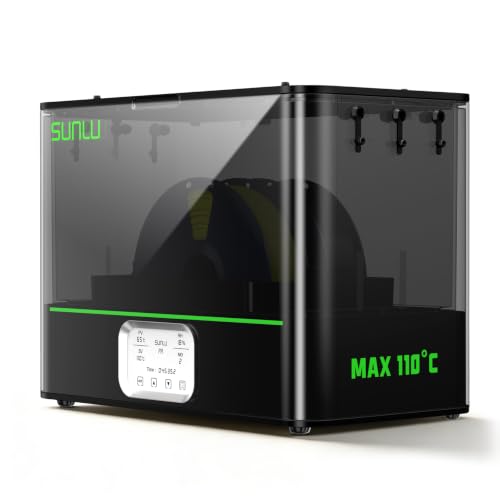
Stock photograph of this product class, not of this specific unit.
#ad We earn a commission · price as of November 20, 2026
2. The in-family alternative
Bambu Lab AMS HT
Single-spool high-temperature drying that feeds the printer directly, so a dried spool never sits in room air waiting to be used.
If the reason you want a 110 C dryer is a single spool of engineering filament feeding a Bambu machine, the AMS HT is the version of this purchase that stays inside the ecosystem. The registry records it as a single-spool material system whose headline feature is high-temperature active drying, printing directly from the unit.
That last part is the real differentiator and it is not a specification: a spool dried in a standalone box starts re-absorbing moisture the moment it comes out. Printing straight from the dryer covers why that window matters, and AMS HT versus a filament dryer is the direct comparison.
What you give up is breadth. One spool, no annealing, and it is useless to anyone whose printer is not a Bambu. The E2 is the more general-purpose box; the AMS HT is the more integrated one.
What it gets right
- Dries at a higher temperature than the AMS 2 Pro, which is what nylon and PC actually need
- Prints directly from the dryer, so there is no window where a dried spool sits absorbing moisture again
- Single spool is the right shape for engineering filament, which you rarely want four of
What it does not
- One spool. If multi-color is the goal, this is the wrong unit entirely
- Costs real money for a capability a standalone high-temp dryer also delivers
- Only worth it if you print materials that genuinely need the extra heat
| Type | Single-spool material system |
|---|---|
| Headline feature | High-temperature active drying |

3. Buy this instead if 110 C is more than you need
SUNLU FilaDryer S4
Four spools at standard drying temperature - the right shape for a multi-color workflow, where the E2 is the wrong shape entirely.
Most people who land on a high-temperature dryer page do not need a high-temperature dryer. They have a four-color workflow and PETG that strings, and the problem is capacity rather than temperature. The S4 is the registry's four-spool answer, and it dries the whole set you are about to print with instead of one spool at a time while the other three re-absorb.
The trade is honest in both directions. Four spools heat more slowly than one, so cycles are long, and it is a big box that needs shelf space next to the printer. But it costs less per spool than any single-spool unit here.
The S4 review is the full page on that unit, including the 70 C ceiling that decides between the two. The dryer roundup ranks the whole shelf by temperature and capacity, and whether a dryer is worth it at all is the question to settle before either purchase.
What it gets right
- Four spools at once is the only capacity that matches a four-color workflow
- Dries the whole set you are about to print with, rather than one spool at a time while three re-absorb
- Cheaper per spool than any single-spool dryer
What it does not
- It is a big box; four-spool dryers need shelf space you may not have next to the printer
- Standard-temperature drying is not enough for nylon or PC — that needs a high-temp unit
- Four spools heat more slowly than one, so cycles are long
| Capacity | Four spools |
|---|---|
| Positioning (cited) | Best for multi-color and multiple printers |
Questions people actually ask
What temperature does the SUNLU E2 reach?
110 C. SUNLU's own product page gives that as the maximum and the West3D listing gives the working range as 35-110 C. That is the whole reason to choose this unit over a standard dryer: it is the only unit in this site's registry whose ceiling covers nylon, PC and the carbon- and glass-filled engineering grades.
How many spools does the SUNLU E2 hold?
The West3D listing states two 1 kg spools, two 2 kg spools, or one 3 kg spool, with a maximum spool size of 250 mm diameter by 153 mm. That makes it a one-or-two-spool unit by design. If you need to dry a four-color set before a print, a four-spool standard-temperature dryer is the right shape instead.
Is the SUNLU E2 worth it for PLA and PETG?
No, and this is the clearest skip recommendation on the page. PLA and PETG dry far below this unit's ceiling - Bambu Lab's own published settings put PLA at the bottom of the scale - so you would be paying for heat you cannot use and accepting a two-spool capacity in exchange. A cheaper standard-temperature dryer is the better purchase for those materials.
How long does the SUNLU E2 take to heat up?
The West3D listing gives 20 minutes to reach 50 C from room temperature and 30 minutes to reach 70 C. It does not publish a time to 110 C, and we have not timed one, so no figure is claimed for the top of the range.
Can you print directly from the SUNLU E2?
Yes - the West3D listing describes filament outputs on the sides and top so the filament can feed a printer while the unit runs. That matters more than it sounds: a spool dried in a sealed box starts re-absorbing moisture as soon as it comes out, so drying and printing in one step closes a real gap.
Does the SUNLU E2 really use 500 W?
The published figures disagree and we are not going to pick one. West3D describes 500 W PTC ultra-high heating power; SUNLU's own specification table lists a 325 W rated power. Both are published by the parties selling it, we have not metered a unit, so both are reported here rather than resolved. Either way it is a heater, not a low-draw background appliance.
Can the SUNLU E2 anneal printed parts?
It is sold as a dryer and an annealer, and 110 C is enough heat to anneal many printed materials. Be careful with the expectation: annealing relieves internal stress and can improve strength and heat resistance, but it also shrinks and distorts the part. It is a technique to dial in on test pieces, not a setting to apply to a finished component.
SUNLU E2 or Bambu Lab AMS HT for nylon?
The AMS HT if you print one engineering material on a compatible Bambu machine and want it to feed the printer directly while drying. The E2 if you want to dry up to two spools, dry filament for any printer regardless of brand, or anneal parts. The AMS HT is the more integrated option; the E2 is the more general-purpose box.
Sources
- SUNLU FilaDryer E2 maximum temperature 110 C, rated power 325 W, net and gross weight 7.6 / 8.3 kg, product dimensions 400 x 220 x 307 mm and carton 454 x 276 x 362 mm, and availability to order direct - SUNLU FilaDryer E2 product page, retrieved 2026-10-24
- SUNLU E2 working temperature range 35-110 C, 500 W PTC heating, 20 minutes to 50 C and 30 minutes to 70 C from room temperature, maximum spool size 250 mm diameter x 153 mm, stated capacity of two 1 kg spools or two 2 kg spools or one 3 kg spool, internal dimensions 372 x 192 x 255 mm, net and gross weight 6.1 / 7 kg, 0-99 hour timer, 10-90% humidity display with +/-10% accuracy, the dual-chamber design, the silicone plug and magnetic sealing, the side and top filament outputs for printing from the unit, and the engineering material list (ABS, ABS-CF, ASA, PC, PA6-GF, PA12-CF and others) - West3D SUNLU E2 FilaDryer listing, retrieved 2026-10-24. The same page shows the unit sold out at that retailer
- Bambu Lab's own published per-material drying settings - PLA Basic blast drying oven 50 C / 8 h at the bottom of the scale, against ABS, ASA, PC and PA6-CF at oven 80 C - reproduced in full on this site's drying pages. Bambu Lab filament guide, retrieved 2026-10-17
- Positioning and feature rows for the AMS HT, the AMS 2 Pro and the SUNLU S4 come from this site's product registry, whose spec provenance is documented in content/products.ts - no figure is asserted that a manufacturer or a cited third party did not publish
Read this next
- The best filament dryer for nylon and PA6-CFNylon and PA6-CF need temperatures most dryers cannot reach - which units are cited as going high enough, and the one you may already own.
- The best filament dryers in 2026Dryer picks split by temperature range and capacity, because a 70 C unit and a 110 C unit are different products for different materials.
- AMS HT vs a filament dryerThe reabsorption gap explained, and whether it justifies an AMS HT over a standalone high-temperature dryer for your print mix.
- Printing while dryingWhat the reabsorption gap costs per material, which units let you print from them, and when closing the gap is worth paying for.
- Is a filament dryer worth it?Who a dryer genuinely pays for, who should buy sealed storage instead, and the free test that settles it before you spend.
- How to tell if your filament is wetThe three near-conclusive signs of wet filament, the ambiguous ones, and the free test that settles it in one print.