Nozzles & Plates
The best nozzle for carbon fiber filament
Two separate problems get confused here. Hardness stops the nozzle wearing out; bore size stops it clogging. Carbon fiber gives you both at once.
By Michael W. · Published October 6, 2026
Some links here are Amazon affiliate links, so a purchase may earn this site a commission at no cost to you. It does not change what gets recommended or the order it appears in — how that works.
Quick picks
Tap any row to jump to the full write-up. Prices and stock live on Amazon, never here.
| # | Product | Best for | Price |
|---|---|---|---|
| 1 | 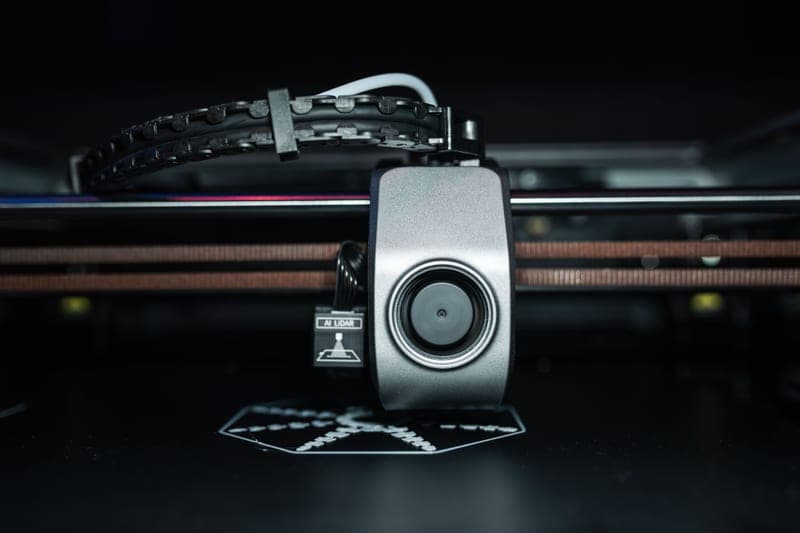 Bambu Lab Hotend with Hardened Steel Nozzle, 0.6 mm Hardened steel plus a 0.6 mm bore solves both carbon-fiber problems at once: wear and clogging. | Best nozzle for carbon fiber overall Carbon-fiber filament that clogs a 0.4 mm nozzle on chopped fiber | Check price on Amazon #ad We earn a commission · live price shown on Amazon |
| 2 | Bambu Lab Hotend with Hardened Steel Nozzle, 0.4 mm The official hardened hotend at the standard bore - fixes wear, does not fix fiber clogging. | Best if you want to keep your 0.4 mm profiles The one purchase that has to happen before your first spool of anything carbon-filled | Check price on Amazon #ad We earn a commission · live price shown on Amazon |
| 3 | BIQU Panda Revo Hotend Quick-change nozzles turn the 0.4 mm versus 0.6 mm decision into a per-print choice instead of a maintenance job. | Best if you switch between carbon fiber and detail work Getting quick nozzle changes on a P1S without buying a P2S | Check price on Amazon #ad We earn a commission · live price shown on Amazon |
| 4 | BIQU Panda Juicer Hotend 0.4 mm hardened steel for the A-series and H2D, cheap enough to keep a spare on the shelf. | Best for an A1, A1 mini or H2D A spare hardened hotend for an A1, A1 mini or H2D at less than the official part | Check price on Amazon #ad We earn a commission · live price shown on Amazon |
The short answer
For carbon fiber filament, use a hardened steel nozzle, and for anything heavily fiber-loaded use 0.6 mm rather than 0.4 mm. On a P1S or P1P that is the Bambu Lab hardened steel 0.6 mm hotend; on an A1, A1 mini or H2D the equivalent third-party hardened hotend.
These are two separate fixes for two separate problems. Hardness stops the nozzle wearing out, which carbon fiber does fast. Bore size stops it clogging, which chopped fiber does to a 0.4 mm orifice regardless of what the nozzle is made of. Carbon-filled filament hands you both problems at once, which is why a hardened 0.4 mm nozzle can still fail you.
Why a hardened 0.4 mm nozzle still clogs on PA6-CF
This is the single most common confusion on the topic, so it is worth being precise. Carbon fiber filament is not polymer with carbon dust in it. It is polymer with short chopped fibers in it, and those fibers have length. Inside a 0.4 mm orifice they can bridge across the opening, catch on each other and pack into a plug.
No amount of nozzle hardness prevents that, because it is a geometry problem rather than a wear problem. The nozzle is not worn; the hole is too small for the particle. The symptom is under-extrusion that gets worse through a print and a partial clog that clears and returns.
Hardness solves the other problem. Abrasive filament scours the orifice wider and rounds the flat of the nozzle tip, which ruins first layers and extrusion width before you notice anything dramatic. Hardened steel is cited at HRA 74 against the HRA 90 cited for the tungsten carbide nozzle on the H2D Pro — both far above what stainless tolerates on abrasive material.
Which bore for which carbon-filled material
| Material | Nozzle hardness | Bore we would use | Why |
|---|---|---|---|
| PLA-CF | Hardened required | 0.4 mm fine | Light fiber loading; abrasion is the issue, not blockage |
| PETG-CF | Hardened required | 0.4 mm fine, 0.6 mm safer | Abrasive and stringy; a wider bore reduces clog risk |
| PA6-CF / PA12-CF | Hardened required | 0.6 mm | Heavily fiber-loaded; this is where 0.4 mm plugs |
| PPS-CF | Hardened required | 0.6 mm | High-temperature engineering filament, heavily loaded |
| Glow-in-the-dark | Hardened required | 0.4 mm fine | Abrasive phosphor particles, no fiber bridging |
| Wood / marble PLA | Hardened required | 0.6 mm safer | Large filler particles clog small bores |
There is a wider version of the hardness question on do I need a hardened nozzle, which goes material by material including the ones people are surprised by. The bore question on its own is on nozzle sizes.
What else carbon fiber needs besides a nozzle
Dry filament, especially the nylon grades
PA6-CF and PA12-CF are among the most hygroscopic materials in the hobby. Printing them from a spool that has been in room air for a week produces steam at the nozzle, foamed surfaces and parts that snap. A nozzle will not fix any of that — a high-temperature dryer will, and it needs to reach well past where the cheap units stop.
A plate that can take the bed temperature
Carbon-filled nylon and PC want a hot bed, and glue stick, on textured PEI. The manufacturer's own published figures for the textured plate put PA and PC at 90-110 C with glue recommended — the full published table is here.
Patience with flow calibration
A new bore and a new nozzle material both change flow. Run the calibration rather than assuming your old profile transfers, and expect to re-tune first layer height after a hotend swap.
How long a nozzle lasts on carbon fiber
We do not publish an hour figure, because we have not measured one and nobody we fetched states one in a form worth quoting. What is safe to say is the shape of it: stainless on carbon-filled filament degrades in a timeframe measured in prints rather than months, and hardened steel moves that into a timeframe where you will notice gradual extrusion-width drift before outright failure. What to actually watch for is the practical version.
Every figure on this page is attributed in the source list below. There is no test lab behind this site and no measurement rig — how we review says so plainly.
Every pick in full
Stock photograph of this product class, not of this specific unit.
#ad We earn a commission · live price shown on Amazon
1. Best nozzle for carbon fiber overall
Bambu Lab Hotend with Hardened Steel Nozzle, 0.6 mm
Hardened steel plus a 0.6 mm bore solves both carbon-fiber problems at once: wear and clogging.
This is the pick, and the reason is the bore rather than the steel. Carbon-filled filament is not powder — it is chopped fiber suspended in polymer, and those fibers bridge and pack inside a 0.4 mm orifice. That is why a hardened 0.4 mm nozzle still clogs on PA6-CF when the owner has done everything right.
At 0.6 mm the same fibers pass. Combined with hardened steel, which is cited at HRA 74, you have a nozzle that neither wears nor jams on the materials that do both. It is also noticeably faster on functional parts, which is most of what gets printed in carbon-filled filament anyway.
Two honest costs. Every profile needs re-slicing — a 0.6 mm nozzle is not a drop-in for 0.4 mm settings. And you will end up wanting both sizes, which is the real argument for a quick-swap hotend further down this page.
What it gets right
- The larger bore is the real fix for carbon-fiber clogging, not just a faster nozzle
- Hardened steel plus 0.6 mm is the combination for chopped-fiber filament
- Noticeably faster on functional parts where layer lines do not matter
What it does not
- Every profile has to be re-sliced; a 0.6 mm nozzle is not a drop-in for 0.4 mm settings
- Visible layer lines and softer detail on anything decorative
- You will end up wanting both sizes, which is the argument for a quick-swap machine
| Nozzle | Hardened steel, 0.6 mm |
|---|---|
| Fits | P1P and P1S |
| Supplied as | Complete hotend assembly |
Stock photograph of this product class, not of this specific unit.
#ad We earn a commission · live price shown on Amazon
2. Best if you want to keep your 0.4 mm profiles
Bambu Lab Hotend with Hardened Steel Nozzle, 0.4 mm
The official hardened hotend at the standard bore - fixes wear, does not fix fiber clogging.
If your carbon-filled printing is mostly PLA-CF and PETG-CF rather than nylon-CF, this is the sensible purchase. Those materials are abrasive — abrasive enough that a single print with the worst of them can round a stainless nozzle — but their fiber loading is light enough that a 0.4 mm bore generally passes it.
The practical appeal is that nothing changes in your slicer. 0.4 mm keeps every existing profile valid, and the part arrives as a complete hotend assembly, so the swap is a module change rather than a nozzle extraction. It fits the P1P and P1S (model FAH001-N-1).
Hardened steel conducts heat slightly worse than stainless, so very high-flow PLA wants a small temperature bump. And if your actual problem is clogging rather than wear, this will not solve it — read the clog page before you buy the wrong part.
What it gets right
- Abrasive filament rounds a stainless nozzle fast — with the worst materials, a single print can do it
- Comes as a complete assembly, so the swap is a module change rather than a nozzle extraction
- 0.4 mm keeps your existing print profiles valid
What it does not
- Hardened steel conducts heat slightly worse than stainless, so very high-flow PLA needs a small temperature bump
- Pointless if you only ever print plain PLA and PETG — stainless lasts for years on those
- P1P and P1S only; the A-series and H-series need their own part
| Nozzle | Hardened steel, 0.4 mm |
|---|---|
| Fits | P1P and P1S (model FAH001-N-1) |
| Hardness reference | Hardened steel is cited at HRA 74 |
| Supplied as | Complete hotend assembly |
Stock photograph of this product class, not of this specific unit.
#ad We earn a commission · live price shown on Amazon
3. Best if you switch between carbon fiber and detail work
BIQU Panda Revo Hotend
Quick-change nozzles turn the 0.4 mm versus 0.6 mm decision into a per-print choice instead of a maintenance job.
The reason most people never use the right nozzle for the job is friction: swapping a hotend is a task, so you leave the 0.4 mm in and accept the clogs. The Revo system changes nozzles by hand in seconds, and that turns bore diameter into something you decide per print.
For a carbon-fiber workflow that is more valuable than it sounds. You run the 0.6 mm for functional PA6-CF parts, swap to 0.4 mm for the detail job that follows, and neither one is a compromise. The high-flow geometry is a genuine throughput gain on large single-color prints as well. Fits the P1S, P1P and X1C.
Verify the nozzle material you order — a quick-change system only protects you from abrasion if the nozzle you fit is hardened. Revo nozzles also cost more per nozzle than Bambu's own, and flow calibration has to be redone after fitting.
What it gets right
- Revo nozzles change by hand in seconds — this is the single feature people buy a P2S for
- High-flow geometry is a genuine throughput gain on large single-color prints
- Turns nozzle diameter into a per-print choice instead of a maintenance decision
What it does not
- You are now off the official hotend, so a Bambu support conversation gets harder
- Revo nozzles cost more per nozzle than Bambu's own
- Flow calibration has to be redone; do not expect your old profiles to be exactly right
| System | E3D Revo quick-change nozzle |
|---|---|
| Fits | Bambu Lab P1S, P1P and X1C |
| Positioning | High-flow, high-speed |
Stock photograph of this product class, not of this specific unit.
#ad We earn a commission · live price shown on Amazon
4. Best for an A1, A1 mini or H2D
BIQU Panda Juicer Hotend
0.4 mm hardened steel for the A-series and H2D, cheap enough to keep a spare on the shelf.
The official hardened hotends above are P1P and P1S parts. If you run an A1, an A1 mini or an H2D, this is the equivalent: 0.4 mm hardened steel at less than the official part, which matters because the A-series ships with a stainless nozzle that abrasive filament eats.
Being cheap is the feature. A clog or a wear-out at an awkward moment is a shelf-spare problem rather than a shipping problem, and standard flow means your existing profiles stay close to right.
Standard flow is also the limit — this is not a throughput upgrade. And a third-party hotend on a machine under warranty is a decision rather than a free lunch. For heavily fiber-loaded nylon on an A-series machine you will still want a larger bore than 0.4 mm.
What it gets right
- Hardened steel at 0.4 mm covers abrasive filament on the A-series, which the stock stainless nozzle does not
- Cheap enough to keep a spare on the shelf, which is the actual answer to a clog at 2 a.m.
- Standard flow means your existing profiles stay close to right
What it does not
- Standard flow, so it is not a speed upgrade — do not buy it expecting one
- A third-party hotend on a machine under warranty is a decision, not a free lunch
- A-series and H2D fitment only; it will not fit a P1S
| Nozzle | 0.4 mm hardened steel |
|---|---|
| Fits | Bambu Lab A1, A1 mini and H2D |
| Positioning | Standard flow, for daily printing and maintenance |
Questions people actually ask
What nozzle do I need for carbon fiber filament?
A hardened steel nozzle, and for heavily fiber-loaded materials like PA6-CF a 0.6 mm bore rather than 0.4 mm. Hardness stops the nozzle wearing out, which carbon fiber does quickly. Bore size stops it clogging, which chopped fiber does to a 0.4 mm orifice regardless of nozzle material.
Why does my hardened 0.4 mm nozzle still clog on carbon fiber?
Because clogging and wear are different problems. Carbon fiber filament contains short chopped fibers with real length, and inside a 0.4 mm orifice they bridge across the opening and pack into a plug. Hardness does nothing about that - the hole is simply too small for the particle. A 0.6 mm bore is the fix.
What size nozzle for carbon fiber filament?
0.4 mm is fine for lightly loaded materials such as PLA-CF and glow-in-the-dark filament, where abrasion is the issue rather than blockage. Use 0.6 mm for PA6-CF, PA12-CF, PPS-CF and filled filaments with large particles such as wood or marble PLA.
Can I print PLA-CF with the stock Bambu nozzle?
Not for long. The stock stainless nozzle on the A-series and P-series will be scoured wider and rounded at the tip by carbon-filled filament, and with the worst materials a single print can do measurable damage. The X1-Carbon is the exception - it ships with a hardened steel nozzle as standard.
Is a tungsten carbide nozzle worth it for carbon fiber?
Only if carbon-filled filament is your default material rather than an occasional job. Carbide is cited at HRA 90 against hardened steel's HRA 74, which changes maintenance intervals outright - but it is also more brittle, so a nozzle crash costs more. For a single hobby machine, hardened steel is the right call.
Sources
- Bambu Lab hardened steel nozzle and hotend upgrade for the P1S - Bambu Lab wiki
- BIQU Panda hotends, build plates and fitment lists - OpenELAB upgrade guide
- Bambu Textured PEI Plate recommended heatbed temperatures and glue-stick requirements per material - official Bambu Lab store product page, retrieved 2026-10-06
Read this next
- The best nozzles and hotends for a Bambu LabHardened steel, quick-change or a second diameter - which nozzle upgrade matches your filament and your machine, with who each is wrong for.
- Do I need a hardened nozzle for this filament?The one rule that answers this for every filament, plus a per-material table covering PETG, ABS, CF, silk, wood, marble and glow.
- Bambu Lab nozzle sizes explainedWhat 0.2, 0.4, 0.6 and 0.8 mm nozzles are each for, what changing costs in re-slicing, and why friction stops most people switching.
- Clearing a clogged nozzleThe procedure for clearing a clog, plus the four causes behind it - because clearing without diagnosing gets you a repeat.
- The best filament dryer for nylon and PA6-CFNylon and PA6-CF need temperatures most dryers cannot reach - which units are cited as going high enough, and the one you may already own.
- Bambu Lab H2D vs H2D ProThe Pro's tungsten carbide nozzle at HRA 90 and enterprise networking are a running-cost argument. For one hobby machine, buy the H2D.