Printers
Bambu Lab P1S vs X2D
The X2D is not a bigger P1S. It is the same build class with a chamber that makes heat instead of trapping it, and that single difference decides whether this upgrade is worth anything to you.
By Michael W. · Published October 31, 2026
Some links here are Amazon affiliate links, so a purchase may earn this site a commission at no cost to you. It does not change what gets recommended or the order it appears in — how that works.
The verdict
The X2D does not print bigger than your P1S. MatterHackers lists 256 x 256 x 260 mm on the main nozzle and 235.5 x 256 x 256 mm in dual-nozzle mode, against the P1S's published 256 mm cube. This is a capability upgrade, not a size one.
The nozzle ceiling is identical at 300 C. Both machines are published at a 300 C maximum nozzle temperature, so no material comes into range on nozzle temperature alone.
What you are actually buying is the chamber. The X2D publishes active chamber heating to a 65 C maximum and a 120 C bed against the P1S's 100 C. For ABS, ASA and carbon-filled nylon that is the difference between working sometimes and working reliably.
Buy the hardened hotend before you buy the machine. Hardened steel is included on the X2D and an upgrade part on the P1S. If abrasive filament is your complaint, that part is the fix and it costs a fraction of a printer.
Side by side
| Bambu Lab P1S | Bambu Lab X2D | Bambu Lab P2S | |
|---|---|---|---|
| Build volume | 256 x 256 x 256 mm | 256 x 256 x 260 mm single nozzle; 235.5 x 256 x 256 mm dual | 256 x 256 x 256 mm |
| Nozzle ceiling | 300 C | 300 C | 300 C |
| Nozzle material included | Stainless steel; hardened sold as an upgrade | Hardened steel, 0.4 mm | Not published by a source we fetched |
| Bed ceiling | 100 C | 120 C | 110 C |
| Chamber | Passive enclosure; no figure asserted here | Active heating, 65 C maximum | No active chamber heater |
| Nozzle count | One | Two | One |
| Maximum toolhead speed | Not published by a source we fetched | 1000 mm/s | Not published by a source we fetched |
| Acceleration | Not published by a source we fetched | 20,000 mm/s2 | Not published by a source we fetched |
| Machine size | 389 x 389 x 458 mm | 392 x 406 x 478 mm | 392 x 406 x 478 mm |
| Net weight | 12.95 kg | 16.25 kg | 14.9 kg |
| Screen | No touchscreen | 5-inch 1280 x 720 touchscreen | Not published by a source we fetched |
| Cameras | Not published by a source we fetched | 1920 x 1080 live view plus 1600 x 1200 toolhead | Not published by a source we fetched |
| Filtration | Not published by a source we fetched | G3 pre-filter, H12 HEPA, granulated coconut-shell carbon | Not published by a source we fetched |
| Third-party parts | Deepest in the range | Thin - April 2026 machine | Growing |
What the 65 C chamber actually changes
A tall ABS or ASA part fails for one reason: the layers at the bottom cool and contract while the layers at the top are still being deposited, and the part tears along a layer line or peels off the plate. Nozzle temperature does not fix that. Bed temperature only fixes the first few millimeters. What fixes it is the air in the box staying warm enough that the whole part contracts together.
A passive enclosure gets you part of the way by trapping what the machine already emits, which is why a P1S prints ABS better than any open-frame A-series ever will. The limit is that its chamber temperature is a by-product: it depends on bed temperature, room temperature, how long the job has been running and how much of the plate the part covers. A published active figure like the X2D's 65 C maximum is a target the machine holds rather than a temperature it happens to reach.
That is the whole upgrade in one paragraph. If you print ABS or ASA occasionally and accept the odd failure, a P1S plus technique is genuinely fine — how to print ABS and why ABS parts shrink and split are the technique pages. If engineering material is most of what you print and failed tall parts are costing you days, the active chamber is the only thing on the X2D's spec sheet you cannot buy separately.
The two nozzles are a separate decision
What a second nozzle gives you
A dual-nozzle machine holds two materials hot at the same time, so switching between them is a mechanical move rather than a flush through one shared hotend. That removes the purge tower, and it makes support material in a genuinely different polymer practical rather than theoretical. What dual nozzles actually change is the long version.
What it costs you
Two things. The first is published: MatterHackers lists the dual-nozzle build volume at 235.5 x 256 x 256 mm, about 20 mm narrower than the main-nozzle figure, because the second toolhead has to park somewhere. The second is maintenance — two hotends is two of every nozzle task, and anyone who has spent an evening on one clogged nozzle should price that in honestly.
If multi-color is the real goal, this is the wrong purchase
Two nozzles is two materials, not sixteen colors. Color comes from an AMS, and an AMS fits the printer you already own. MatterHackers states the X2D supports up to four AMS 2 Pro and eight AMS HT units with a single hotend, with the AMS hub not compatible — impressive, and beside the point of whether you need a new machine. AMS 2 Pro compatibility is the page for adding four dried spools to a P1S.
What does not change
The printable cube. Both machines are 256 mm class, and the X2D's extra 4 mm of Z is not a reason to do anything. If your prints do not fit, this is the wrong comparison entirely and the biggest build volume page is the right one.
The nozzle ceiling. Both are published at 300 C, which puts the same materials in and the same materials out. PPS-CF's published nozzle range of 310-340 C is above both of them.
The desk. 392 x 406 x 478 mm against 389 x 389 x 458 mm is not a meaningful difference in where the machine lives, though the X2D is 3.3 kg heavier if you move it.
Who should actually upgrade
Three cases, and they are narrow on purpose.
Engineering material is most of your printing and tall parts keep failing. The active chamber is the fix, the 120 C bed helps the first layer, and the hardened nozzle is already in the box. This is the case the X2D was built for.
You want two materials in one print, not more colors. Soluble support in a different polymer, or two engineering materials together. No AMS does that and no upgrade to a P1S will.
You were going to replace the machine anyway. If the P1S is heading to a second user or a print farm and you are buying new regardless, the X2D is the current version of the same class. X1C vs X2D covers the same decision from the former flagship, which ceased production in March 2026.
Everyone else: buy the hardened hotend, buy a plate that suits your materials, and spend the difference on filament. The best-value page ranks the lineup by what each step adds over the one below it, which is the honest frame for this whole question.
What this page is and is not based on
X2D figures come from the MatterHackers X2D listing and the Makerpoint X2D listing, both retrieved 31 October 2026; where they overlap they agree, and the Makerpoint page also showed stock, which is the availability check behind the buy rows above. P1S figures come from the Makerpoint P1S listing, same date, which showed the machine available on backorder and which contradicts itself on chamber temperature — flagged above rather than resolved. P2S figures come from the 3DJake P2S listing retrieved 11 October 2026. The stainless-versus-hardened factory nozzle point comes from the Bambu Lab wiki's P1S extruder upgrade page. The X1 series end-of-production date comes from 3D Printing Industry. AMS behavior and third-party fitment are registry spec rows whose provenance is documented in content/products.ts. I have not run an X2D, and have not run any of these machines side by side: there is no test lab behind this site and no chamber thermometer, which is why every number above carries a source and the rows nobody published are marked as such. See how we review. No price appears in prose.
The two machines, side by side

1. Still the right answer for most owners
Bambu Lab P1S
A 256 mm enclosed cube with the deepest third-party parts shelf in desktop printing. If your prints fit and your materials behave, nothing on the X2D's spec sheet changes your output.
Start with what you already own, because this is the honest baseline. Makerpoint lists the P1S at a 256 x 256 x 256 mm build volume, a 300 C maximum nozzle, a 100 C maximum bed, 389 x 389 x 458 mm and 12.95 kg. The X2D is listed at the same nozzle ceiling. Not higher — the same 300 C.
That is the first thing to absorb. If you have been told the new machine unlocks hotter materials, the published nozzle figure says otherwise. What the X2D publishes above the P1S is bed temperature, chamber temperature, a second nozzle and the nozzle material in the box. Three of those four are about what happens to the air and the plate, not what happens at the tip.
The P1S also sits on a parts shelf the X2D does not have yet. P1S mods worth doing is the catalog, and upgrading from a P1S is the page that usually concludes: keep it and fix the one weakness. This comparison does not overturn that. It tells you what the newest machine would actually give you.
What it gets right
- The enclosure plus auxiliary fan is what makes ABS and ASA realistic rather than aspirational
- Still the best-supported machine in the range for third-party upgrades — screens, hotends, plates, ducts
- Fast enough that the P2S's speed gain is not the reason to replace it
What it does not
- No touchscreen as shipped, which is why the Panda Touch exists
- No quick-swap nozzle: a nozzle change is a hotend job, not a 30-second one
- Passive chamber only — it holds heat, it does not make heat
| Released | July 13, 2023 |
|---|---|
| Type | Enclosed CoreXY |
| Over the P1P | Enclosure, auxiliary cooling fan and air filter |
| Multi-color | AMS and AMS 2 Pro (4 spools, expandable) |
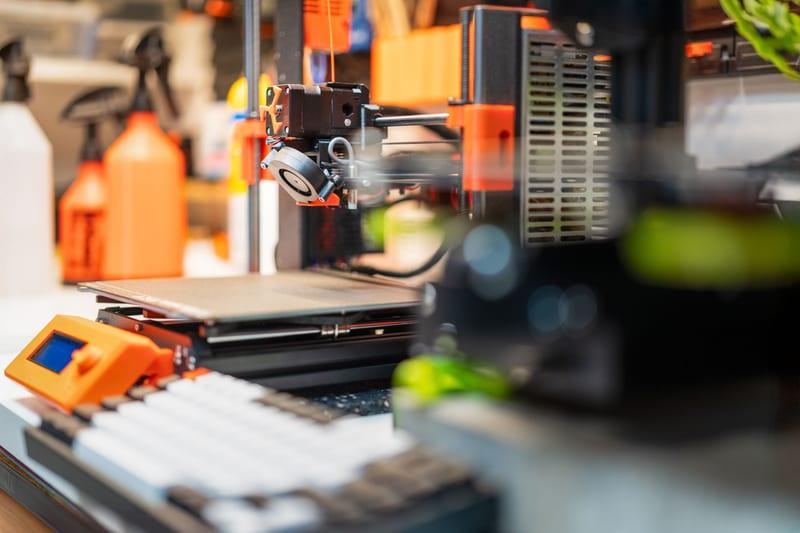
Stock photograph of this product class, not of this specific unit.
#ad We earn a commission · price as of November 20, 2026
2. Best if engineering material is the point
Bambu Lab X2D
A published 65 C active chamber, a 120 C bed, a hardened steel nozzle included and a second nozzle, inside a P2S-sized body. The capability jump is thermal, not dimensional.
MatterHackers lists the X2D at a 256 x 256 x 260 mm main-nozzle build volume and 235.5 x 256 x 256 mm in dual-nozzle mode, a 300 C maximum nozzle in hardened steel with a 0.4 mm nozzle included, a 120 C maximum heatbed, active chamber heating to a 65 C maximum, 1000 mm/s maximum toolhead speed and 20,000 mm/s² acceleration, a 5-inch 1280 x 720 touchscreen, a 1920 x 1080 live-view camera plus a 1600 x 1200 toolhead camera, and a three-stage G3 pre-filter, H12 HEPA and granulated coconut-shell carbon filter stack. Makerpoint's listing agrees on the build volume, nozzle, bed and chamber figures and adds 392 x 406 x 478 mm at 16.25 kg.
Hold that body size against the P1S: 392 x 406 x 478 mm against 389 x 389 x 458 mm. The X2D is a couple of centimeters deeper and taller and 3.3 kg heavier for the same printable cube. It is the same desk footprint class as a P2S, not a step toward the H-series.
The honest caution is the ecosystem. The registry records the X2D as an April 2026 machine and the third-party market has not caught up — the plates, ducts, fans and screens that make a P1S feel bespoke mostly have no X2D version yet. For now you are buying a finished machine rather than a platform.
What it gets right
- Dual nozzle without stepping up to the H2 footprint — two materials on a desk-sized machine
- A reported 65 C heated chamber is a real capability jump over any passive P-series enclosure
- Newest filtration and thermal hardware in the smaller form factor
What it does not
- Released April 2026, so third-party part support is thin compared with the P1S
- Same reported 256 mm build volume as a P1S — this is a capability upgrade, not a size one
- I have not run one. What follows anywhere on this site about the X2D is specification and reasoning, not observation
| Released | April 14, 2026 |
|---|---|
| Type | Enclosed CoreXY, dual nozzle |
| Improvements cited | Air filtration, thermal management and speed |
| Build volume (reported) | 256 mm cube |
| Chamber (reported) | Heated to 65 C |

3. The cheaper half-step
Bambu Lab P2S
The same published 392 x 406 x 478 mm body as the X2D with a 110 C bed and the convenience fixes, without the active chamber or the second nozzle.
This is the machine that quietly answers most P1S-versus-X2D searches. 3DJake lists the P2S at the same 256 mm cube, a 300 C nozzle, a 110 C bed, 392 x 406 x 478 mm and 14.9 kg — the identical body dimensions the X2D publishes — and no active chamber heater.
So the three machines form a ladder with one rung that is not about printing at all: the P1S is the 100 C bed with no screen, the P2S adds bed temperature and convenience, and the X2D adds the chamber and the second nozzle on top of that. P1S vs P2S is the page for the first rung and P2S vs X2D is the page for the second.
If your complaint is the missing touchscreen and the fiddly nozzle change rather than material failure, the P2S is the cheaper version of this decision — and a Panda Touch on the P1S you own is the cheaper version still.
What it gets right
- Quick-swap nozzle turns a 0.4-to-0.6 change from a maintenance task into a between-prints decision
- A real touchscreen on the machine, so you are not opening an app to start a print
- Same footprint and roughly the same build area as the P1S, so your enclosure and shelf still work
What it does not
- If you have never once wished your P1S had a screen, this is not the upgrade you need
- Reported build volume is a 256 mm cube — the same class as the P1S, so it buys you nothing in size
- Your P1S-specific third-party parts may not carry over; check fitment per part, not per brand
| Released | October 9, 2025 |
|---|---|
| Type | Enclosed CoreXY, P1S successor |
| Over the P1S | Touchscreen and quick-swap nozzle |
| Build volume (reported) | 256 mm cube |

4. The cheapest part of the X2D you can buy today
Bambu Lab Hotend with Hardened Steel Nozzle, 0.4 mm
A complete hardened steel hotend assembly that fits the P1S, P1P and X1C. It is the one X2D advantage that transfers to the machine you already own.
MatterHackers lists hardened steel as the X2D's nozzle material with a 0.4 mm nozzle in the box. The Bambu Lab wiki records the P1 series as shipping with a stainless steel hotend and extruder suited to standard non-abrasive filament, with the hardened version sold as an upgrade part. That is a real capability difference and it costs a fraction of a machine to erase.
It matters more than it sounds, because abrasive filament is the single most common reason a P1S owner starts shopping. Carbon-filled, glass-filled, glow-in-the-dark and metal-filled filaments scour a stainless nozzle wider and rounder at the tip, and with the worst of them one print can do measurable damage. Whether you need a hardened nozzle works through which materials actually require it.
Buy this first and ask the upgrade question again afterward. If the answer changes, the machine was never the problem. If carbon-filled nylon is specifically what you are after, the carbon fiber page ranks the machines and names the rest of what the job needs.
What it gets right
- Abrasive filament rounds a stainless nozzle fast — with the worst materials, a single print can do it
- Comes as a complete assembly, so the swap is a module change rather than a nozzle extraction
- 0.4 mm keeps your existing print profiles valid
What it does not
- Hardened steel conducts heat slightly worse than stainless, so very high-flow PLA needs a small temperature bump
- Pointless if you only ever print plain PLA and PETG — stainless lasts for years on those
- P-series and X1 only; the A-series and H-series need their own part
| Nozzle | Hardened steel, 0.4 mm |
|---|---|
| Fits | P1S, P1P, X1C and X1 Carbon (model FAH001-N-1) |
| Hardness reference | Hardened steel is cited at HRA 74 |
| Supplied as | Complete hotend assembly |
Questions people actually ask
Is the Bambu Lab X2D bigger than the P1S?
Barely, and not in a way that matters. MatterHackers lists the X2D at 256 x 256 x 260 mm on the main nozzle - 4 mm more Z than the P1S's published 256 mm cube - and 235.5 x 256 x 256 mm in dual-nozzle mode, which is narrower than a P1S. The machine body is slightly larger at 392 x 406 x 478 mm against 389 x 389 x 458 mm, and 3.3 kg heavier. If you need a bigger bed, neither machine is the answer.
Does the X2D print hotter materials than a P1S?
Not on nozzle temperature. Both are published at a 300 C maximum nozzle, so nothing comes into range on that figure alone. What the X2D publishes above the P1S is a 120 C bed against 100 C and active chamber heating to a 65 C maximum, which is what ABS, ASA and carbon-filled nylon actually struggle with. PPS-CF, at a published 310-340 C nozzle range, is out of reach on both.
Is it worth upgrading from a P1S to an X2D?
Only if your printing is failing in a way the chamber fixes. If tall ABS or ASA parts split and lift, or you want two materials hot in one print, the X2D addresses the cause. If your complaint is a missing touchscreen, a slow nozzle change or abrasive filament wear, those are a Panda Touch, a quick-change hotend and a hardened steel hotend respectively - all of which fit the printer you own for a fraction of a new machine.
Does the X2D come with a hardened steel nozzle?
Yes. MatterHackers lists hardened steel as the X2D's nozzle material with a 0.4 mm nozzle included, and 0.2, 0.6 and 0.8 mm supported. The Bambu Lab wiki records the P1 series as shipping with a stainless steel hotend and extruder, with hardened steel sold as a separate upgrade part. For anyone printing carbon-filled filament that is a genuine difference - and the cheapest way to erase it is to buy the P1S upgrade part.
What is the difference between the X2D and the P2S?
They share a published body size of 392 x 406 x 478 mm and the same 300 C nozzle ceiling. The X2D adds active chamber heating to 65 C, a 120 C bed against the P2S's 110 C, a second nozzle, a published 1000 mm/s maximum toolhead speed and the three-stage filter stack. 3DJake lists no active chamber heater on the P2S. If the chamber is not why you are upgrading, the P2S is the cheaper version of the same step.
Will my P1S accessories fit an X2D?
Mostly no, and this is the X2D's weakest point today. The registry records it as an April 2026 machine, so the plates, ducts, fans, screens and printed accessories that fit a P1S largely have no X2D version yet. AMS units do carry over - MatterHackers states support for up to four AMS 2 Pro and eight AMS HT units with a single hotend, with the AMS hub not compatible.
Should I buy an X2D or keep the P1S and add an AMS?
If the goal is color, add the AMS. An AMS 2 Pro gives a P1S four dried spools and automatic color change, which is the thing most people actually want when they start looking at a newer machine. A second nozzle is for two materials in one print, not for more colors, and no number of nozzles replaces what an AMS does.
Is the P1S discontinued now that the X2D exists?
No. The X2D replaced the X1 series - 3D Printing Industry reports the X1, X1 Carbon and X1E all ceased production on 31 March 2026 - not the P series. The P1S was shown available on backorder at Makerpoint when this page was written, and it remains the machine with the deepest third-party parts support in the range.
Sources
- X2D main-nozzle build volume 256 x 256 x 260 mm against 235.5 x 256 x 256 mm in dual-nozzle mode, 300 C maximum nozzle, hardened steel nozzle material with 0.4 mm included and 0.2, 0.4, 0.6 and 0.8 mm supported, 120 C maximum heatbed, active chamber heating to a 65 C maximum, 1000 mm/s maximum toolhead speed, 20,000 mm/s2 maximum toolhead acceleration, 392 x 406 x 478 mm, 16.25 kg net weight, 5-inch 1280 x 720 touchscreen, a 1920 x 1080 live-view camera and a 1600 x 1200 toolhead camera, G3 pre-filter plus H12 HEPA plus granulated coconut-shell activated carbon filtration, and the stated AMS limits of up to four AMS 2 Pro and eight AMS HT units with the AMS hub not compatible - MatterHackers X2D listing, retrieved 2026-10-31
- X2D build volume 256 x 256 x 260 mm with the dual-nozzle mode given as around 235 x 256 x 256 mm, 300 C maximum nozzle, 120 C maximum build plate, 65 C maximum chamber, machine size 392 x 406 x 478 mm, 16.25 kg net weight, hardened 0.4 mm steel nozzles, textured PEI spring steel plate with automatic bed leveling, 1.75 mm filament and AMS compatibility - Makerpoint X2D listing, retrieved 2026-10-31. The same page showed the machine in stock, which is the availability check behind every X2D buy row in this round
- P1S build volume 256 x 256 x 256 mm, 300 C maximum nozzle, 100 C maximum bed, machine dimensions 389 x 389 x 458 mm and 12.95 kg net weight, shown available on backorder - Makerpoint P1S listing, retrieved 2026-10-31. The same page contradicts itself on chamber heating: its specification table gives a maximum chamber temperature of 0 C while its description copy claims an actively heated chamber to 60 C, so no P1S chamber figure is asserted anywhere in this round
- P2S build volume (256 x 256 x 256 mm), machine dimensions (392 x 406 x 478 mm), net weight 14.9 kg, 300 C nozzle, 110 C bed and the absence of an active chamber heater - 3DJake P2S listing, retrieved 2026-10-11
- The P1 series ships with a stainless steel hotend and extruder suited to standard non-abrasive filament, with the hardened steel nozzle and hotend sold as a separate upgrade part - Bambu Lab wiki, P1S extruder upgrade page
- PPS-CF recommended nozzle temperature range 310-340 C - Bambu Lab PPS-CF product page, retrieved 2026-10-17
- The Bambu Lab X1, X1 Carbon and X1E ceased production on 2026-03-31, with the X2D named as the replacement - 3D Printing Industry, published 2026-04-22, retrieved 2026-10-24
- Feature rows for the AMS units, the hardened hotends and the H-series machines come from this site's product registry, whose spec provenance is documented in content/products.ts - no figure is asserted that a manufacturer or a cited third party did not publish
Read this next
- Bambu Lab P2S vs X2DP2S for workflow, X2D for materials. Both reported at a 256 mm cube, so neither is a size upgrade over a P1S.
- Bambu Lab X1C vs X2DWhat four years changed between the X1C and the X2D, and why the X1C is still a reasonable buy at the right price.
- Upgrading from a P1SThe two reasons to replace a P1S and the four cheaper parts that cover everything else, with the arithmetic laid out.
- Bambu Lab P1S vs P2SThe P2S adds a touchscreen and a quick-swap nozzle and no build volume. When that is worth a new machine and when a far cheaper part does the same job.
- The best Bambu Lab printer for carbon fiberPA6-CF and PAHT-CF are published at 260-290 C with a hardened 0.6 mm nozzle, an enclosed printer and 80 C drying. Which machine clears all three, and the part that matters more than the machine.
- Chamber temperature on a passive enclosureHow passive chamber heating works, the safe ways to raise it, the modifications to avoid, and when an actively heated machine is the real answer.