Upgrades
A1 and A1 mini maintenance
An open-frame bed slinger has a different wear list from an enclosed CoreXY. Most A-series maintenance costs nothing; the parts worth stocking are few and specific.
By Michael W. · Published October 11, 2026
Some links here are Amazon affiliate links, so a purchase may earn this site a commission at no cost to you. It does not change what gets recommended or the order it appears in — how that works.
The short answer
There is no official “A1 maintenance kit” you need to buy. Most A-series maintenance is free: washing the plate with dish soap and hot water, wiping the rods, checking the nozzle wiper, keeping filament dry and re-running calibration after anything mechanical.
Three parts are worth stocking. A spare 0.4 mm hardened hotend in A-series fitment, a spare plate, and extruder gears if and when yours wear. That is the kit.
And the A-series wear list is not the P-series list. No enclosure means no chamber-heat wear and no filter; a travelling bed and open-air filament create their own jobs instead.
Why an A-series wears differently
The enclosed machines and the bed slingers fail in different places, so a maintenance list copied from a P1S page will have you looking after things your printer does not have.
The bed moves, so the bed is the mechanism
On a CoreXY machine the bed sits still and the toolhead moves in two axes. On an A1 or A1 mini the bed travels in Y, which means the Y motion system takes the load of a hot plate and a growing print, repeatedly, for the whole job. Keep the rods clean and keep the machine on something rigid — a flexing desk is a Y-axis problem that looks like a quality problem.
No chamber means no chamber jobs
There are no panels to reseat, no door to replace when it hazes, and no air filter to change. 3DJake lists the A1 mini bed at a maximum of 80 C, which tells you where the material ceiling sits as well: this is a PLA, PETG and TPU machine and its maintenance reflects that.
Filament lives in the open
The AMS Lite has no enclosure at all, so spools are exposed between prints. On an A-series machine filament storage is maintenance, not an accessory. A dryer or sealed boxes do more for reliability here than any mechanical part — wet filament symptoms is the page that explains why, and enclosing an AMS Lite is the fix if your room is humid.
What to keep on the shelf, and what not to
| Item | Why | Stock it? |
|---|---|---|
| Spare 0.4 mm hardened hotend (A-series fitment) | A clog you cannot clear stops the machine | Yes |
| Spare build plate | Plates are consumables and wear out | Yes |
| Extruder gear set | Worn gears cause under-extrusion | Buy when diagnosed |
| Nozzle cleaning needle | Ships with the machine; the first response to a clog | Keep the one you have |
| Dish soap | The correct plate cleaner, and you own it | Already have it |
| Auxiliary cooling fan | An open frame already cools well | Rarely worth it |
| Air filter | The A-series has no enclosure to filter | Not applicable |
| Replacement door panel | There is no door | Not applicable |
The A1 mini is not just a smaller A1
For maintenance purposes the difference that matters is heat. 3DJake lists the A1 mini bed at 80 C maximum against the A1's 100 C, which narrows the material list and with it the wear profile. A mini run on PLA is close to a zero-maintenance machine; the same mini run on filled PLA is not.
The other difference is the spool situation. Both take the AMS Lite, and on a mini the desk problem arrives sooner because the machine is small and the four spools are not. A1 and A1 mini mods covers the rack and riser options, including what to print rather than buy.
The free jobs, in the order that pays
Wash the plate with dish soap and hot water, handle it by the edges afterwards, and never use an abrasive pad or a metal scraper. Keep the Y rods clean and unlubricated unless the manufacturer says otherwise. Check the nozzle wiper is not packed solid. Re-run calibration after any mechanical change, including a plate swap. And keep filament dry, because moisture causes more apparent faults on an open machine than every mechanical cause combined.
Every one of those costs nothing and each removes a failure mode that people routinely buy parts to fix. That is the real answer to “what maintenance kit does an A1 need”: mostly an hour, not a box.
What this page is and is not based on
Fitment, material and stated-benefit rows are registry spec rows whose provenance is documented in content/products.ts. The A1 mini's 80 C bed ceiling and the A1's 100 C come from the 3DJake listings cited on the value page and in Sources. The extruder procedure reference is Bambu Lab's own wiki. No interval, hour count or wear rate is claimed, because none was measured here — how we review says so, and no price appears in this copy.
What to buy
#ad We earn a commission · price as of October 10, 2026
1. The one spare worth owning
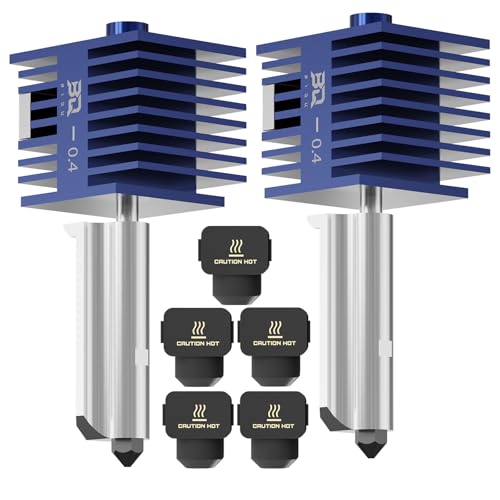
BIQU Panda Juicer SF 0.4 mm Hotend Kit
A 0.4 mm hardened steel hotend listed for the A1 and A1 mini, cheap enough to keep on the shelf. That is the real answer to a clog at an awkward hour.
The single most useful thing in an A-series maintenance box is a second hotend, and the reason is practical rather than technical: a clog you cannot clear stops the machine until a part arrives, and a clog you can swap out stops it for ten minutes.
The registry lists this as a 0.4 mm hardened steel hotend kit for the A1 and A1 mini at standard flow. Hardened steel matters because the stock A-series nozzle is stainless, which abrasive filament rounds off fast — with the worst materials a single print can do it. Standard flow means your existing profiles stay close to right, which is what you want from a spare rather than an experiment.
Two caveats. It is not a speed upgrade, so do not buy it expecting one, and a third-party hotend on a machine under warranty is a decision rather than a free lunch. Hotend replacement is the procedure and do I need a hardened nozzle is the page on which materials force the issue.
What it gets right
- Hardened steel at 0.4 mm covers abrasive filament on the A-series, which the stock stainless nozzle does not
- Cheap enough to keep a spare on the shelf, which is the actual answer to a clog at 2 a.m.
- Standard flow means your existing profiles stay close to right
What it does not
- Standard flow, so it is not a speed upgrade — do not buy it expecting one
- A third-party hotend on a machine under warranty is a decision, not a free lunch
- A-series fitment only; it will not fit a P1S, and the H2 series takes a different Juicer variant
| Nozzle | 0.4 mm hardened steel |
|---|---|
| Fits | Bambu Lab A1 and A1 mini |
| Positioning | Standard flow, for daily printing and maintenance |

#ad We earn a commission · price as of October 10, 2026
2. The repair you will eventually need
BIQU Panda Claw Extruder Gear Set
Nano-coated hardened steel extruder gears listed for the X1, P1 and A1 series. The fix when gears chew filament instead of feeding it.
Extruder gears are the A-series wear item people do not expect, and the symptom is misleading: under-extrusion that looks like a clog, a bad profile, a dirty plate or wet filament. Worn gears slip rather than grip, so less filament arrives than the slicer thinks.
The registry lists these as golden nano-coated hardened steel, fitting the X1, P1 and A1 series, with better grip stated for PLA, PETG, TPU and ABS. The TPU case is the one A1 owners hit first, because the AMS Lite feeds through open air and soft filament needs grip rather than pressure.
Diagnose before buying. Pull the filament and look at the bite marks: a clean set of teeth leaves even indentations, a worn set leaves chewed, shiny flats. Filament not feeding has the full fault tree.
What it gets right
- Extruder gears are a wear item, and a worn set causes under-extrusion that looks like six other faults
- Hardened and coated gears grip TPU better than the stock set, which is the common TPU-slipping complaint
- Fits X1, P1 and A1 — one part number for most of the lineup
What it does not
- This is a repair for a real symptom, not an upgrade to buy preemptively
- An extruder teardown is the most intimidating job on the machine for a first-timer
- If your gears are not worn, new gears will change nothing
| Material | Golden nano-coated hardened steel gears |
|---|---|
| Fits | Bambu X1, P1 and A1 series |
| Materials supported | PLA, PETG, TPU, ABS |
| Stated benefit | Improved grip, fewer jams |

#ad We earn a commission · price as of October 10, 2026
3. The consumable you should stock
BIQU PyroGrip Textured PEI Plate
Textured PEI on the standard mounting system, cited at roughly half the official plate. Plates wear out, and that is not a fault.
A build plate is a maintenance item rather than a fitting, and on an open machine it collects dust and skin oils faster than one behind a door. The first response to failing adhesion is always a wash with dish soap and hot water — not isopropyl alcohol, which smears oil around rather than lifting it off.
When a wash stops working, the PEI surface is worn and the plate needs replacing. The registry records this plate as textured PEI on the same mounting system as the official one at a cited price position of roughly half, which is what makes replacing a worn plate an ordinary decision rather than a grudging one.
Re-check Z offset after a swap. Third-party PEI varies in thickness and coating more than one brand's own line does. Why prints do not stick runs through the free fixes first.
What it gets right
- Same surface technology and mounting as the official plate at a much lower price point
- Makes keeping two or three plates on the shelf a reasonable decision rather than an expensive one
- No adapter, no modification — it drops onto the magnetic bed you already have
What it does not
- PEI thickness and coating consistency vary more between third-party plates than within one brand's official line
- Expect to re-tune Z offset when you swap brands mid-queue
- Not a performance upgrade over the official plate — a price one
| Surface | Textured PEI |
|---|---|
| Mounting | Same mounting system as the official plate |
| Price positioning (cited) | Roughly half the official plate |
Questions people actually ask
Is there an official Bambu Lab A1 maintenance kit?
There is no single box you have to buy. The things an A1 actually needs are a spare 0.4 mm hardened hotend in A-series fitment, a spare build plate, and an extruder gear set if and when yours wear - plus the free jobs, which matter more: washing the plate with dish soap and hot water, keeping the Y rods clean, checking the nozzle wiper and keeping filament dry.
What maintenance does an A1 mini need that an A1 does not?
Less, mostly, because of heat. 3DJake lists the A1 mini bed at 80 C maximum against the A1's 100 C, which narrows the material list and with it the wear. The mini's practical problem is space rather than wear: it is a small machine and an AMS Lite with four spools is not small.
Do I need a hardened nozzle on an A1?
Yes, as soon as abrasive filament is involved - carbon-filled, glass-filled, glow-in-the-dark or marble PLA all wear a stainless nozzle quickly, and with the worst materials a single print can round one off. Buy the hardened hotend listed for the A1 and A1 mini specifically; P-series and H-series hotends are different parts.
How often should I replace an A1 nozzle?
There is no honest hour figure, because it depends entirely on what you print - a machine running carbon-filled filament wears a nozzle in a fraction of the time a PLA machine does. Watch for the symptoms instead: inconsistent extrusion, a wider-than-expected first layer, and detail that has gone soft at settings that used to work.
Does an A1 need an air filter or door replacement like a P1S?
No - it is open-frame, so there is no chamber to filter and no door to haze. Those are enclosed-machine maintenance items. What the open frame creates instead is a filament-storage job, because spools sit exposed and the AMS Lite has no enclosure at all.
What causes under-extrusion on an A1?
Four common causes in order: wet filament, a partially blocked nozzle, worn extruder gears slipping instead of gripping, and a flow calibration that no longer matches the hotend fitted. Check them in that order, because the first two are free to rule out and the third is the most intimidating to fix.
Sources
- Bambu Lab P1S extruder upgrade and service procedure - Bambu Lab wiki, retrieved 2026-10-11
- BIQU Panda range overview - build plates, hotends, fans, extruder parts and AMS accessories, and which Bambu Lab models each is listed for - OpenELAB, retrieved 2026-10-11
- Every fitment list, material and stated-benefit row below is a registry spec row; provenance for each is documented in content/products.ts. Nothing here was measured by this site
Read this next
- Maintenance that actually mattersThe five maintenance jobs that change print quality, in priority order, plus the consumables worth stocking before you need them.
- A1 and A1 mini mods worth doingA-series mods ordered by the problem each solves, why P-series parts do not fit, and the two problems specific to an open machine.
- Spare parts worth having before you need themWhich spares to stock before a failure and which to order after, judged by how long the machine sits idle waiting.
- Replacing a Bambu Lab hotendHow the complete-assembly hotend format works, the replacement procedure, what the silicone sock does, and the fitment rule to check first.
- How long a nozzle lasts, and how to tell when it is doneThe difference between a worn nozzle and a clogged one, what actually wears a nozzle, and when to replace rather than clean.
- AMS not loading filamentThe four real causes of an AMS feed failure in diagnostic order, three of which cost nothing and take minutes.