Enclosures
The best enclosure for a Bambu Lab A1
The A1 and A1 mini are open-frame machines, and a box around one is a genuinely good purchase. Just buy it for the right reasons: a fireproof shell, less noise, less dust - and a modest warmth gain, not a new material list.
By Michael W. · Published November 22, 2026
Some links here are Amazon affiliate links, so a purchase may earn this site a commission at no cost to you. It does not change what gets recommended or the order it appears in — how that works.
Quick picks
Tap any row to jump to the full write-up. Prices are read from Amazon and dated; stock is always whatever the listing says.
| # | Product | Best for | Price |
|---|---|---|---|
| 1 |  FYSETC Fireproof Foldable 3D Printer Enclosure A foldable fireproof fabric box with listed A1 fitment and no frame to build - the right purchase for a machine that runs unattended overnight. | Best overall enclosure for an A1 Giving an open-frame A1 a warm, dust-free, quieter box for the least money | |
| 2 |  Creality Fireproof 3D Printer Enclosure A larger fabric enclosure at 480 x 600 x 720 mm with a built-in fan interface - big enough to swallow a printer and a four-spool unit together. | Budget pick, and the one to buy if an AMS Lite shares the box A larger fabric enclosure when the printer plus an AMS has to fit inside together | $48.99 · View on Amazon #ad We earn a commission · price as of November 23, 2026 |
| 3 | 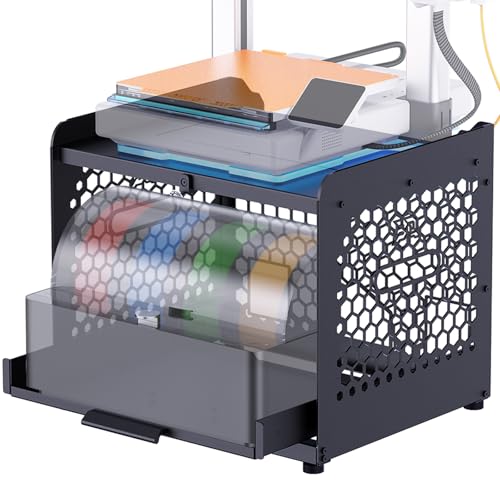 BIQU Panda Stack An aluminum multi-layer rack for the A1 and A1 mini - where the spools and the AMS Lite go once the printer is inside a box. | Best for the problem an A1 enclosure creates Getting an A1's spools, AMS Lite and accessories off the desk and onto a frame | $159.99 · View on Amazon #ad We earn a commission · price as of November 23, 2026 |
| 4 |  Bambu Lab P1S The enclosed CoreXY machine the A1 upgrade path ends at - a real enclosure, an auxiliary fan and an air filter, with a published 100 C bed. | Best if you keep hitting the enclosure's limits The machine most people reading this site already own, and the one most of them should keep |
Buy the FYSETC fireproof foldable enclosure. It is the one on this page whose listing explicitly fits a Bambu Lab A1, it needs no frame assembly, it folds flat between jobs, and its fireproof shell is the single best reason to put a box around a machine you leave running overnight. If your A1 has an AMS Lite on it, buy the larger Creality fabric enclosure instead — at 480 x 600 x 720 mm it swallows a printer and a four-spool unit together, and it is also the budget pick, the cheapest enclosure here at the last price check.
But be clear about what an A1 enclosure is for: safety, quiet, dust and a modest warmth gain. It is not a route to ABS. Bambu publishes 90-100 C for ABS and ASA on the bed, and the A1 mini's published maximum bed temperature is 80 C - a gap no box closes. The A1 itself publishes 100 C, which puts it exactly at the edge rather than clear of it.
What an A1 enclosure actually buys you
Four things, in the order they are worth paying for. Getting this order wrong is the reason people feel let down by a box that is working exactly as designed.
1. A fireproof shell - the real reason
An A1 is a machine people run unattended on a desk, in a bedroom, overnight. A flame-retardant fabric shell does not make a printer safe, but it is a cheap layer between an unlikely failure and the room. Both enclosures here carry a fireproof claim and both are on the page partly because of it.
2. Dust and interference
Dust on an open frame ends up in the feed path and on the plate. Children, pets and sleeves end up in the gantry. A box with a clear window removes both without removing your ability to watch a first layer.
3. Noise - reduced, not removed
Worth setting expectations precisely. An enclosure dampens; it does not soundproof. The A1 mini is already the quietest machine in the lineup specifically because there is no enclosure resonating around it, which is a neat illustration of how small the effect is in both directions. The measures that actually work are on noise reduction.
4. A warmer chamber - modestly
A closed box holds the heat the bed and motors are already producing. That narrows the temperature gradient across a tall part and does genuinely reduce warping on PETG and on the edge cases of PLA. It does not create heat. What a passive enclosure measures in practice is on enclosure temperature.
The limit, stated honestly
Here is the sentence a lot of A1 owners need before they spend anything. An enclosure cannot raise the bed ceiling, and on the A-series the bed ceiling is what rules ABS out.
| Machine | Published bed ceiling | ABS and ASA need 90-100 C | With a fabric enclosure |
|---|---|---|---|
| A1 mini | 80 C | Below the range | Still below the range - the box changes nothing about this |
| A1 | 100 C | At the top of the range | Possible with care; the chamber is passive, so the room matters |
| P1S | 100 C | At the top of the range | Already enclosed, with an auxiliary fan and a filter |
So if ABS or ASA is the goal, the honest sequence is: check the bed ceiling first, then the chamber, then the plate. How to print ABS has the full sequence, ABS shrinkage explains why the chamber matters more than the bed, and the ABS plate page covers the surface. What an A-series machine can print, with and without a box, is on A1 filament compatibility.
Fitment: measure before you buy
Fabric enclosures are sold by internal volume rather than by printer, and only one of the two here lists an A1 by name. The published figures to work from: the FYSETC box is 23.9 x 21.7 x 22 in with listed A1 fitment; the Creality box is 480 x 600 x 720 mm with a compatibility list written for Creality Ender machines. Against those, the A1 is 465 x 410 x 430 mm and the A1 mini 347 x 315 x 365 mm, so both machines clear both boxes on the printer alone — the question is always the spools.
Two measurements people forget. First, the AMS Lite rides above the printer, so your real height is the machine plus the unit plus a loaded spool. Second, you need clearance to open the door and to reach the plate, which an exact-fit box does not give you. Every per-machine external dimension this site holds is on printer dimensions.
The options, side by side
| Option | Type | Size | Holds an AMS Lite? | Buy it for |
|---|---|---|---|---|
| FYSETC fireproof foldable | Foldable fabric, no frame | 23.9 x 21.7 x 22 in | No - sized for the printer | The A1-fitment box that folds away |
| Creality fireproof enclosure | Fabric with frame, fan interface | 480 x 600 x 720 mm | Yes | Printer plus four spools in one box |
| BIQU Panda Stack | Aluminum multi-layer rack | A1 and A1 mini fitment | Holds it outside the box | Where the spools go instead |
| Bambu Lab P1S | Enclosed CoreXY printer | 256 mm cube build volume | Takes an AMS, not an AMS Lite | When the box was never going to be enough |
Who should buy what
You have a bare A1 or A1 mini on a desk. The FYSETC box. Fireproof, folds flat, lists your machine.
You have an A1 Combo with the AMS Lite fitted. The larger Creality enclosure, after measuring your stack height against its internal dimensions.
Your desk is the actual problem. The vertical rack first, the box second. It is organization and it says so, but it is the purchase that makes the other one fit.
You want to print ABS or ASA. Buy neither box. Read upgrading from an A1; on an A1 mini the published 80 C bed ceiling settles it.
You want silence. Buy neither box, at least not for that. An enclosure dampens; it does not soundproof.
What this page is and is not based on
The FYSETC enclosure dimensions, foldable construction, listed A1 fitment and fireproof, water-resistant, window and carry-handle claims are the vendor's own listing claims held in this site's registry and are labeled as claims. The Creality enclosure's 480 x 600 x 720 mm size, frame, fan interface and its fireproof, dustproof and temperature-regulation claims are from the cited review. The BIQU Panda Stack material and fitment are the vendor's published figures. The A1 and A1 mini build volumes and bed ceilings, and the P1S nozzle and bed ceilings, are the cited retailer listings retrieved 11 October 2026. The 90-100 C ABS and ASA bed range is Bambu's published figure for the textured PEI plate, retrieved 6 October 2026. No enclosure on this page has been fitted, measured or temperature-logged by this site, and no noise reduction figure is claimed. See how we review.
Every pick in full
1. Best overall enclosure for an A1
FYSETC Fireproof Foldable 3D Printer Enclosure
A foldable fireproof fabric box with listed A1 fitment and no frame to build - the right purchase for a machine that runs unattended overnight.
This is the enclosure to buy for an A1, and the reason is fitment plus the one claim that actually matters on an open-frame machine. The listing is explicit that it fits the Bambu Lab A1, it measures 23.9 x 21.7 x 22 in, it is foldable fabric with no frame assembly, and the cited claims include fireproof and water-resistant construction, a clear window and a top carry handle.
Take the fireproof claim seriously, because it is the strongest argument for enclosing an A-series printer at all. These are machines people leave running overnight on a desk in a room they sleep near, and a flame-retardant shell is the kind of upgrade nobody regrets buying. The clear window keeps the useful part of an open frame — you can still check a first layer without opening anything. And because it folds flat, it stores between jobs in a way an acrylic box never will, which is the quiet reason a fabric enclosure survives contact with a real desk.
Honest cons, stated plainly. It reduces noise; it does not soundproof — expect a difference, not silence. It is fabric with no active heating, so it holds whatever warmth the bed and motors produce and nothing more. And it is sized for the printer, so an A1 with an AMS Lite bolted on top is a different shopping problem — see the next pick.
What it gets right
- A fireproof shell on a machine that runs unattended overnight is the kind of upgrade you do not regret
- No frame to build — it folds flat, so it stores between jobs in a way an acrylic box never will
- The clear window means you can still check a first layer without opening it
What it does not
- It reduces noise; it does not soundproof. Expect a difference, not silence
- Fabric and no active heat will never give you a 60 C chamber — this is not an ABS solution
- Sized and sold for the A1; check the internal dimensions before trusting it to fit an A1 plus an AMS lite
| Type | Foldable fabric enclosure — no frame assembly required |
|---|---|
| Size | 23.9 x 21.7 x 22 in |
| Fits | Bambu Lab A1 |
| Claims cited | Fireproof, water-resistant, clear window, top carry handle |
#ad We earn a commission · price as of November 23, 2026
2. Budget pick, and the one to buy if an AMS Lite shares the box
Creality Fireproof 3D Printer Enclosure
A larger fabric enclosure at 480 x 600 x 720 mm with a built-in fan interface - big enough to swallow a printer and a four-spool unit together.
The cheapest enclosure on this page at the last price check, and the one that solves the problem the purpose-shaped boxes do not. At 480 x 600 x 720 mm it is large enough to hold a printer and a four-spool unit together, which is exactly the configuration most A1 owners who bought the Combo are actually trying to enclose. It is a fabric enclosure with a frame, and it has a built-in fan interface (the fan is not included), so venting is a fitting job rather than a modification.
The cited claims are fireproof, dustproof and constant temperature regulation, with better bed adhesion at high temperature and reduced warping among the stated benefits. Treat the last two as vendor claims rather than measurements — this site has measured neither — but the direction is right: a closed box narrows the temperature gradient across a tall part.
Honest cons, and one needs care. Large enclosures trap heat around electronics as well as around the print, so leave the vents alone and do not seal it up in pursuit of a warmer chamber. The published compatibility list is written for Creality Ender machines, so measure your own printer against those internal dimensions before you buy. And a passive tent cannot replace an actively heated chamber for ASA, no matter how large it is.
What it gets right
- At 480 x 600 x 720 mm it is large enough to swallow a printer and a four-spool unit, which the printer-shaped boxes cannot
- Same flame-retardant safety argument as any good fabric enclosure
- A fan interface is built in, so venting is a fitting job rather than a modification
What it does not
- Large enclosures trap heat around electronics as well as around the print — leave the vents alone
- The compatibility list is written for Creality Ender machines; measure your own printer against the internal dimensions
- A passive tent cannot replace an actively heated chamber for ASA
| Type | Fabric enclosure with frame, fan interface (fan not included) |
|---|---|
| Size | 480 x 600 x 720 mm |
| Claims cited | Fireproof, dustproof, constant temperature regulation |
| Stated benefits | Better bed adhesion at high temperature, reduced warping |
#ad We earn a commission · price as of November 23, 2026
3. Best for the problem an A1 enclosure creates
BIQU Panda Stack
An aluminum multi-layer rack for the A1 and A1 mini - where the spools and the AMS Lite go once the printer is inside a box.
Enclose an A1 and you immediately meet a problem the enclosure did not cause and does not fix: the AMS Lite sits in open air by design, with four spools above the machine, and that is precisely the volume a printer-shaped box wants to occupy. Something has to move.
This is the registry's answer: an aluminum alloy multi-layer rack with listed fitment for the A1 and A1 mini, which supports a dual AMS setup. Vertical is the only direction left on a desk that already has a printer in a box on it, and aluminum matters here because four loaded spools will flex a printed frame over time. If you bought the Combo and then bought an enclosure, this is the third purchase you were always going to make.
Honest cons, and they are blunt. This is pure organization and will not improve a single print. It is A1 and A1 mini only. And a printed riser costs you filament and an evening instead of money — printed against bought is the page that argues when to print one instead.
What it gets right
- An A1 with AMS Lite takes over a desk; a vertical rack is the only real fix
- Aluminum alloy, so it does not flex under four loaded spools the way a printed frame does
- Supports a dual setup, which is where the desk problem becomes genuinely unmanageable
What it does not
- Pure organization — it will not improve a single print
- A1 and A1 mini only
- A printed riser costs you filament and an evening instead of money
| Type | Aluminum alloy multi-layer rack |
|---|---|
| Fits | Bambu Lab A1 and A1 mini |
| Supports | Dual AMS and ViViD setup |
4. Best if you keep hitting the enclosure's limits
Bambu Lab P1S
The enclosed CoreXY machine the A1 upgrade path ends at - a real enclosure, an auxiliary fan and an air filter, with a published 100 C bed.
Stated here because an enclosure roundup that never says “buy a different printer” is being dishonest about the ceiling. If the reason you are shopping for a box is ABS and ASA, a box around an A-series machine is not going to get you there, and the P1S is where that path actually leads: a real enclosure plus an auxiliary cooling fan and an air filter, with a published 256 mm cube, a 300 C nozzle and a 100 C bed that clears the 90-100 C range Bambu publishes for ABS and ASA.
It is also the best-supported machine in the range for third-party upgrades, which is worth something on a site about upgrades. The decision from the A-series side is laid out on upgrading from an A1, and the direct comparison is on A1 against P1S.
Honest cons. It is many times the price of either enclosure above, so if your real problem is noise, dust or a cat, buy the box. The P1S has no touchscreen as shipped. Its chamber is passive too — it holds heat rather than making it — so it is a better enclosure, not an actively heated one. And a nozzle change on it is a hotend job.
What it gets right
- The enclosure plus auxiliary fan is what makes ABS and ASA realistic rather than aspirational
- Still the best-supported machine in the range for third-party upgrades — screens, hotends, plates, ducts
- Fast enough that the P2S's speed gain is not the reason to replace it
What it does not
- No touchscreen as shipped, which is why the Panda Touch exists
- No quick-swap nozzle: a nozzle change is a hotend job, not a 30-second one
- Passive chamber only — it holds heat, it does not make heat
| Released | July 13, 2023 |
|---|---|
| Type | Enclosed CoreXY |
| Over the P1P | Enclosure, auxiliary cooling fan and air filter |
| Multi-color | AMS and AMS 2 Pro (4 spools, expandable) |
Questions people actually ask
What is the best enclosure for a Bambu Lab A1?
The FYSETC fireproof foldable enclosure, because its listing explicitly fits the A1, it needs no frame assembly, it folds flat for storage and its fireproof shell is the strongest argument for enclosing a machine that runs unattended. If your A1 has an AMS Lite fitted, the larger Creality fabric enclosure at 480 x 600 x 720 mm is the one that holds both.
Will an enclosure let my A1 print ABS?
No, and this is the most important thing to know before buying one. ABS and ASA need 90-100 C on the bed per Bambu's published table. The A1 mini's published maximum bed temperature is 80 C, which is below the range, and the A1's 100 C sits exactly at its top edge. An enclosure cannot raise a bed ceiling.
Does an A1 enclosure make the printer quieter?
It reduces noise rather than removing it - expect a difference, not silence. Worth noting that the A1 mini is already the quietest machine in the Bambu lineup precisely because there is no enclosure resonating around it, which tells you how modest the effect is in both directions.
Will an AMS Lite fit inside an A1 enclosure?
Not in a box sized for the printer. The AMS Lite rides above the machine with four spools in open air, so your real height is the printer plus the unit plus a loaded spool. The larger fabric enclosure here, at 480 x 600 x 720 mm, is sized to hold a printer and a four-spool unit together; the alternative is moving the spools onto a vertical rack outside the box.
Is a fabric enclosure or an acrylic one better for an A1?
Fabric, for most desks. It folds flat so it stores between jobs, it is lighter to move, and the fireproof versions carry a safety argument an acrylic box does not. The trade is that fabric gives you less structure and no mounting points, and it holds heat rather than sealing it.
Does enclosing an A1 cause any problems?
One, and it is worth planning for: humidity. A box that holds warmth also slows air movement around four spools of filament sitting in open air on the AMS Lite, and a warm still space is not a dry one. If you enclose an A1 Combo, budget for a dryer rather than hoping the enclosure helps.
Should I just buy a P1S instead of an enclosure for my A1?
Only if your reason for wanting a box is ABS or ASA, because a box around an A-series machine will not get you there. If the reason is noise, dust, pets or children, the enclosure solves all of those for a tiny fraction of the price of a new printer, and the A-series is the quieter machine to start with.
Can I build my own A1 enclosure instead?
Yes, and it is a well-trodden route - the A1's open frame makes it one of the easier machines to box in. The honest comparison is that a bought fireproof fabric enclosure costs little, needs no assembly and carries a flame-retardant claim your own panels will not, so the DIY case is strongest when you need an unusual size or already have the materials.
Sources
- FYSETC Fireproof Foldable 3D Printer Enclosure: foldable fabric construction with no frame assembly, 23.9 x 21.7 x 22 in, listed fitment for the Bambu Lab A1, with fireproof, water-resistant, clear window and top carry handle among the cited claims - Amazon listing, read via this site's registry (content/products.ts)
- Creality fireproof 3D printer enclosure: 480 x 600 x 720 mm fabric enclosure with frame and a built-in fan interface (fan not included), with fireproof, dustproof and constant temperature regulation among the cited claims, and better bed adhesion at high temperature and reduced warping among the stated benefits - Creality enclosure review, 3DPrinterly
- Bambu Lab A1 enclosure options including Clearview Plastics and DIY - All3DP
- A1 build volume (256 x 256 x 256 mm), 100 C bed and 300 C nozzle - 3DJake A1 listing, retrieved 2026-10-11
- A1 mini build volume (180 x 180 x 180 mm) and 80 C maximum bed temperature - 3DJake A1 mini listing, retrieved 2026-10-11
- Bambu Textured PEI Plate recommended heatbed temperatures per material: PLA 45-60 C, PETG 60-80 C, ABS and ASA 90-100 C, TPU 35-45 C - official Bambu Lab store product page, retrieved 2026-10-06
- Enclosure types, internal and external dimensions, fitment lists and the vendors' own cited claims come from this site's product registry, whose spec provenance is documented in content/products.ts - a vendor claim is labeled as a claim, and no figure is asserted that a manufacturer or a cited third party did not publish
- Every price shown on a buy button on this page is the live Amazon figure for that listing, refreshed daily and stamped with the date it was checked; a listing with no buyable offer at the last check renders "Check price on Amazon". No price is typed into this copy - see lib/prices.ts
Read this next
- The best Bambu Lab enclosuresOne pick per reason - ABS capability, noise, dust, or fixing a hazy P1S door - because a box that is good at one is mediocre at the others.
- Enclosures for the A1 and A1 miniFabric, purpose-built and DIY enclosure options for an A1, what each realistically delivers, and the measurement people get wrong.
- Building your own enclosureHow to build a working enclosure cheaply, the ventilation rule that is not optional, and the three mistakes that make DIY worse than nothing.
- Bambu Lab printer dimensions, and sizing a space for oneP1S 389 x 389 x 458 mm, P2S 392 x 406 x 478 mm, A1 465 x 410 x 430 mm, A1 mini 347 x 315 x 365 mm - plus the clearances an enclosure and an AMS add.
- The AMS Lite enclosure problemWhy the AMS Lite's open-air design costs you prints in a humid room, and the three fixes ranked by what they actually cost.
- Upgrading from an A1 or A1 miniThe A1's one real limit, the two routes past it, and why a bigger open-frame machine is the wrong direction.