Filament Drying
What the A1 and A1 mini can actually print
The nozzle is not the limit on an A-series machine. The missing enclosure is, and the A1 mini's 80 C bed narrows it further.
By Michael W. · Published October 17, 2026
Some links here are Amazon affiliate links, so a purchase may earn this site a commission at no cost to you. It does not change what gets recommended or the order it appears in — how that works.
The short answer
PLA, PETG and TPU are what an A-series machine is for. 3DJake lists both the A1 and A1 mini at a 300 C nozzle, which covers every one of them with headroom. These are also the materials an open frame cools best.
ABS and ASA are the real limit, and the reason is the missing enclosure. Neither machine has one. Warping on tall parts is a chamber problem, not a nozzle problem, and no slicer profile fixes a cold open chamber.
The A1 mini is narrower than the A1. 3DJake lists the A1 mini's maximum bed temperature at 80 C against the A1's 100 C. That 20 C gap closes off materials that want a hot bed, and it also limits bed-based drying.
Material by material
| Material | On an A1 / A1 mini | What decides it |
|---|---|---|
| PLA and PLA variants | Yes, and it is the machine's best material | Open frame cools PLA better than an enclosure does |
| PETG | Yes | Wants cooling, which suits an open frame. Published dryer setting 65 C / 8 h |
| TPU | Yes, slowly | Published dryer setting 70 C / 8 h, and the listing calls it highly humidity-sensitive |
| ABS / ASA | Not properly | No enclosure. Published oven drying is 80 C / 8 h, but drying is not the limit here — the chamber is |
| PLA-CF, PETG-CF, wood, marble, glow | Yes, with a hardened nozzle | Abrasion, not temperature. The A-series takes its own hardened hotend |
| PA6-CF | Not realistically | Published nozzle range 260-300 C is at the machine's 300 C ceiling, and it wants an enclosure and hot bed the A-series lacks |
| PC | No | Published heatbed drying setting alone is 100 C / 12 h, above the A1 mini's 80 C bed, and it warps badly without a chamber |
| PPS-CF | No | Published nozzle range is 310-340 C. Both machines are listed at a 300 C nozzle |
Why the open frame is the actual limit
It is worth being precise, because “no enclosure” sounds like a comfort feature. What an enclosure does is keep the air around a part at a stable, elevated temperature while it is being built. Materials with high thermal contraction — ABS and ASA above all — shrink as each layer cools, and if the bottom of a part cools faster than the top is being added, the part pulls itself off the plate or splits along a layer line.
That is a chamber problem. A hotter nozzle does not fix it, a stickier plate delays it, and a slower print makes it worse by giving each layer more time to cool. 3DJake lists the A1 at a 100 C bed and the A1 mini at 80 C, which helps the first few layers and does nothing for a part 80 mm tall.
Why your prints keep warping covers the mechanism, and how to print ABS is the technique page for when you do have a chamber.
Where the A1 and the A1 mini differ
They are usually treated as one machine in two sizes, and for materials they are not quite that. 3DJake lists the A1 at 256 x 256 x 256 mm with a 100 C bed and 300 C nozzle, and the A1 mini at 180 x 180 x 180 mm with an 80 C maximum bed.
The 80 C bed is the consequential difference. It is below Bambu's published heatbed drying figures for everything above TPU, it is below what warm-bed materials ask for, and it means the A1 mini is a PLA and PETG machine in a way the A1 is slightly less of. The smaller build volume matters less than people expect; the bed ceiling matters more.
The abrasion question, separately
Filled filaments fail on the A-series for a different reason from ABS, and the two get confused. Carbon-filled, glass-filled, wood, marble and glow-in-the-dark filaments all contain hard particles that wear a brass or stainless nozzle from the inside out. That is independent of temperature and independent of the enclosure.
The answer is a hardened nozzle, and the fitment is machine-specific: the A-series takes its own hotend rather than a P-series part. Glow-in-the-dark is the one that catches people — it is abrasive, and it does not look like it should be. Hardened steel versus stainless covers why, and how long a nozzle lasts tells you when yours is done.
The AMS Lite footnote that affects everything
If you run an AMS Lite, add moisture to the materials question. The registry describes the unit as open-air with zero moisture protection, filament exposed between prints, and no sealed chamber — and notes directly that PETG, TPU and nylon all need a separate dryer as a result.
Since PETG and TPU are the A-series' best non-PLA materials, that is a central fact rather than a footnote. Bambu's published dryer settings for them are 65 C and 70 C for 8 hours, both within a basic unit's range. Which AMS works with an A1 mini covers the setup, and how to tell if your filament is wet is how you confirm it is the problem.
What this page is and is not based on
A1 and A1 mini build volumes, device dimensions, net weights, nozzle temperatures and bed ceilings come from the 3DJake A1 and A1 mini listings retrieved 11 October 2026. Published drying settings come from the Bambu Lab filament guide and the Bambu Lab TPU 95A HF product page, and the PA6-CF 260-300 C and PPS-CF 310-340 C nozzle ranges from the listings cited below, all retrieved 17 October 2026. Hardened-nozzle fitment, AMS Lite behavior and enclosure positioning are registry spec rows whose provenance is documented in content/products.ts. The reasoning about thermal contraction and chamber temperature is mechanism rather than measurement — nothing here was printed and compared on a bench, and how we review says so. Any material with no published figure in a source we fetched is named as such rather than estimated.
What to buy
1. What you need before any filled filament
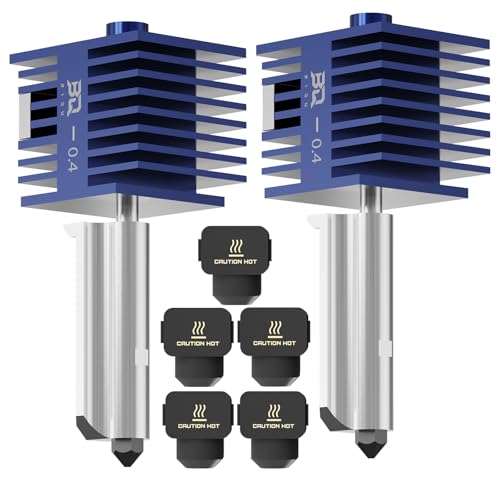
BIQU Panda Juicer SF 0.4 mm Hotend Kit
A 0.4 mm hardened steel hotend kit listed for the A1 and A1 mini at standard flow. Abrasive filament rounds a stainless nozzle off fast, and nothing else fits these machines.
The first real limit on an A-series machine is not temperature, it is abrasion. Any filled filament — carbon fibre, glass fibre, glow-in-the-dark, marble, wood — wears a stainless nozzle, and with the worst materials a single print can do it.
The registry lists this kit as 0.4 mm hardened steel at standard flow for the A1 and A1 mini. Standard flow is the right choice for a replacement rather than an upgrade: your existing profiles stay close to correct, so you are solving one problem rather than starting a calibration project.
Note the fitment carefully. The A-series takes its own hotend, and a P1S part is not a substitute no matter how similar it looks. Do I need a hardened nozzle for this filament answers it material by material, and A1 and A1 mini maintenance covers the rest of the A-series spares list.
What it gets right
- Hardened steel at 0.4 mm covers abrasive filament on the A-series, which the stock stainless nozzle does not
- Cheap enough to keep a spare on the shelf, which is the actual answer to a clog at 2 a.m.
- Standard flow means your existing profiles stay close to right
What it does not
- Standard flow, so it is not a speed upgrade — do not buy it expecting one
- A third-party hotend on a machine under warranty is a decision, not a free lunch
- A-series fitment only; it will not fit a P1S, and the H2 series takes a different Juicer variant
| Nozzle | 0.4 mm hardened steel |
|---|---|
| Fits | Bambu Lab A1 and A1 mini |
| Positioning | Standard flow, for daily printing and maintenance |

2. What changes the list
FYSETC Fireproof Foldable 3D Printer Enclosure
A fireproof foldable enclosure for an open-frame A1 - warmer, dust-free and quieter. It widens what the machine can do without touching the printer.
Because the open frame is what limits the A-series, an enclosure is the only purchase that genuinely extends the materials list. The registry positions this one as giving an open-frame A1 a warm, dust-free, quieter box for the least money.
What it actually buys is draft elimination. A tall part cooling unevenly because room air crosses it is the commonest cause of warping on an open machine, and a box removes that variable regardless of how warm it gets.
Be realistic about the ceiling. A fabric tent helps with dust, drafts and noise; it does not give you a chamber that makes ABS easy. Enclosures for the A1 and A1 mini compares the options and chamber temperature covers how far a passive enclosure gets.
What it gets right
- A fireproof shell on a machine that runs unattended overnight is the kind of upgrade you do not regret
- No frame to build — it folds flat, so it stores between jobs in a way an acrylic box never will
- The clear window means you can still check a first layer without opening it
What it does not
- It reduces noise; it does not soundproof. Expect a difference, not silence
- Fabric and no active heat will never give you a 60 C chamber — this is not an ABS solution
- Sized and sold for the A1; check the internal dimensions before trusting it to fit an A1 plus an AMS lite
| Type | Foldable fabric enclosure — no frame assembly required |
|---|---|
| Size | 23.9 x 21.7 x 22 in |
| Fits | Bambu Lab A1 |
| Claims cited | Fireproof, water-resistant, clear window, top carry handle |

3. What an AMS Lite makes necessary
SUNLU FilaDryer S2
The cheapest dryer worth owning if you just need PETG and TPU to behave - which on an open-air A-series setup is most of what goes wrong.
The A-series materials list has a hidden entry: moisture. The registry records the AMS Lite as open-air with zero moisture protection and filament exposed between prints, and explicitly notes that PETG, TPU and nylon all need a separate dryer on that setup.
PETG and TPU are exactly the two materials the A-series is best at, so this is not an edge case. Bambu's own published figures put PETG HF at 65 C and TPU 95A HF at 70 C for 8 hours in a dryer, both well inside what a basic unit does.
The registry positions this as the cheapest dryer worth owning for precisely that pair. The dryer roundup covers the rest of the range.
What it gets right
- 35-70 C covers PLA, PETG and TPU, which is most of what actually goes wet in a hobby workshop
- Quiet enough to run overnight in a room you sleep in
- The cheapest entry point that is still a real dryer rather than a warm box
What it does not
- 70 C ceiling means nylon, PC and PA-CF are out of range
- One spool at a time, which does not fit a four-color job
- No printing from the unit, so a dried spool starts re-absorbing the moment it comes out
| Temperature range (cited) | 35-70 C |
|---|---|
| Capacity | One spool |
| Diameters | Supports all common filament diameters |
| Noted | Quiet enough for overnight drying |
Questions people actually ask
What filament can a Bambu Lab A1 print?
PLA and its variants, PETG and TPU comfortably - 3DJake lists both the A1 and A1 mini at a 300 C nozzle, which covers all of them with headroom. Filled filaments like PLA-CF, wood, marble and glow-in-the-dark also work but need a hardened nozzle. ABS and ASA are the real limit, because neither machine has an enclosure.
What filaments can the A1 not print?
PPS-CF is a hard no - its published nozzle range is 310-340 C and both machines are listed at a 300 C nozzle. PC is effectively out too: its published heatbed drying setting alone is 100 C, above the A1 mini's 80 C bed, and it warps badly without a chamber. ABS, ASA and PA6-CF are technically within the nozzle range but fight the open frame to the point of not being worth it.
Can an A1 mini print the same filaments as an A1?
Mostly, with one real difference: 3DJake lists the A1 mini's maximum bed temperature at 80 C against the A1's 100 C. That 20 C closes off materials that want a hot bed and puts the A1 mini below Bambu's published heatbed drying figures for everything above TPU. The smaller build volume matters less than the bed ceiling does.
Can the A1 print ABS?
Not properly, and the reason is the missing enclosure rather than any temperature limit. ABS contracts as it cools, so if the bottom of a tall part cools faster than the top is being added, it lifts off the plate or splits along a layer line. That is a chamber problem - a hotter nozzle does not fix it and a slower print makes it worse. An enclosure is the only purchase that changes the answer.
Do I need a hardened nozzle for an A1?
If any of your filament is filled, yes - carbon fibre, glass fibre, wood, marble and glow-in-the-dark all contain hard particles that wear a stainless nozzle from the inside out, and with the worst materials a single print can do it. Glow-in-the-dark is the one that surprises people. Note the fitment: the A-series takes its own hotend, and a P1S part is not a substitute.
Does an enclosure let an A1 print more materials?
It widens the list, but set expectations correctly. A fabric enclosure blocks drafts, holds some heat, cuts dust and reduces noise, and draft elimination alone fixes a lot of warping on an open machine. What it does not give you is an actively heated chamber, so ABS becomes workable rather than effortless.
Sources
- A1 build volume (256 x 256 x 256 mm), device dimensions (465 x 410 x 430 mm), net weight 8.3 kg, 100 C bed and 300 C nozzle - 3DJake A1 listing, retrieved 2026-10-11
- A1 mini build volume (180 x 180 x 180 mm), device dimensions (347 x 315 x 365 mm), net weight 5.5 kg and 80 C maximum bed temperature - 3DJake A1 mini listing, retrieved 2026-10-11
- Published drying settings reproduced verbatim: PLA Basic blast drying oven 50 C / 8 h, AMS 2 Pro and AMS HT 55 C / 8 h, X1 series heatbed 60-70 C / 12 h; PLA Wood oven 55 C / 8 h, heatbed 65-75 C / 12 h; PETG HF oven 65 C / 8 h, X1 heatbed 75-85 C / 12 h; ABS and ASA oven 80 C / 8 h, X1 heatbed 90-100 C / 12 h; PA6-CF oven 80 C / 8-12 h, X1 heatbed 90-100 C / 12 h; PC oven 80 C / 8 h, heatbed 100 C / 12 h - Bambu Lab filament guide, retrieved 2026-10-17
- TPU 95A HF drying settings - blast drying oven 70 C / 8 h and X1 series heatbed 80-90 C / 12 h - and the note that the material is highly sensitive to humidity - Bambu Lab TPU 95A HF product page, retrieved 2026-10-17
- PA6-CF nozzle temperature range 260-300 C - Bambu Lab PA6-CF listing, retrieved 2026-10-17
- PPS-CF recommended nozzle temperature range 310-340 C - Bambu Lab PPS-CF product page, retrieved 2026-10-17
- Dryer capabilities, hotend fitment and AMS behavior rows come from this site's product registry, whose spec provenance is documented in content/products.ts - no figure is asserted that a manufacturer or a cited third party did not publish
Read this next
- Which filaments your Bambu Lab can actually printA per-machine compatibility table, the three things that actually gate material choice, and which of them you can buy your way past.
- What a P1S can and cannot printPA6-CF fits at 260-300 C against the P1S's 300 C ceiling. PPS-CF needs 310-340 C and does not. PPA-CF is listed for the P1S with an enclosure and a hardened nozzle.
- Enclosures for the A1 and A1 miniFabric, purpose-built and DIY enclosure options for an A1, what each realistically delivers, and the measurement people get wrong.
- Do I need a hardened nozzle for this filament?The one rule that answers this for every filament, plus a per-material table covering PETG, ABS, CF, silk, wood, marble and glow.
- Which AMS works with an A1 miniThe AMS Lite is the only AMS that fits an A1 mini. Open air means no moisture protection, so the real budget is the unit plus a dryer plus somewhere to put it.
- A1 and A1 mini maintenanceA-series wear parts differ from the P-series: a different hotend, an exposed bed, open-air filament. Three parts worth stocking, and the free jobs that matter more.