Filament Drying
What a P1S can and cannot print
Two published numbers decide almost every case: a 300 C nozzle and a 100 C bed. Here is what fits inside them, what needs a part, and the one material that is simply out of reach.
By Michael W. · Published October 17, 2026
Some links here are Amazon affiliate links, so a purchase may earn this site a commission at no cost to you. It does not change what gets recommended or the order it appears in — how that works.
The short answer
Two published numbers answer most of these questions. Makerpoint lists the P1S at a 300 C nozzle and a 100 C bed. Compare a material's own published printing range to those two figures and the answer stops being a guess.
PA6-CF fits; PPS-CF does not. The cited PA6-CF listing gives a nozzle range of 260-300 C, which reaches the P1S ceiling exactly. The PPS-CF page gives 310-340 C, which is above it. PPA-CF is explicitly listed as compatible with the P1S, X1C and X1E, needing an enclosure and a hardened steel nozzle.
Yes, the P1S prints ABS, ASA, PC, nylon and carbon-filled material — with a hardened nozzle and dry filament. The enclosure is what makes the warping materials viable, and the hardened hotend is what survives the filled ones. Neither is optional.
Material by material, against the published ceilings
| Material | On a P1S | The deciding figure |
|---|---|---|
| PLA and variants | Yes | Well inside both ceilings |
| PETG | Yes | Inside both ceilings. Published dryer setting 65 C / 8 h |
| TPU | Yes, slowly | Published dryer setting 70 C / 8 h; the listing calls it highly humidity-sensitive |
| ABS | Yes — this is what the enclosure is for | Published oven drying 80 C / 8 h; the chamber is the enabling factor |
| ASA | Yes, same as ABS | Published oven drying 80 C / 8 h |
| PC | Yes, with dry filament and good adhesion | Published oven drying 80 C / 8 h, heatbed 100 C / 12 h |
| PA6-CF / nylon | Yes, with a hardened nozzle | Published nozzle range 260-300 C, exactly at the P1S's 300 C ceiling |
| PLA-CF, PETG-CF, glow, marble, wood | Yes, with a hardened nozzle | Abrasion, not temperature |
| PPA-CF | Yes — the listing names the P1S | Stated to need an enclosure and a hardened steel nozzle |
| PPS-CF | No | Published nozzle range 310-340 C, above the P1S's listed 300 C |
| PEEK | No listed Bambu Lab filament, and out of reach regardless | No source we fetched publishes a Bambu PEEK figure; the relevant limit is the P1S's 300 C nozzle |
The nozzle ceiling is the hard wall
Of the two published P1S figures, the 300 C nozzle is the one that produces absolute answers. A material whose manufacturer specifies 310-340 C cannot be printed on a machine whose nozzle is listed at 300 C — that is not a tuning problem or a profile tweak, it is arithmetic. PPS-CF is the clean example.
PA6-CF is the interesting case, because its published 260-300 C range reaches the ceiling exactly. In practice that means you are printing at the top of the machine's range with no headroom, which is workable and unforgiving: a slightly cold hotend, a slightly high flow rate or a marginal hotend connection all show up faster at the limit than in the middle of a range. Nozzle temperature malfunction is the page for when that goes wrong.
The enclosure is the reason most of this works
Everything on the list above that an A-series machine cannot do, the P1S can do because it has a box. The mechanism is contraction: a material that shrinks as it cools needs the air around the part to stay warm, or the lower layers cool and pull while the upper ones are still being added.
It is a passive enclosure, not a heated chamber, so the ceiling is real. Tall ABS parts still want a chamber soak before the print starts, and large flat parts still warp more than small ones. Chamber temperature covers what a passive enclosure actually reaches, ABS shrinkage covers printing to size, and ABS versus ASA covers which of the two to pick.
Moisture is the limit people miss
Most “can the P1S print X” failures are not capability failures. Nylon, PC and the carbon-filled materials all absorb water from room air, and wet engineering filament prints with popping, internal voids and weak layer bonding before anything obvious appears on the surface.
Bambu publishes drying settings for all of them: 80 C for 8 to 12 hours in a blast drying oven for PA6-CF, and 80 C for 8 hours for PC, ABS and ASA. Those are above what a standard-temperature dryer delivers, which is why the engineering shelf wants its own unit. Drying filament in an oven has the full published table, and drying in the printer covers the heatbed route and what the P1S bed can reach.
What to buy, in order
If you are moving a P1S onto engineering materials, the sequence that avoids wasted money is hardened hotend, then drying, then plate. The hotend is a hard requirement for filled filament and a cited requirement for PPA-CF. Drying is what makes the result usable. The plate is what stops a long print letting go at hour six.
Everything beyond that is optimisation. P1S mods worth doing covers the rest, and what the A1 and A1 mini can print is the sibling page if you also run an open-frame machine.
What this page is and is not based on
P1S build volume, machine dimensions, net weight, nozzle temperature (300 C) and bed temperature (100 C) come from the Makerpoint P1S listing retrieved 11 October 2026. The PA6-CF nozzle range of 260-300 C, the PPS-CF range of 310-340 C, and the PPA-CF statement that it is compatible with the P1S, X1C and X1E requiring an enclosure and a hardened steel nozzle come from the listings cited below, retrieved 17 October 2026, as do all published drying settings. Hotend and plate fitment are registry spec rows whose provenance is documented in content/products.ts. No figure is given for PEEK because no source we fetched published one. Nothing on this page was printed and measured here; there is no test lab and how we review says so.
What to buy

1. Required before any filled filament
Bambu Lab Hotend with Hardened Steel Nozzle, 0.4 mm
A complete hotend assembly with a hardened steel nozzle cited at HRA 74, for the P1S, P1P and X1C. The P1S does not ship with one and most engineering filament needs it.
This is the gating purchase for the interesting half of the P1S's materials list. Every filled filament — carbon fibre, glass fibre, and the decorative ones people forget about like glow-in-the-dark and marble — contains hard particles that wear a stainless nozzle from the inside out.
The registry lists this as a complete hotend assembly with a hardened steel nozzle cited at HRA 74, for the P1S, P1P, X1C and X1 Carbon. Buying the assembly rather than a bare nozzle is why fitting it is a module swap instead of a soldering job.
It is also a hard requirement rather than an improvement for some materials: the cited PPA-CF listing names a hardened steel nozzle alongside an enclosure as what the material needs on a P1S. The Bambu Lab hardened steel nozzle is the detail page.
What it gets right
- Abrasive filament rounds a stainless nozzle fast — with the worst materials, a single print can do it
- Comes as a complete assembly, so the swap is a module change rather than a nozzle extraction
- 0.4 mm keeps your existing print profiles valid
What it does not
- Hardened steel conducts heat slightly worse than stainless, so very high-flow PLA needs a small temperature bump
- Pointless if you only ever print plain PLA and PETG — stainless lasts for years on those
- P-series and X1 only; the A-series and H-series need their own part
| Nozzle | Hardened steel, 0.4 mm |
|---|---|
| Fits | P1S, P1P, X1C and X1 Carbon (model FAH001-N-1) |
| Hardness reference | Hardened steel is cited at HRA 74 |
| Supplied as | Complete hotend assembly |

#ad We earn a commission · price as of November 20, 2026
2. For chopped-fibre filament that clogs
Bambu Lab 0.6 mm High Flow Induction Hotend
A 0.6 mm high-flow induction hotend, positioned for carbon-fibre filament that clogs a 0.4 mm nozzle on chopped fibre. Diameter is the fix, not temperature.
The second failure mode with engineering filament on a P1S is not wear, it is blockage. Chopped carbon fibre comes in lengths, and a fibre longer than the orifice is a clog waiting for the moment it arrives at the nozzle. More heat does not help; a bigger hole does.
The registry lists this as a 0.6 mm high-flow induction hotend positioned for exactly that problem. If you have run PA6-CF or PETG-CF through a 0.4 mm nozzle and had mid-print blockages you could not explain, this is the explanation.
The cost is detail: 0.6 mm is a throughput nozzle and the wrong choice for fine features. The best nozzle for carbon fiber filament is the full comparison, the carbon fiber machine ranking sets out all four published requirements those filaments bring, and nozzle sizes explained covers what each diameter changes.
What it gets right
- The larger bore is the real fix for carbon-fiber clogging, not just a faster nozzle
- Hardened steel plus 0.6 mm is the combination for chopped-fiber filament
- Noticeably faster on functional parts where layer lines do not matter
What it does not
- H2-series only — this is not the part for a P1S or an X1C, whatever the nozzle size you want
- Every profile has to be re-sliced; a 0.6 mm nozzle is not a drop-in for 0.4 mm settings
- Visible layer lines and softer detail on anything decorative
| Nozzle | Hardened steel, 0.6 mm |
|---|---|
| Fits | Bambu Lab H2 series (listing states H2C) |
| Type | High-flow induction hotend, genuine replacement part |
3. What engineering filament needs before it prints
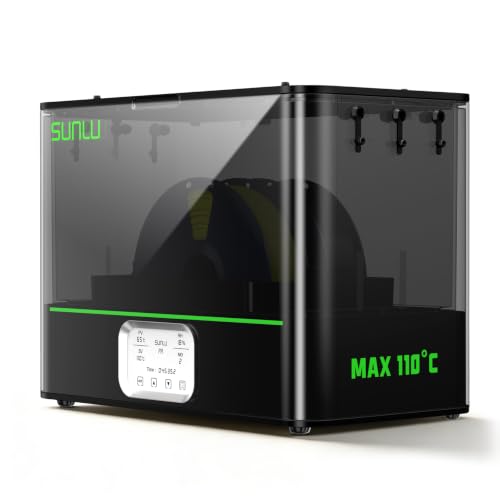
SUNLU E2 FilaDryer
Built for PA6-CF, PA12-CF, PC, ABS and ASA, with annealing. These are the materials whose published oven drying setting is 80 C - above a standard dryer.
On a P1S the hardware ceiling is often not what stops an engineering filament — moisture is. Nylon in particular absorbs water from room air fast enough that a spool can be unusable within a day of opening, and it prints with popping, voids and weak layers long before anything looks obviously wrong.
Bambu's published drying settings put PA6-CF at 80 C for 8 to 12 hours and PC, ABS and ASA at 80 C for 8 hours. The registry positions this unit for exactly that set — PA6-CF, PA12-CF, PC, ABS and ASA — with a cited temperature range, a 500 W PTC heater and an annealing function.
For PLA and PETG it is more unit than you need. The best filament dryer for nylon and PA6-CF is the page for this end of the shelf.
What it gets right
- 110 C is the first number on this page that is genuinely enough for nylon and PC
- A 500 W PTC heater gets to temperature fast instead of creeping there over an hour
- Doubles as an annealing oven, which is a second real use rather than a marketing bullet
What it does not
- Overkill and over-priced if PLA and PETG are all you print
- A 500 W heater is not a quiet, low-draw appliance
- Annealing shrinks and distorts parts — it is a technique to learn, not a button to press
| Temperature range (cited) | 35-110 C |
|---|---|
| Heater (cited) | 500 W PTC |
| Second function | Annealing as well as drying |
| Materials cited | PA6-CF, PA12-CF, PC, ABS, ASA |
Stock photograph of this product class, not of this specific unit.
#ad We earn a commission · price as of November 20, 2026
4. The plate the hard materials need
Bambu Lab Textured PEI Plate
Powder-coated textured PEI on a 0.5 mm steel base, stated to resist warping on large models in ABS, PC and nylon. Adhesion is where engineering prints fail first.
The P1S can reach the temperatures ABS and nylon want. Holding the part down for eight hours while it tries to contract is the separate problem, and it is where these prints actually fail.
The registry lists this plate as powder-coated textured PEI on a 0.5 mm stainless steel base with enhanced magnetic adhesion, stated to resist warping on large models in ABS, PC and nylon. The 0.5 mm base matters because a thin plate lifts at the corners under a hot bed, which is the same failure by a different route.
Two honest cautions from the registry: the texture transfers to the first layer, so it is the wrong plate for a cosmetic underside, and TPU can grip hard enough to tear the surface on removal. The build plate roundup compares the options, and textured PEI plate temperature by material has the published settings.
What it gets right
- Powder-coated texture grips hard without glue stick and releases when cool, which is the whole job
- The 0.5 mm steel base is stiff enough that it does not lift at the corners under a hot bed
- Hides first-layer imperfections, so a slightly off Z offset is forgiving rather than a failure
What it does not
- The texture transfers to your first layer — wrong plate for anything whose bottom face is a show surface
- PEI surfaces are consumable; skin oils and over-aggressive scraping both shorten their life
- TPU can grip hard enough on textured PEI to tear the surface on removal
| Surface | Powder-coated textured PEI |
|---|---|
| Base | 0.5 mm stainless steel with enhanced magnetic adhesion |
| Stated strength | Resists warping on large models in ABS, PC and nylon |
Questions people actually ask
Can the P1S print nylon?
Yes, with a hardened nozzle and properly dried filament. The cited PA6-CF listing gives a nozzle temperature range of 260-300 C and Makerpoint lists the P1S nozzle at 300 C, so it fits - at the very top of the machine's range with no headroom. Dry it first: Bambu publishes 80 C for 8 to 12 hours in a blast drying oven for PA6-CF.
Can the P1S print PPS-CF?
No. The Bambu Lab PPS-CF page gives a recommended nozzle temperature range of 310-340 C, and Makerpoint lists the P1S nozzle at 300 C. That is arithmetic rather than a tuning problem - there is no profile that makes a 300 C hotend reach 310 C.
Can the P1S print PC?
Yes, with dry filament and good bed adhesion. The published drying settings alone tell you how much moisture matters: 80 C for 8 hours in a blast drying oven, or 100 C for 12 hours on a heatbed. The enclosure is what makes the warping manageable, and a stiff textured PEI plate - stated to resist warping on large models in ABS, PC and nylon - is what holds the part down.
Can the P1S print carbon fiber filament?
Yes, with a hardened nozzle - that part is not optional, because chopped fibre wears a stainless nozzle from the inside out. If you get unexplained mid-print blockages, the fix is diameter rather than temperature: a 0.6 mm high-flow hotend is positioned specifically for carbon-fibre filament that clogs a 0.4 mm nozzle on chopped fibre.
Can the P1S print PEEK?
No, and this page will not give you a temperature for it, because no source we fetched publishes a Bambu Lab PEEK filament or a processing figure for one. What is published is the P1S ceiling: a 300 C nozzle. High-temperature engineering polymers of that class are outside what this machine was built for.
Can the P1S print PPA-CF?
Yes - the 3D Universe PPA-CF listing names the P1S, X1C and X1E as compatible, requiring only an enclosure and a hardened steel nozzle. The P1S has the enclosure; the hardened nozzle is the purchase. Dry it before printing, as with every engineering filament.
Can the P1S print ABS and ASA?
Yes, and the enclosure is exactly what it is for. It is a passive enclosure rather than a heated chamber, so the ceiling is real: tall parts still want a chamber soak before the print starts, and large flat parts warp more than small ones. Dry the filament too - Bambu publishes 80 C for 8 hours in a blast drying oven for both.
Sources
- P1S build volume (256 x 256 x 256 mm), machine dimensions (389 x 389 x 458 mm), net weight 12.95 kg, 300 C nozzle and 100 C bed - Makerpoint P1S listing, retrieved 2026-10-11
- PA6-CF nozzle temperature range 260-300 C - Bambu Lab PA6-CF listing, retrieved 2026-10-17
- PPS-CF recommended nozzle temperature range 310-340 C - Bambu Lab PPS-CF product page, retrieved 2026-10-17
- PPA-CF stated printer compatibility (P1S, X1C and X1E) and its requirement for an enclosure and a hardened steel nozzle - 3D Universe Bambu Lab PPA-CF listing, retrieved 2026-10-17
- Published drying settings reproduced verbatim: PLA Basic blast drying oven 50 C / 8 h, AMS 2 Pro and AMS HT 55 C / 8 h, X1 series heatbed 60-70 C / 12 h; PLA Wood oven 55 C / 8 h, heatbed 65-75 C / 12 h; PETG HF oven 65 C / 8 h, X1 heatbed 75-85 C / 12 h; ABS and ASA oven 80 C / 8 h, X1 heatbed 90-100 C / 12 h; PA6-CF oven 80 C / 8-12 h, X1 heatbed 90-100 C / 12 h; PC oven 80 C / 8 h, heatbed 100 C / 12 h - Bambu Lab filament guide, retrieved 2026-10-17
- TPU 95A HF drying settings - blast drying oven 70 C / 8 h and X1 series heatbed 80-90 C / 12 h - and the note that the material is highly sensitive to humidity - Bambu Lab TPU 95A HF product page, retrieved 2026-10-17
- Dryer capabilities, hotend fitment and AMS behavior rows come from this site's product registry, whose spec provenance is documented in content/products.ts - no figure is asserted that a manufacturer or a cited third party did not publish
Read this next
- Which filaments your Bambu Lab can actually printA per-machine compatibility table, the three things that actually gate material choice, and which of them you can buy your way past.
- What the A1 and A1 mini can actually printPLA, PETG and TPU are the A-series' home ground. ABS and ASA fight the open frame, and the A1 mini's 80 C bed closes off more than the A1's 100 C one.
- Do I need a hardened nozzle for this filament?The one rule that answers this for every filament, plus a per-material table covering PETG, ABS, CF, silk, wood, marble and glow.
- How to print ABS on a Bambu Lab printerThe four real causes of ABS failure in order, the warm-up step most people skip, and the cooling setting that works against you.
- How to dry filament in an ovenBambu's published oven settings run 50 C for PLA to 80 C for ABS, ASA, PA6-CF and PC - but they specify a forced-air oven, which a kitchen oven is not.
- P1S mods worth doingP1S modifications ordered by the problem each solves, with the popular ones that change nothing clearly marked.