Printers
Bambu Lab P1S vs Elegoo Centauri Carbon
The cheaper machine has the hotter nozzle. That is the uncomfortable fact this comparison starts from, and it matters less than the thing the spec sheet cannot show you.
By Michael W. · Published October 18, 2026
Some links here are Amazon affiliate links, so a purchase may earn this site a commission at no cost to you. It does not change what gets recommended or the order it appears in — how that works.
The verdict
Keep the P1S if you own one, and buy it if you want the ecosystem. The AMS, the third-party parts shelf and the already-debugged profiles are the product. None of them shows up on a specification sheet and all of them save you time every week.
Buy the Centauri Carbon if you need above 300 C. 3DJake lists the Centauri Carbon 2 at a 350 C hardened steel nozzle against the P1S's 300 C, and that difference reaches materials the Bambu cannot — PPS-CF's published range is 310-340 C.
Build volume is not a reason either way. Both are 256 x 256 x 256 mm. If you came hoping one prints bigger parts, neither does.
Side by side
| Bambu Lab P1S | Centauri Carbon | Centauri Carbon 2 | |
|---|---|---|---|
| Build volume | 256 x 256 x 256 mm | 256 x 256 x 256 mm | 256 x 256 x 256 mm |
| Nozzle ceiling | 300 C | 320 C | 350 C, hardened steel |
| Bed ceiling | 100 C | 110 C | 110 C |
| Motion | Enclosed CoreXY | Fully enclosed CoreXY | Fully enclosed CoreXY |
| Top speed | Not published by a source we fetched | 500 mm/s | 500 mm/s |
| Acceleration | Not published by a source we fetched | 20,000 mm/s² | 20,000 mm/s² |
| Chamber control | Passive enclosure | Passive enclosure | Automated louvre vents, by material |
| Filtration | Ships with an air filter | Not published by a source we fetched | HEPA plus activated carbon |
| Screen | No touchscreen | 4.3-inch | 5-inch |
| Rated noise | Not published by a source we fetched | 50 dB | 45 dB |
| Multi-material | AMS and AMS 2 Pro fit it | Combo variant sold | Combo variant sold |
| Third-party parts | Deep — a whole market | Thin | Thin |
The nozzle ceiling is the one real capability gap
Of everything in that table, one row changes what you can physically make. A material whose manufacturer specifies a nozzle range above your machine's ceiling is not a tuning problem, it is arithmetic — and PPS-CF is the clean example. Its published recommended range is 310-340 C. A P1S listed at 300 C cannot print it. A Centauri Carbon 2 at 350 C can.
Be careful how much weight that carries, though. PPS-CF is a specialist material most people never buy, and the materials a Bambu owner actually prints — PLA, PETG, TPU, ABS, ASA, and PA6-CF at its published 260-300 C — all sit inside the P1S's range already. The 350 C nozzle is a real door, and most people never walk through it.
The bed difference reads similarly. 110 C against 100 C is a genuine margin on tall ABS and ASA parts, where adhesion fights contraction for hours. It is an improvement in how reliably a difficult print succeeds rather than a new set of achievable materials. ABS shrinkage covers that fight, and what a P1S can and cannot print has the full material list against both published ceilings.
What the specification sheet cannot show you
The AMS has no equivalent in your Bambu workflow
Both brands sell a multi-material variant, so on paper this is a tie. In practice it is not, for one reason: if you own a P1S, the AMS 2 Pro bolts onto it. You keep the printer, the profiles and the plates, and you gain four spools and active drying. Switching brands for color means buying a whole second machine and learning a second system.
The parts shelf is the site you are reading
The P-series has a third-party ecosystem that an Elegoo does not. Hardened hotends, quick change hotends, plates in several surfaces, auxiliary cooling, touchscreens, extruder gears, printhead ducts. The registry's own Elegoo entry says the honest thing: nothing from your Bambu shelf transfers. The upgrades roundup is the scale of what you would be walking away from, and P1S mods worth doing is the short list that matters.
Profiles are other people’s debugging time
The least glamorous advantage and possibly the largest. When a filament misbehaves on a P1S, somebody has already posted the fix. On a newer, smaller-installed-base machine you are closer to the front of that queue. That is hours per month, invisible on every spec sheet ever printed.
Where the Elegoo genuinely wins beyond temperature
Two things, and both are worth naming because the ecosystem argument can be used to wave away real engineering.
The first is the louvre system on the Carbon 2. A fixed enclosure is a compromise: good for ABS, actively unhelpful for fast PLA, which wants cooling. 3DJake describes vents that open or close according to the material, which addresses a trade every P1S owner works around by opening the door. A passive box cannot do that, and the registry says plainly that a P1S enclosure holds heat rather than making or managing it.
The second is the screen. The P1S has no touchscreen, which is the single most common P1S complaint on this site and the reason a third-party screen is a popular purchase. Both Elegoo generations ship with one. That is a quality-of-life gap the Bambu closes only by buying a part or buying a P2S.
Who should actually switch
Three cases, stated narrowly on purpose.
You print above 300 C. If PPS-CF or a similar material is on your list, there is no P1S answer and this is a capability purchase.
You want a second enclosed machine and the first one is staying. A second 256 mm cube, in a different ecosystem, with a higher ceiling, running jobs the P1S cannot — that is additive and the ecosystem objection largely evaporates.
You print single-material and single-color, and value the screen and the filtration. If the AMS was never going to be bought, its absence costs you nothing.
Everybody else is better served by spending the difference on the machine they own. An AMS and a hardened hotend between them address more real complaints than twenty degrees of nozzle ceiling. Upgrading from a P1S lays out the in-family rungs, and Bambu Lab upgrade kits covers what bolts onto a P1S today. If you want the whole cross-brand shortlist in one place, including the availability check that keeps this machine off it, Bambu Lab alternatives is that page.
What this page is and is not based on
P1S build volume, machine dimensions, net weight, nozzle ceiling (300 C) and bed ceiling (100 C) come from the Makerpoint P1S listing retrieved 11 October 2026. The Elegoo figures — both build volumes, the 320 C and 350 C nozzle ceilings, the 110 C beds, the enclosure construction, 500 mm/s and 20,000 mm/s², the louvre system, the HEPA plus activated carbon filtration, the screen sizes and the 50 dB and 45 dB noise ratings — come from the 3DJake Centauri Carbon and Centauri Carbon 2 listings and the generation comparison cited below, all retrieved 18 October 2026. The PPS-CF 310-340 C range is from the Bambu Lab PPS-CF product page. AMS behavior and third-party fitment are registry spec rows whose provenance is documented in content/products.ts. I have not run a Centauri Carbon of either generation and have not run these machines side by side: there is no test lab behind this site, no print-time stopwatch and no sound meter, which is why every number above carries a source and the rows nobody published are left empty. See how we review. No price appears in prose.
The two machines, side by side

1. Best for almost everyone reading this
Bambu Lab P1S
Lower published ceilings than the Elegoo and a far deeper ecosystem - AMS, third-party parts, proven profiles. The ecosystem is the product.
Start with the honest version: on paper the P1S loses this comparison. Makerpoint lists it at a 256 x 256 x 256 mm build volume, a 300 C nozzle and a 100 C bed. The Centauri Carbon matches the build volume and beats both temperatures. If you buy on specification alone, stop reading and buy the Elegoo.
What the P1S actually sells is everything around the machine. Four-spool color with active drying that bolts onto the printer you own. A third-party parts market deep enough that this site has a whole hub about it. Slicer profiles that thousands of people have already debugged for the exact filament you are about to load. None of that appears in a specification table and all of it is why most P1S owners should keep theirs.
The honest cost is the nozzle ceiling, and it is a hard wall rather than a soft one. At 300 C the P1S cannot reach PPS-CF's published 310-340 C range at all. What a P1S can and cannot print works through that material by material, and P1S versus P2S is the in-family upgrade if the machine itself is your complaint.
What it gets right
- The enclosure plus auxiliary fan is what makes ABS and ASA realistic rather than aspirational
- Still the best-supported machine in the range for third-party upgrades — screens, hotends, plates, ducts
- Fast enough that the P2S's speed gain is not the reason to replace it
What it does not
- No touchscreen as shipped, which is why the Panda Touch exists
- No quick-swap nozzle: a nozzle change is a hotend job, not a 30-second one
- Passive chamber only — it holds heat, it does not make heat
| Released | July 13, 2023 |
|---|---|
| Type | Enclosed CoreXY |
| Over the P1P | Enclosure, auxiliary cooling fan and air filter |
| Multi-color | AMS and AMS 2 Pro (4 spools, expandable) |
Stock photograph of this product class, not of this specific unit.
#ad We earn a commission · price as of November 20, 2026
2. Best as a second machine, for hotter materials
Elegoo Centauri Carbon 2
A 350 C hardened steel nozzle and a 110 C bed at the same 256 mm cube, in a fully enclosed CoreXY with HEPA plus activated carbon filtration.
This is a genuinely strong machine and pretending otherwise would be dishonest. 3DJake lists the Centauri Carbon 2 at a 256 x 256 x 256 mm build volume with a 350 C hardened steel nozzle, a 110 C maximum bed, 500 mm/s top speed and 20,000 mm/s² acceleration, HEPA plus activated carbon filtration, a 5-inch screen and fully automatic calibration.
The 350 C nozzle is the headline and it is a real capability rather than a number. It reaches into PPS-CF's published 310-340 C range, which a 300 C machine cannot touch. The louvre system is the more interesting engineering: 3DJake describes vents that open or close depending on the material, so the chamber runs cool for PLA and stays closed for engineering filament — which is the trade a fixed enclosure forces you to pick once and live with.
What you give up is the part this site exists to document. No AMS fits it. No BIQU Panda part fits it. Your Bambu plates, hotends, screens and ducts do not fit it. As a second machine beside a P1S that is irrelevant; as a replacement for one it is the whole decision. Bambu Lab versus the Creality K2 is the other cross-brand comparison at a much larger size, and Bambu Lab versus FlashForge covers the cheaper four-color machines and the four-toolhead Creator 5.
What it gets right
- A 350 C hardened steel nozzle out of the box clears material ranges a 300 C machine cannot reach at all
- Same 256 mm cube as a P1S, so it slots into an existing workflow rather than replacing it
- HEPA plus activated carbon filtration and a louvre system that adapts the chamber to the material
What it does not
- Different slicer, different profiles and a separate ecosystem — nothing from your Bambu shelf transfers
- Third-party upgrade support is a fraction of what exists for the P-series
- I have not run one; everything on this site about it is published specification and reasoning, not observation
| Build volume | 256 x 256 x 256 mm |
|---|---|
| Type | Fully enclosed CoreXY |
| Nozzle | Hardened steel, to 350 C |
| Bed | To 110 C |
| Speed / acceleration | 500 mm/s, 20,000 mm/s2 |
| Chamber | Automated louvre system that opens or closes vents by material |
| Filtration | HEPA plus activated carbon |
| Screen | 5-inch |
| Rated noise | 45 dB |
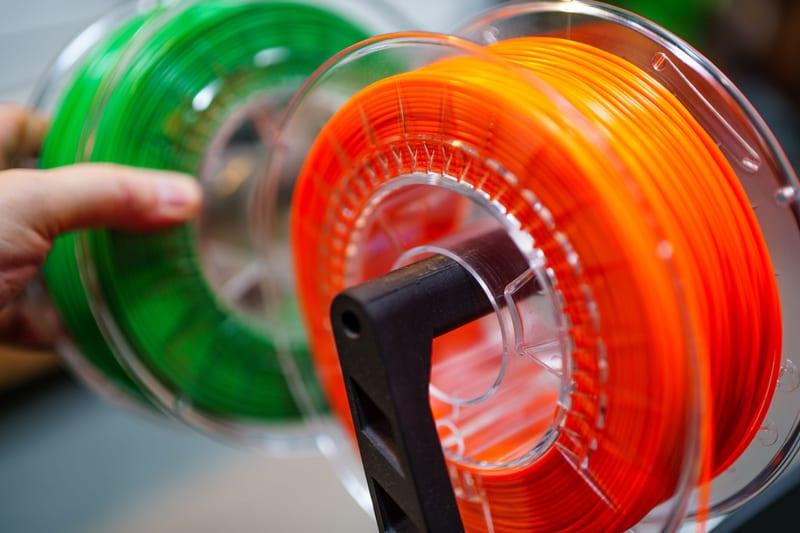
Stock photograph of this product class, not of this specific unit.
#ad We earn a commission · price as of November 20, 2026
3. The part that settles it
Bambu Lab AMS 2 Pro
Four spools with active drying on the P1S you already own. This is the capability the Elegoo comparison usually ignores, and it is the reason most people stay.
Most people arriving at this comparison are not choosing a first printer. They own a P1S, they have seen the Elegoo's specification, and they are wondering whether they bought wrong. The AMS is the answer to that question.
The registry lists the AMS 2 Pro as a four-spool automatic material system whose headline feature is active filament drying, inheriting humidity monitoring and RFID logging from the original AMS, and calls it the single best upgrade for a P1S or X1C owner tempted by a new machine. Four colors plus a solved drying problem on hardware you already have is a different kind of value from twenty extra degrees at the nozzle.
Costs, stated plainly: four-color printing wastes filament on every tool change and the purge tower is real and not small, and it needs space beside or above the printer. AMS 2 Pro compatibility and the filament buffer covers which printers take it and which kit variant to order.
What it gets right
- Active drying means the spool you print from is the spool you dried — no transfer step, no re-absorption window
- Four colors on a machine you already own, for a fraction of a new printer
- RFID logging removes the single most common cause of a ruined multi-color print: the wrong material profile
What it does not
- Four-color printing wastes filament on every tool change; the purge tower is real and it is not small
- If you only print single-color PLA, you are buying a dryer with a filament changer attached
- Needs the space beside or above the printer that your shelf may not have
| Type | Four-spool automatic material system |
|---|---|
| Headline feature | Active filament drying |
| Inherits | Humidity monitoring and RFID logging from the original AMS |
Questions people actually ask
Is the Elegoo Centauri Carbon better than the Bambu Lab P1S?
On published specifications, yes - same 256 x 256 x 256 mm build volume, but 3DJake lists the Centauri Carbon 2 at a 350 C hardened steel nozzle and a 110 C bed against the P1S's 300 C and 100 C. On everything a specification sheet cannot show, no: the AMS bolts onto a P1S, the third-party parts market is deep, and the slicer profiles are already debugged. For most owners the ecosystem is worth more than twenty degrees of nozzle ceiling.
Does the Elegoo Centauri Carbon have a bigger build volume than the P1S?
No - both are 256 x 256 x 256 mm, and so is the Centauri Carbon 2. If you need a larger bed, this comparison is not the one to read.
Can the Elegoo Centauri Carbon print materials a P1S cannot?
Yes, at the top end. The Centauri Carbon 2's published 350 C nozzle reaches into PPS-CF's recommended 310-340 C range, which a P1S listed at 300 C cannot touch at all. The caveat is how narrow that set is: PLA, PETG, TPU, ABS, ASA and PA6-CF at its published 260-300 C all fit inside the P1S's existing range.
What is the difference between the Centauri Carbon and the Centauri Carbon 2?
The nozzle is the main one: 3DJake lists 350 C hardened steel on the Carbon 2 against 320 C on the original. The generation comparison cited on this page also records 45 dB rated noise against 50 dB, a 5-inch screen instead of 4.3-inch, added HEPA plus activated carbon filtration and fully automatic calibration. Both share the same 256 mm cube, 500 mm/s top speed and 20,000 mm/s2 acceleration.
Can I use an AMS with an Elegoo Centauri Carbon?
No. The AMS and AMS 2 Pro are Bambu units for Bambu printers, and nothing adapts them across brands. Elegoo sells its own Combo variant for multi-material printing, but that is a separate purchase of a separate system - you cannot move the AMS you already own onto it.
Should I switch from a P1S to an Elegoo Centauri Carbon?
Only in three cases: you need a nozzle above 300 C, you want a second enclosed machine while keeping the P1S, or you print single-color and single-material and value the included screen and filtration. Otherwise spend the difference on the machine you own - an AMS 2 Pro and a hardened hotend address more real complaints than the temperature gap does.
Does the P1S have a touchscreen like the Centauri Carbon?
No, and it is the most common P1S complaint on this site. Both Elegoo generations ship with a touchscreen - 4.3-inch on the original, 5-inch on the Carbon 2. On a P1S you close that gap by fitting a third-party screen or by stepping up to a P2S, which ships with one.
Sources
- Elegoo Centauri Carbon 2 build volume (256 x 256 x 256 mm), 350 C hardened steel nozzle, 110 C maximum bed, 500 mm/s top speed and 20,000 mm/s2 acceleration, the automated louvre system that opens or closes vents by material, HEPA plus activated carbon filtration, 5-inch screen and fully automatic calibration - 3DJake Centauri Carbon 2 listing, retrieved 2026-10-18
- Elegoo Centauri Carbon build volume (256 x 256 x 256 mm), 320 C nozzle, 110 C bed, fully enclosed CoreXY construction with a die-cast aluminum frame, SPCC steel side panels and tempered glass door and lid, four pressure sensors with automatic Z-axis compensation, and the onboard camera - 3DJake Centauri Carbon listing and 3DPrinterly review, retrieved 2026-10-18
- The generation-to-generation changes between the Centauri Carbon and the Centauri Carbon 2 - 350 C nozzle against 320 C, 45 dB rated noise against 50 dB, a 5-inch screen against 4.3-inch, and the added HEPA plus activated carbon filter, with both models sharing the same 256 mm cube, 500 mm/s top speed and 20,000 mm/s2 acceleration - Printer Hub generation comparison, retrieved 2026-10-18
- P1S build volume (256 x 256 x 256 mm), machine dimensions (389 x 389 x 458 mm), net weight 12.95 kg, 300 C nozzle and 100 C bed - Makerpoint P1S listing, retrieved 2026-10-11
- PPS-CF recommended nozzle temperature range 310-340 C - Bambu Lab PPS-CF product page, retrieved 2026-10-17
- Build volumes and feature rows for the H2D, H2S, X1-Carbon and every AMS unit, and the fitment rows on every third-party part, come from this site's product registry, whose spec provenance is documented in content/products.ts - no figure is asserted that a manufacturer or a cited third party did not publish
Read this next
- Bambu Lab P1S vs P2SThe P2S adds a touchscreen and a quick-swap nozzle and no build volume. When that is worth a new machine and when a far cheaper part does the same job.
- Bambu Lab vs the Creality K2 PlusThe K2 Plus Combo publishes 350 x 350 x 350 mm, a 350 C nozzle, a 120 C bed and a 60 C heated chamber. Bambu answers with ecosystem and footprint.
- What a P1S can and cannot printPA6-CF fits at 260-300 C against the P1S's 300 C ceiling. PPS-CF needs 310-340 C and does not. PPA-CF is listed for the P1S with an enclosure and a hardened nozzle.
- Upgrading from a P1SThe two reasons to replace a P1S and the four cheaper parts that cover everything else, with the arithmetic laid out.
- AMS 2 Pro compatibility and the filament bufferListed for the P1P, P1S, X1C and X1E. One kit variant includes a filament buffer for a single unit; the other has a hub for chaining several.
- P1S mods worth doingP1S modifications ordered by the problem each solves, with the popular ones that change nothing clearly marked.