Printers
Bambu Lab vs the Creality K2 Plus
An actively heated chamber and a true 350 mm cube against the deepest ecosystem in desktop printing. This one genuinely splits on what you print, not on brand.
By Michael W. · Published October 18, 2026
Some links here are Amazon affiliate links, so a purchase may earn this site a commission at no cost to you. It does not change what gets recommended or the order it appears in — how that works.
The verdict
Buy the K2 Plus for big engineering parts in warping materials. 3DJake lists a 350 x 350 x 350 mm build volume, a 350 C tri-metal nozzle, a 120 C bed and a chamber actively heated to 60 C. That last figure is the one no current Bambu machine publishes, and it is what makes tall ABS and ASA a setting rather than a technique.
Stay with Bambu for dual-material work and for the ecosystem. The H2D's direct-drive dual nozzle holds two materials hot at once, which gives dissolvable support in a second polymer. The CFS four-spool system feeds one hotend and purges between colors — a different thing.
Measure your room before your prints. At 495 x 515 x 640 mm and 33.5 kg the K2 Plus is a floor-standing appliance. The P1S, for scale, is 389 x 389 x 458 mm and 12.95 kg.
Side by side
| Creality K2 Plus Combo | Bambu Lab H2D | Bambu Lab P1S | |
|---|---|---|---|
| Build volume | 350 x 350 x 350 mm | 350 x 320 x 325 mm (reported) | 256 x 256 x 256 mm |
| Nozzle ceiling | 350 C, tri-metal | Not published by a source we fetched | 300 C |
| Bed ceiling | 120 C | Not published by a source we fetched | 100 C |
| Chamber | Actively heated to 60 C | Enclosed, large format — holds heat, no active heater described | Passive enclosure |
| Nozzles | Single, all-metal direct drive | Direct-drive dual nozzle | Single |
| Multi-material | CFS four spools, automatic filament change, in the box | AMS units fit it | AMS and AMS 2 Pro fit it |
| Top speed | Up to 600 mm/s | Not published by a source we fetched | Not published by a source we fetched |
| Acceleration | Up to 30,000 mm/s² | Not published by a source we fetched | Not published by a source we fetched |
| Machine dimensions | 495 x 515 x 640 mm | Not published by a source we fetched | 389 x 389 x 458 mm |
| Net weight | 33.5 kg | Not published by a source we fetched | 12.95 kg |
| Screen | 4.3-inch color touchscreen | Touchscreen | No touchscreen |
| Third-party parts | Thin for this chassis | Thin — the H2 chassis is recent | Deep — a whole market |
The heated chamber is the real argument
Strip the brands out and this comparison has one row that changes what you can reliably make. 3DJake lists the K2 Plus chamber as actively heated to 60 C. Every Bambu enclosure this site documents is passive — the registry describes the P1S box as holding chamber heat rather than making it, and nothing in the H2 entries describes an active heater either.
Why it matters is mechanical rather than marketing. ABS and ASA contract as each layer cools. In a passive box the chamber warms slowly from the bed and hotend, so the first part of a tall print happens in cooler air than the last, and that gradient is what splits a part along a layer line or pulls its corners off the plate. A chamber held at a set temperature removes the gradient.
The practical consequence is not that Bambu cannot print ABS — a P1S does it well, and how to print ABS is the technique page. It is that on a passive machine success depends on a chamber soak, part placement and a bit of patience, and on an actively heated one it depends less on all three. Chamber temperature covers how far a passive enclosure actually gets.
One Bambu machine does report a heated chamber: the registry records the X2D with a reported 65 C chamber, released April 2026, at the 256 mm class. If a hot chamber is what you want and a big bed is not, that is the in-family answer. H2D versus X2D compares them.
Four spools is not two nozzles
This is where the K2 Plus comparison most often gets written wrongly, because both systems get described as multi-material. They are not the same capability.
What a four-spool system does
The CFS holds four spools and changes between them automatically. One hotend does the printing, so every change means purging the previous material out of the nozzle. You get colors, and you pay for them in purged filament on every switch.
What two nozzles do
The H2D holds two materials hot simultaneously in two independent hotends. That is what allows a support structure in a different polymer from the part — something that breaks away or dissolves instead of being cut out of an internal cavity — and rigid plus flexible in one object.
So the question is not which has more material slots. It is whether your blocked designs are blocked on color or on support. Color is four spools, on either brand, or an AMS on the machine you own. Dual nozzles, AMS and hotend swapping explained separates the three properly, and the multicolor roundup is the page if color is the whole goal.
Footprint, weight and the thing nobody plans for
3DJake lists the K2 Plus at 495 x 515 x 640 mm and 33.5 kg. For scale, Makerpoint lists the P1S at 389 x 389 x 458 mm and 12.95 kg. That is not a bigger desk printer; it is a different category of object, and 33.5 kg is a two-person lift onto anything.
Two consequences people discover after buying. A machine that lives on the floor is a machine in the room with you, which makes noise a live issue rather than a specification. And a 640 mm-tall appliance does not go under a shelf, so the space has to be planned rather than found. Bambu Lab printer dimensions, and sizing a space for one has the published figures for the Bambu side and the clearances a door, a spool and a feeder add, and making a printer quieter matters more once it is beside you.
What switching actually costs you
The ecosystem cost is easy to wave away in a spec comparison and easy to feel in week two. Nothing you own transfers: not plates, not hotends, not the AMS, not a BIQU Panda part, not a single slicer profile. You also leave a community whose answer to most filament problems is already written down.
That is not an argument against the K2 Plus. It is an argument for being honest about which column you are buying. If the 60 C chamber and the 350 mm cube are what your work needs, the ecosystem is a cost worth paying. If they are not, the same money spent on the machine you own buys a hardened hotend, four-spool color with active drying, and a dryer — and leaves you inside the system that already works. Bambu Lab upgrade kits is what that looks like, and which Bambu Lab printer has the largest print area is the in-family answer if size is the only problem. For the whole shortlist rather than this one head-to-head, Bambu Lab alternatives sets the three machines worth considering against a P1S on published figures.
What this page is and is not based on
Every K2 Plus Combo figure — build volume, machine dimensions, net weight, the 350 C tri-metal nozzle, the 120 C bed, the 60 C actively heated chamber, up to 600 mm/s and up to 30,000 mm/s², the CFS four-spool system with automatic filament change, the Apus all-metal direct drive extruder, the 4.3-inch touchscreen and the stated PLA, PETG, ABS, ASA and PA-CF support — comes from the 3DJake K2 Plus Combo listing retrieved 18 October 2026, with the Micro Center listing cited as confirmation that the machine is currently sold in the US. P1S figures come from the Makerpoint P1S listing retrieved 11 October 2026. H2D, H2S and X2D build volumes, nozzle architecture, chamber descriptions and release dates are registry spec rows whose provenance is documented in content/products.ts, and every reported figure is labelled as reported. I have not run a K2 Plus or an H2D: there is no test lab behind this site, no stopwatch and no scale, so this page quotes published figures with their sources attached and leaves empty every row nobody published. See how we review. No price appears in prose.
The two machines, side by side
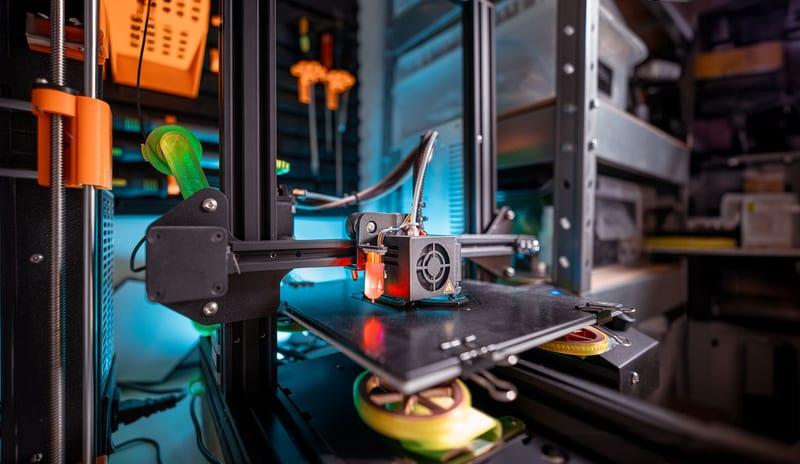
Stock photograph of this product class, not of this specific unit.
#ad We earn a commission · price as of November 20, 2026
1. Best for big engineering parts
Creality K2 Plus Combo
A true 350 mm cube with an actively heated 60 C chamber, a 350 C tri-metal nozzle and a 120 C bed - a combination no current Bambu machine publishes.
The K2 Plus wins the specification argument outright, and on one row it wins something no Bambu offers. 3DJake lists it at a 350 x 350 x 350 mm build volume, a tri-metal nozzle to 350 C, a bed to 120 C and — the important one — a chamber actively heated to 60 C, with speeds up to 600 mm/s and acceleration up to 30,000 mm/s².
An actively heated chamber is a different class of tool for warping materials. Every P-series and H-series Bambu enclosure is passive: it retains the heat the bed and hotend put into it. A chamber that makes its own heat turns a tall ABS or ASA part from a technique into a setting, and it is the single most defensible reason on this page to buy outside the Bambu range.
The Combo also includes the CFS four-spool system with automatic filament change and an Apus all-metal direct drive extruder, so color is in the box rather than an upgrade. The costs are physical and ecological: 495 x 515 x 640 mm and 33.5 kg is an appliance that needs floor space, and nothing you own for a Bambu fits it. Printer dimensions is the page for working out whether it fits where you intend to put it.
What it gets right
- An actively heated 60 C chamber is a capability no P-series or H-series Bambu enclosure has
- A 350 mm cube in all three axes, where the largest Bambu reported figure is 350 x 320 x 325 mm
- Four-spool color and a 350 C tri-metal nozzle included rather than bought as upgrades
What it does not
- At 33.5 kg and 495 x 515 x 640 mm this is a floor-standing appliance, not a desk one
- Separate ecosystem: different slicer, different profiles, and no AMS or Bambu part fits it
- I have not run one; everything on this site about it is published specification and reasoning, not observation
| Build volume | 350 x 350 x 350 mm |
|---|---|
| Machine dimensions | 495 x 515 x 640 mm |
| Net weight | 33.5 kg |
| Nozzle | Tri-metal, to 350 C |
| Bed | To 120 C |
| Chamber | Actively heated to 60 C |
| Speed / acceleration | Up to 600 mm/s, up to 30,000 mm/s2 |
| Multi-material | CFS four-spool system with automatic filament change |
| Extruder | Apus all-metal direct drive |
| Screen | 4.3-inch color touchscreen |
Stock photograph of this product class, not of this specific unit.
#ad We earn a commission · price as of November 20, 2026
2. Best large-format Bambu, if you stay
Bambu Lab H2D
A reported 350 x 320 x 325 mm build volume with a direct-drive dual nozzle. The dual nozzle is the capability the K2 Plus does not have.
If you want large format and you want to stay in the ecosystem, this is the machine, and it is not simply a smaller K2 Plus. The registry lists the H2D at a reported 350 x 320 x 325 mm build volume with a direct-drive dual nozzle, released March 25, 2025.
The dual nozzle is the capability that runs the other way. Two independent hotends held hot at once means dissolvable support in a different polymer from the part, and rigid plus flexible in one print. A four-spool system like the CFS feeds one hotend and purges between materials — it gives you colors, not two simultaneous materials. If support removal is what limits your designs, the K2 Plus does not solve it.
Set expectations on the two rows where it loses: the reported build volume is 320 and 325 mm in two axes against the K2 Plus's 350 across all three, and the registry does not describe any active chamber heating. Is the H2D worth it runs the four tests that decide whether you need either machine.
What it gets right
- Direct-drive dual nozzle is a different kind of machine, not a faster version of the one you own
- The largest reported build area of the models an enthusiast realistically buys
- Two hotends means dissolvable or contrast material without an AMS color-change purge every layer
What it does not
- This is the biggest single jump in money in the whole lineup — it has to replace a workflow, not a wish
- Two nozzles is two of every maintenance task
- If multi-color is the actual goal, an AMS 2 Pro on your existing printer gets you most of the way for a fraction of it
| Released | March 25, 2025 |
|---|---|
| Type | Large-format enclosed, direct-drive dual nozzle |
| Build volume (reported) | 350 x 320 x 325 mm |
| Laser Edition (reported) | Adds laser, blade and pen toolheads |

3. Best if you already own one — do the maths first
Bambu Lab P1S
A 256 mm cube, a 300 C nozzle and a 100 C bed, plus the deepest parts and profile ecosystem in desktop printing. Often the right answer is to keep it.
Most people reading a cross-brand large-format comparison own a P1S and are deciding whether to escalate. It is worth being precise about what you would actually be buying. Makerpoint lists the P1S at 256 x 256 x 256 mm, a 300 C nozzle and a 100 C bed.
Two things on this page are genuine P1S limits with no upgrade path: a bed bigger than 256 mm, and a chamber that makes its own heat. If neither of those is blocking you, the K2 Plus is selling you throughput and headroom you can largely buy as parts — a hardened hotend for materials, an AMS for color, a dryer for reliability.
The ecosystem is the counterweight and it is not a small one. Plates, hotends, screens, ducts, fans and gears all fit the P-series, and the profiles are already debugged. P1S versus the Elegoo Centauri Carbon is the same argument at the same build volume, Bambu Lab versus FlashForge is the version where the rival undercuts rather than outguns you, and the upgrades roundup is what switching would cost you access to.
What it gets right
- The enclosure plus auxiliary fan is what makes ABS and ASA realistic rather than aspirational
- Still the best-supported machine in the range for third-party upgrades — screens, hotends, plates, ducts
- Fast enough that the P2S's speed gain is not the reason to replace it
What it does not
- No touchscreen as shipped, which is why the Panda Touch exists
- No quick-swap nozzle: a nozzle change is a hotend job, not a 30-second one
- Passive chamber only — it holds heat, it does not make heat
| Released | July 13, 2023 |
|---|---|
| Type | Enclosed CoreXY |
| Over the P1P | Enclosure, auxiliary cooling fan and air filter |
| Multi-color | AMS and AMS 2 Pro (4 spools, expandable) |
Questions people actually ask
Is the Creality K2 Plus better than a Bambu Lab printer?
For big parts in warping materials, it has one advantage nothing in the Bambu range matches: 3DJake lists its chamber as actively heated to 60 C, where every Bambu enclosure this site documents is passive. It also publishes a true 350 x 350 x 350 mm build volume, a 350 C nozzle and a 120 C bed. What it does not have is a dual nozzle, or Bambu's parts and profile ecosystem.
How does the K2 Plus build volume compare to the H2D?
The K2 Plus Combo is listed at 350 x 350 x 350 mm. The registry reports the H2D at 350 x 320 x 325 mm - the same in one axis and 25 to 30 mm smaller in the other two. For most parts that is immaterial; for a cube-shaped job near the limit it is the difference between fitting and not.
Does the Creality K2 Plus have a heated chamber?
Yes - 3DJake lists the chamber as actively heated to 60 C, and that is the single most defensible reason on this comparison to buy outside the Bambu range. A passive enclosure retains the heat the bed and hotend produce, so a tall ABS part is built in air that warms as the print proceeds. A chamber held at a set temperature removes that gradient.
Is the CFS system the same as an AMS?
Functionally similar, and neither is a dual nozzle. The CFS holds four spools and changes between them automatically through one hotend, purging the previous material each time - so you get colors and you pay in purged filament. An AMS does the same job on a Bambu machine. What neither does is hold two materials hot at once, which is what gives you dissolvable support in a second polymer.
Will my Bambu accessories work on a Creality K2 Plus?
No. Nothing transfers - not build plates, not hotends, not the AMS, not any BIQU Panda part, and not your slicer profiles. That ecosystem cost is easy to overlook in a specification comparison and easy to feel in the second week of ownership.
Is the K2 Plus too big for a desk?
For most desks, yes. 3DJake lists it at 495 x 515 x 640 mm and 33.5 kg, against Makerpoint's 389 x 389 x 458 mm and 12.95 kg for a P1S. It is a floor-standing appliance and a two-person lift, and at 640 mm tall it will not go under a shelf - plan the space rather than finding it.
Is there a Bambu Lab printer with a heated chamber?
One reports it: the registry records the X2D with a reported 65 C heated chamber, released April 2026, at the 256 mm build-volume class. So if an actively heated chamber is what you are after and a 350 mm bed is not, there is an in-family answer - you just do not get the large format with it.
Sources
- Creality K2 Plus Combo build volume (350 x 350 x 350 mm), machine dimensions (495 x 515 x 640 mm), net weight 33.5 kg, tri-metal nozzle to 350 C, bed to 120 C, chamber to 60 C, speed up to 600 mm/s and acceleration up to 30,000 mm/s2, the CFS four-spool filament system with automatic filament change, the Apus all-metal direct drive extruder, the 4.3-inch color touchscreen and the stated PLA, PETG, ABS, ASA and PA-CF material support - 3DJake K2 Plus Combo listing, retrieved 2026-10-18
- Creality K2 Plus listed and sold as a current product by a US retailer - Micro Center K2 Plus listing, retrieved 2026-10-18
- P1S build volume (256 x 256 x 256 mm), machine dimensions (389 x 389 x 458 mm), net weight 12.95 kg, 300 C nozzle and 100 C bed - Makerpoint P1S listing, retrieved 2026-10-11
- Bambu Lab model list and release dates - Wikipedia, retrieved 2026-10-18
- Build volumes and feature rows for the H2D, H2S, X1-Carbon and every AMS unit, and the fitment rows on every third-party part, come from this site's product registry, whose spec provenance is documented in content/products.ts - no figure is asserted that a manufacturer or a cited third party did not publish
Read this next
- Bambu Lab P1S vs Elegoo Centauri CarbonIdentical 256 mm cubes. Elegoo publishes 350 C and 110 C against the P1S's 300 C and 100 C. The P1S wins on AMS, parts and profiles.
- Is the Bambu Lab H2D worth it?Worth it for two things only: a 350 x 320 x 325 mm bed and a direct-drive dual nozzle. Four tests tell you whether either is your problem, before the money leaves.
- Which Bambu Lab printer has the largest print areaThe H2D holds the largest reported figure at 350 x 320 x 325 mm - with the full table, the models we will not estimate, and the test for whether you need it.
- Dual nozzles, AMS and hotend swapping explainedDual nozzle, AMS and automatic hotend swapping compared - what each actually does and which models have which.
- Bambu Lab printer dimensions, and sizing a space for oneP1S 389 x 389 x 458 mm, P2S 392 x 406 x 478 mm, A1 465 x 410 x 430 mm, A1 mini 347 x 315 x 365 mm - plus the clearances an enclosure and an AMS add.
- Bambu Lab H2D vs X2DH2D for build volume, X2D for an actively heated chamber in a desk footprint. Both reported dual nozzle, so that is not the deciding factor.