Filament Drying
The best filament dryer under $300
Under $100 you buy a dryer that handles PLA, PETG and TPU. Under $300 you can buy one that handles nylon, PC and carbon-filled material - and that single temperature difference is what the extra money is for.
By Michael W. · Published November 22, 2026
Some links here are Amazon affiliate links, so a purchase may earn this site a commission at no cost to you. It does not change what gets recommended or the order it appears in — how that works.
Quick picks
Tap any row to jump to the full write-up. Prices are read from Amazon and dated; stock is always whatever the listing says.
| # | Product | Best for | Price |
|---|---|---|---|
| 1 | 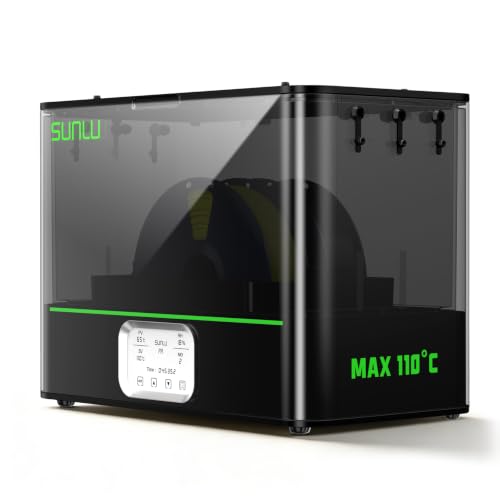 SUNLU E2 FilaDryer A cited 35-110 C range with a 500 W PTC heater, which is the first figure on this page genuinely high enough for nylon, PC and the filled engineering materials. | Best overall under $300 - the only unit here that reaches engineering temperatures Engineering filament — PA6-CF, PA12-CF, PC, ABS and ASA — and annealing finished parts | $299.99 · View on Amazon #ad We earn a commission · price as of November 23, 2026 |
| 2 | 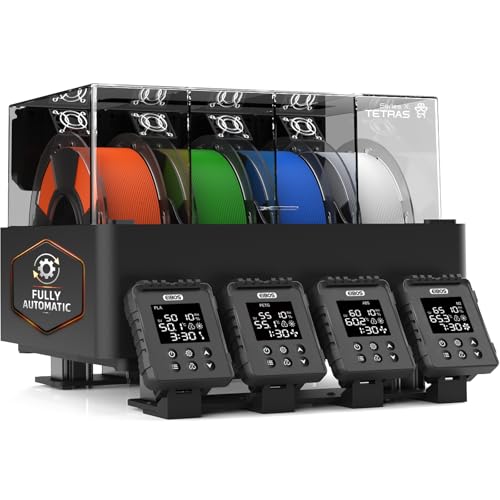 EIBOS Tetras Active drying built around the multi-material unit you have already paid for, rather than asking you to replace it. | Best under $300 if you already own an AMS AMS owners — active drying that works with the unit you already bought | |
| 3 |  SUNLU FilaDryer S4 Four spools dried at once, cheaper per spool than any single-spool unit here - the capacity that actually matches a four-color job. | Best four-spool capacity per dollar Multi-color and multi-printer owners — four spools dried at once | |
| 4 |  EIBOS Cyclopes Four spools with a cited infinite timer, so the unit can simply stay on as dry storage rather than running a cycle and stopping. | Best as permanent dry storage Four-spool drying with a timer that does not force you to restart it | |
| 5 |  SUNLU FilaDryer S2 A cited 35-70 C range, one spool, quiet enough to run overnight - and that range covers almost everything that actually goes wet in a hobby workshop. | Budget pick - the cheapest dryer here worth owning The cheapest dryer worth owning, if you just need PETG and TPU to behave |
Buy the SUNLU E2 if engineering filament is why you are here. Its cited 35-110 C range is the only figure on this page high enough for nylon, PC and PA-CF; every other unit here is a standard-temperature dryer that stops around 70 C, and no amount of extra time at 70 C substitutes for 110 C. It also anneals, which is a genuine second use. The budget pick is the SUNLU S2, the cheapest unit here that is a real dryer, and its cited 35-70 C range covers PLA, PETG and TPU — most of what actually goes wet.
Two readers should buy something else. If you already own an AMS, the EIBOS Tetras dries while the unit feeds the printer, which closes a gap no standalone box can. If you run four-color jobs, the SUNLU S4 dries the whole set you are about to print with instead of one spool while three re-absorb. Six registry dryers carried a live price under $300 at the last check; the E2 sat within about a dollar of the line, so read the figure on its button rather than this sentence.
Why $300, and what it buys that $100 does not
The line comes from this site's own price layer rather than from a round number. On 22 November 2026, six registry dryers carried a live Amazon price under $300 — double the three-product minimum this site requires before writing a price-band page. But the count is not the interesting part. The interesting part is that this is the first band that contains a high-temperature unit at all.
That is what separates this page from the best dryer under $100, which is a genuinely different ranking rather than a shorter version of this one. Under $100 the question is “what is the cheapest thing that dries PETG properly”. Under $300 the question is “do I need 110 C, and if not, what should I spend the difference on” — and the answers are capacity, continuous storage, or drying while printing.
The temperature wall, in one table
This is the whole page in five rows. A dryer that cannot reach a material's drying temperature does not dry it slowly; it does not dry it.
| Dryer | Cited temperature range | Capacity | Distinguishing feature | Reaches nylon and PC? |
|---|---|---|---|---|
| SUNLU E2 | 35-110 C | Single spool | 500 W PTC heater; also anneals | Yes - the only one here |
| EIBOS Tetras | Not published | Works with your AMS | Active drying while the AMS feeds | Not claimed |
| SUNLU S4 | Standard-temperature class | Four spools | Cheapest per spool here | No |
| EIBOS Cyclopes | Standard-temperature class | Four spools | Infinite timer; 100 W PTC | No |
| SUNLU S2 | 35-70 C | Single spool | Quiet enough for overnight | No |
The blank cells are deliberate. Where a manufacturer or cited retailer published no temperature figure, this site does not supply one — a range nobody published is not a range. The material-by-material detail is on how to dry filament and the engineering-material case is on the nylon dryer page.
What actually decides this, in four questions
1. What is the hardest material on your shelf?
If the answer is nylon, PC, PA-CF or PAHT-CF, the decision is already made: you need the 110 C unit and nothing cheaper substitutes. If the answer is PETG, PLA, TPU, ABS or ASA, every unit on this page can do the job and you should spend the money on capacity or convenience instead.
2. How many spools does one job use?
One spool means a single-spool unit is fine. Four spools means a single-spool unit creates the problem it is meant to solve — three spools sitting out while the fourth dries. This is the most common mistake AMS owners make in this category.
3. Do you need to print from it?
Bambu's own PETG HF guidance is to keep the filament moisture-free during the print, not just before it, and on a long print a spool dried last night is not a dry spool by morning. If that describes your work, the unit that dries while it feeds is worth more than any temperature figure. Printing while drying quantifies it per material.
4. Is this drying or storage?
Drying is a cycle; storage is a condition. A unit with an infinite timer can be either, and a sealed box with desiccant is the cheapest way to hold a condition without a power bill. The PolyDryer's approach — sealed storage first with a cited 10-20% RH, active drying second — is the third route, and it is ranked on dryer boxes.
Who should buy what
You print nylon, PC or filled engineering filament. The E2. Nothing cheaper reaches the temperature, and read the live price on the button because it sits near the line.
You own an AMS and your filament keeps going wet mid-print. The Tetras, after verifying fitment for your exact unit.
You run four-color jobs. The S4, for capacity per dollar.
You want the filament shelf to simply stay dry. The Cyclopes, for the infinite timer — or sealed boxes with desiccant if a standing power draw bothers you.
You print PLA, PETG and TPU and want this solved cheaply. The S2. It is the budget pick and for a large share of readers it is the correct purchase.
What this page is and is not based on
The $300 line was set and verified against this site's live Amazon price layer on 22 November 2026; no price is written into the copy and every button carries its own date. Temperature ranges, heater wattages, capacities, timers and material lists are the manufacturers' or cited retailers' published figures held in this site's registry, with vendor positioning labeled as cited and omitted where nobody published it. The PETG HF drying guidance and the TPU 95A HF humidity statement are quoted from Bambu Lab's own product pages, retrieved 22 November 2026. No dryer on this page has been run here, no chamber humidity was measured here, and no drying time was timed here. See how we review.
Every pick in full
#ad We earn a commission · price as of November 23, 2026
1. Best overall under $300 - the only unit here that reaches engineering temperatures
SUNLU E2 FilaDryer
A cited 35-110 C range with a 500 W PTC heater, which is the first figure on this page genuinely high enough for nylon, PC and the filled engineering materials.
This is the pick that justifies the band, and the reason is one number. Its cited temperature range is 35-110 C. Every other dryer on this page is a standard-temperature unit that tops out around 70 C, and 70 C is not enough for nylon, PC or PA-CF — it is a figure that dries PLA, PETG and TPU and then stops. So the extra money in this band is not buying you a nicer box. It is buying a different capability.
Two more cited specifics matter. A 500 W PTC heater gets the chamber to temperature quickly rather than creeping there over an hour, which turns drying from an overnight commitment into something you can do before a print. And it doubles as an annealing oven — a genuine second use, not a marketing bullet, since annealing is the step that gets published mechanical properties out of a printed nylon or PC part. The materials cited for it are PA6-CF, PA12-CF, PC, ABS and ASA. There is a full review on the SUNLU E2 review.
Honest cons, including a price one. It is overkill and over-priced if PLA and PETG are all you print. A 500 W heater is not a quiet, low-draw appliance, so it is not the unit to run continuously in a bedroom. Annealing shrinks and distorts parts, which makes it a technique to learn rather than a button to press. And this is the unit on the page that sits closest to the $300 line — within about a dollar of it at the last check — so read the live figure on the button rather than trusting the headline.
What it gets right
- 110 C is the first number on this page that is genuinely enough for nylon and PC
- A 500 W PTC heater gets to temperature fast instead of creeping there over an hour
- Doubles as an annealing oven, which is a second real use rather than a marketing bullet
What it does not
- Overkill and over-priced if PLA and PETG are all you print
- A 500 W heater is not a quiet, low-draw appliance
- Annealing shrinks and distorts parts — it is a technique to learn, not a button to press
| Temperature range (cited) | 35-110 C |
|---|---|
| Heater (cited) | 500 W PTC |
| Second function | Annealing as well as drying |
| Materials cited | PA6-CF, PA12-CF, PC, ABS, ASA |
2. Best under $300 if you already own an AMS
EIBOS Tetras
Active drying built around the multi-material unit you have already paid for, rather than asking you to replace it.
The smartest buy in the band for a specific reader, and the reader is common on this site: you own an AMS, your filament keeps going wet, and the upgrade you were considering was a whole new multi-material unit. This is positioned instead as active drying that reuses the AMS you already own, which is a materially different proposition from every standalone box here.
The mechanism is what makes it worth the money. Every standalone dryer has a gap built into it: you dry a spool, you take it out, and it starts re-absorbing immediately. Drying while the AMS feeds the printer closes that gap, which matters most for the materials that re-absorb fastest. Bambu's own PETG HF page states that the filament must be dried before use and remain moisture-free during the printing process, especially for longer print times — “during” is the operative word, and it is the thing a cycle-and-remove dryer cannot do. It is also cheaper than an AMS 2 Pro upgrade if drying was the only reason you were considering one.
Honest cons. The entire value proposition depends on you owning a compatible AMS, so verify fitment for your exact unit before buying — AMS compatibility is the page for that. If you have no AMS, a plain four-spool dryer is simpler and cheaper. And more parts in the filament path is more places for a feed problem to start: filament not feeding is the troubleshooting page when it does.
What it gets right
- Built around the fact that you already own an AMS, rather than asking you to replace it
- Active drying while the AMS feeds the printer closes the gap between drying and printing
- Cheaper than an AMS 2 Pro upgrade if drying is the only reason you were considering one
What it does not
- Its whole value proposition depends on you owning a compatible AMS — verify fitment for your exact unit
- If you do not have an AMS, a plain four-spool dryer is simpler and cheaper
- More parts in the filament path is more places for a feed problem to start
| Positioning (cited) | Best for Bambu Lab AMS owners |
|---|---|
| Approach (cited) | Active drying that reuses the AMS you own |
3. Best four-spool capacity per dollar
SUNLU FilaDryer S4
Four spools dried at once, cheaper per spool than any single-spool unit here - the capacity that actually matches a four-color job.
The capacity answer, and in this band you can buy it without thinking hard about the money. Four spools at once is the only capacity that matches a four-color workflow, and the reason that matters is a trap people fall into with single-spool dryers: you dry one spool while the other three sit in the room re-absorbing, then print with all four. Drying the whole set you are about to print with is the only version of this that works.
It is also cheaper per spool than any single-spool dryer here, which makes it the value pick of the page for anyone with a filament shelf rather than a filament spool. There is a full review on the SUNLU S4 review, and dryer cabinets covers the four-spool class as a whole.
Honest cons. It is a big box, and four-spool dryers need shelf space next to the printer that you may not have — measure first. Standard-temperature drying is not enough for nylon or PC, which is the whole argument for the top pick. And four spools heat more slowly than one, so cycles are long: this is an overnight appliance rather than a pre-print one.
What it gets right
- Four spools at once is the only capacity that matches a four-color workflow
- Dries the whole set you are about to print with, rather than one spool at a time while three re-absorb
- Cheaper per spool than any single-spool dryer
What it does not
- It is a big box; four-spool dryers need shelf space you may not have next to the printer
- Standard-temperature drying is not enough for nylon or PC — that needs a high-temp unit
- Four spools heat more slowly than one, so cycles are long
| Capacity | Four spools |
|---|---|
| Positioning (cited) | Best for multi-color and multiple printers |
4. Best as permanent dry storage
EIBOS Cyclopes
Four spools with a cited infinite timer, so the unit can simply stay on as dry storage rather than running a cycle and stopping.
The direct competitor to the four-spool pick above, with one cited difference that changes how you use it: an infinite timer. A dryer with a fixed cycle is an appliance you remember to start; a dryer that can stay on indefinitely is dry storage that happens to be heated, which is a different and arguably better way to solve the problem.
The other cited figure is a 100 W PTC heater for four spools, which is efficient for the volume it holds — relevant precisely because you might leave it running. Since it is a direct competitor to the SUNLU four-spool unit at a similar capacity, the honest advice is to shop both and let the live prices decide; the registry entry says exactly that.
Honest cons. Running a dryer continuously as storage costs power, and for genuinely long-term storage a sealed box with desiccant is cheaper and does not plug in — dryer boxes covers that route. It is a standard-temperature class unit, so nylon and PC are not its job. And it has the same four-spool footprint problem: measure the shelf.
What it gets right
- An infinite timer means the unit can simply stay on as dry storage, not just run a cycle
- Four spools at a 100 W PTC heater is efficient for the volume it holds
- Direct competitor to the SUNLU S4 at a similar capacity, so shop both
What it does not
- Running a dryer continuously as storage costs power — consider a sealed box with desiccant for long-term storage instead
- Standard-temperature class, so nylon and PC are not its job
- Four-spool footprint again: measure the shelf first
| Capacity | Four spools |
|---|---|
| Heater (cited) | 100 W PTC |
| Timer (cited) | Infinite |
5. Budget pick - the cheapest dryer here worth owning
SUNLU FilaDryer S2
A cited 35-70 C range, one spool, quiet enough to run overnight - and that range covers almost everything that actually goes wet in a hobby workshop.
The cheapest unit on the page and still a real dryer rather than a warm box. Its cited range is 35-70 C, it takes one spool, it supports all common filament diameters, and it is noted as quiet enough for overnight drying. On a page that spends most of its words on the expensive end, this deserves a clear statement: that range covers PLA, PETG and TPU, which is most of what actually goes wet in a hobby workshop.
It matters for TPU especially. Bambu states that TPU 95A HF is highly sensitive to humidity and recommends drying before use and after storage, and TPU is the material where a cheap dryer most visibly earns its money — the TPU dryer page has that case. Being quiet enough to run overnight in a room you sleep in is the quiet reason this unit gets used rather than shelved.
Honest cons. The 70 C ceiling puts nylon, PC and PA-CF out of range entirely, which is the line the top pick crosses. One spool at a time does not fit a four-color job. And there is no printing from the unit, so a dried spool starts re-absorbing the moment it comes out — printing while dryingexplains how much that costs per material.
What it gets right
- 35-70 C covers PLA, PETG and TPU, which is most of what actually goes wet in a hobby workshop
- Quiet enough to run overnight in a room you sleep in
- The cheapest entry point that is still a real dryer rather than a warm box
What it does not
- 70 C ceiling means nylon, PC and PA-CF are out of range
- One spool at a time, which does not fit a four-color job
- No printing from the unit, so a dried spool starts re-absorbing the moment it comes out
| Temperature range (cited) | 35-70 C |
|---|---|
| Capacity | One spool |
| Diameters | Supports all common filament diameters |
| Noted | Quiet enough for overnight drying |
Questions people actually ask
What is the best filament dryer under $300?
The SUNLU E2, if engineering filament is why you are shopping. Its cited 35-110 C range is the only figure in this band high enough for nylon, PC and PA-CF, where every other unit here is a standard-temperature dryer that stops around 70 C. If you only print PLA, PETG and TPU, buy the cheapest unit on the page instead and spend the difference on capacity.
What does $300 buy that $100 does not?
One thing that matters: temperature. This is the first price band that contains a high-temperature unit at all, and 110 C versus 70 C is the difference between drying nylon and not drying it. Everything else the extra money buys - four-spool capacity, an infinite timer, drying while the AMS feeds the printer - is convenience rather than capability.
Do I need 110 C to dry filament?
Only for the engineering materials. PLA, PETG and TPU dry well inside a 35-70 C range, which is what the cheap units cover. Nylon, PC, PA-CF and PAHT-CF need more heat than that, and a unit that cannot reach their drying temperature does not dry them slowly - it does not dry them.
Should I buy a four-spool dryer or a single-spool one?
Count the spools in one job. If a print uses four colors, a single-spool dryer creates the problem it is meant to solve: you dry one spool while three sit in the room re-absorbing, then print with all four. Four-spool units are also cheaper per spool. The trade is footprint and much longer cycles, because four spools heat more slowly than one.
Is a dryer that prints while drying worth the extra?
For long prints in absorbent materials, yes. Bambu's own PETG HF guidance is to keep the filament moisture-free during the print, not just before it, and a spool dried last night is not a dry spool by hour eight. A standalone dryer has that gap built in; a unit that dries while it feeds does not.
Can I leave a filament dryer running all the time?
One unit in this band publishes an infinite timer specifically so you can, which effectively turns it into heated dry storage. It does cost power to run continuously, so for genuinely long-term storage a sealed box with desiccant is cheaper and does not plug in. Drying is a cycle; storage is a condition.
Does a dryer help with ABS and ASA?
Yes, and both absorb moisture, so a standard-temperature unit is worth having if you print them. But moisture is not what makes ABS prints fail most often - uneven cooling is, which is a chamber problem rather than a filament one. Dry the spool and close the chamber; neither substitutes for the other.
How do I know moisture is my problem before spending the money?
Look for the signature: popping or hissing at the nozzle, stringing between parts, rough surfaces and inconsistent extrusion. Those overlap with a worn feed path and a partially clogged nozzle, so the symptoms page is worth reading first - and if you print PLA in a dry climate, the honest answer may be that you do not need a dryer at all.
Sources
- Temperature ranges, heater wattages, capacities, timers, cited humidity figures and material lists for every dryer on these pages come from this site's product registry, whose spec provenance is documented in content/products.ts - every figure is the manufacturer's or a cited retailer's published number, vendor positioning is labeled as cited, and nothing was measured by this site
- Bambu Lab PETG HF printing tips: "PETG HF must be dried before use and remain moisture-free during the printing process, especially for longer print times (over 6 hours)" - Bambu Lab US store, retrieved 2026-11-22
- Bambu Lab TPU 95A HF drying recommendation: "TPU 95A HF is highly sensitive to humidity. To achieve optimal printing performance, it is recommended further drying before use and after storage" - Bambu Lab US store, retrieved 2026-11-22
- Bambu Textured PEI Plate recommended heatbed temperatures per material: PLA 45-60 C, PETG 60-80 C, ABS and ASA 90-100 C, TPU 35-45 C - official Bambu Lab store product page, retrieved 2026-10-06
- Every price shown on a buy button on this page is the live Amazon figure for that listing, refreshed daily and stamped with the date it was checked. The $300 line was set and verified against those live figures on 2026-11-22, when six registry dryers sat under it with a buyable offer; the high-temperature unit sat within about a dollar of the line, which is stated in the copy rather than glossed over. No price is typed into the copy - see lib/prices.ts
Read this next
- The best filament dryers in 2026Dryer picks split by temperature range and capacity, because a 70 C unit and a 110 C unit are different products for different materials.
- The best filament dryer under $100Three dryers under the line, all in the 70 C class. Capacity and feed-through are what separate them - and the one material group no unit at this price can serve.
- SUNLU alternativesWhat SUNLU is known for, stated from its published figures, and three non-SUNLU dryers that match it on a stated strength or a lower price: an infinite-timer four-spool unit, a sealed per-spool box system, and active drying inside an AMS.
- SUNLU FilaDryer E2The only 110 C unit in this site's registry. Published range, capacity, timer and heat-up figures - plus the two specs the maker and the retailer disagree on.
- The best filament dryer for nylon and PA6-CFNylon and PA6-CF need temperatures most dryers cannot reach - which units are cited as going high enough, and the one you may already own.
- Printing while dryingWhat the reabsorption gap costs per material, which units let you print from them, and when closing the gap is worth paying for.