Filament Drying
SUNLU alternatives
SUNLU is the brand most people buy their first dryer from, for a good reason: it covers the cheap end, the four-spool middle and the high-temperature top of the range. The alternatives are worth knowing where they do something SUNLU does not.
By Michael W. · Published November 22, 2026
Some links here are Amazon affiliate links, so a purchase may earn this site a commission at no cost to you. It does not change what gets recommended or the order it appears in — how that works.
Quick picks
Tap any row to jump to the full write-up. Prices are read from Amazon and dated; stock is always whatever the listing says.
| # | Product | Best for | Price |
|---|---|---|---|
| 1 |  EIBOS Cyclopes The same four-spool capacity with a cited infinite timer, which turns a drying cycle into permanent heated storage. | Best alternative to the four-spool SUNLU Four-spool drying with a timer that does not force you to restart it | |
| 2 |  Polymaker PolyDryer Sealed per-spool storage first and active drying second, with a cited 10-20% RH - the cheapest way into a non-SUNLU system. | Budget pick, and the alternative with a different philosophy Sealed storage first, active drying second — the per-spool approach | |
| 3 | 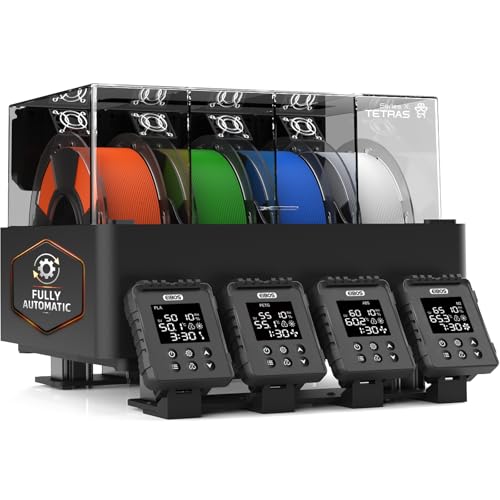 EIBOS Tetras Active drying positioned around the multi-material unit you already own, rather than a box the spool has to leave. | Best alternative if you own an AMS AMS owners — active drying that works with the unit you already bought | |
| 4 | Bambu Lab AMS HT A single-spool material system with high-temperature active drying that prints straight from the dryer - Bambu's own answer to the same problem. | The first-party alternative, if you print from the unit One engineering-grade spool, dried hot, printed straight from the unit | Check price on Amazon #ad We earn a commission · price as of November 23, 2026 |
If you want a four-spool dryer that is not a SUNLU, buy the EIBOS Cyclopes. Same capacity class, and its cited infinite timer lets it stay on as permanent heated storage rather than running a cycle and stopping — which is a different way of solving the problem rather than a cheaper version of the same one. The budget pick is the Polymaker PolyDryer, the cheapest non-SUNLU route here: a sealed per-spool box system with a cited 10-20% RH that prevents moisture rather than removing it. If you own an AMS, the EIBOS Tetras dries while the unit feeds the printer, which no standalone box can do.
Said plainly: three of the five dryers this site recommends anywhere are SUNLU units, and that is not an accident. SUNLU covers the cheapest entry point that is still a real dryer, the common four-spool middle, and — with a cited 35-110 C range — the only unit in this site's registry that reaches engineering-filament temperatures. Look elsewhere where another brand does something specific that SUNLU does not, not on principle.
What SUNLU is known for
Worth stating accurately before recommending anything else, because “alternatives” pages usually skip it. Everything here is from the published and cited figures this site holds in its own registry.
The cheapest unit that is still a real dryer
The S2's cited range is 35-70 C, one spool, all common filament diameters, and it is noted as quiet enough for overnight drying. That range covers PLA, PETG and TPU, which is most of what actually goes wet in a hobby workshop. It is the entry point this whole category is priced against.
The four-spool middle
The S4 holds four spools and is cited as positioned for multi-color and multi-printer owners. Four spools is the only capacity that matches a four-color job, and it is cheaper per spool than any single-spool unit.
The high-temperature top
The E2's cited range is 35-110 C with a 500 W PTC heater, and it also anneals. It is the only unit in this site's registry — from any brand — that reaches the temperatures nylon, PC and PA-CF need. If that is your requirement, this page has no alternative to offer you and says so.
Covering all three tiers with one brand is a real advantage, and it is why the main dryer roundup features three SUNLU units. The question this page answers is narrower: where does another brand do something specific better?
Where an alternative genuinely wins
| Alternative | Matches SUNLU on | Does differently | Where SUNLU still wins |
|---|---|---|---|
| EIBOS Cyclopes | Four-spool capacity | Cited infinite timer - stays on as dry storage | Nothing specific; shop the two on live price |
| Polymaker PolyDryer | A lower entry price, per box | Sealed per-spool storage, cited 10-20% RH | Cheaper to cover a whole shelf in one unit |
| EIBOS Tetras | Active drying | Dries inside the AMS you already own | Works without an AMS, and costs less |
| Bambu Lab AMS HT | High-temperature drying | Prints straight from the unit, first-party | One spool here; a standalone high-temp dryer costs less |
Permanent storage rather than cycles
The clearest win. A cited infinite timer is a feature, not a spec-sheet line: it changes the unit from an appliance you remember to start into a condition your filament lives in. If your actual complaint is “my filament is wet again” rather than “this spool is wet”, that is the difference you are looking for.
Preventing rather than removing
A sealed per-spool system with a cited 10-20% RH attacks the problem one step earlier. It also lets you spend a small amount to find out whether drying helps your prints at all, instead of committing to a four-spool box on a hunch. The per-box economics invert once you are covering a whole shelf, which is the honest limit.
Drying during the print, not before it
The gap every standalone box has. Bambu's own PETG HF guidance is to keep filament moisture-free during the print, especially past about six hours, and TPU 95A HF is described as highly sensitive to humidity with drying recommended before use and after storage. A unit that dries while it feeds closes that window; printing while drying works through how much it is worth per material.
Who should buy what
You want four spools and are shopping on price. Compare the Cyclopes and the four-spool SUNLU on today's live figures. They are close enough that the price should decide.
You want permanent dry storage rather than drying cycles. The Cyclopes, for the infinite timer — or sealed boxes with desiccant if a standing power draw bothers you.
You are not sure drying will fix your prints. One PolyDryer box. It is the lowest-risk purchase in the category, and is a filament dryer worth it is the page to read alongside it.
You own an AMS and lose prints to moisture mid-job. The Tetras, after verifying fitment.
You print nylon, PC or filled engineering filament. Buy the SUNLU E2 or Bambu's AMS HT. This page has no alternative that reaches those temperatures, and saying so is more useful than filling the slot.
What this page is and is not based on
Capacities, cited temperature ranges, heater wattages, timers, the cited 10-20% RH figure and every statement of positioning are the manufacturers' or cited retailers' published figures held in this site's registry; where nobody published a figure, none is asserted. The PETG HF drying guidance and the TPU 95A HF humidity statement are quoted from Bambu Lab's own product pages, retrieved 22 November 2026. No comparative claim on this page is based on testing: this site has not run, measured or timed any dryer from any brand, has made no humidity measurement of its own, and makes no claim that any unit here dries better than any other. See how we review.
Every pick in full
1. Best alternative to the four-spool SUNLU
EIBOS Cyclopes
The same four-spool capacity with a cited infinite timer, which turns a drying cycle into permanent heated storage.
This is the direct competitor, and the registry entry for it says so in as many words: a direct competitor to the four-spool SUNLU at a similar capacity, so shop both. That is the honest framing — these two units are close, and on any given day the live prices should decide it.
The cited difference worth buying for is the infinite timer. A four-spool dryer with a fixed cycle is something you start; one that can stay on indefinitely is dry storage that happens to be heated, which is a different way of solving the problem: you stop drying spools and start never letting them get wet. The other cited figure is a 100 W PTC heater for four spools, which is efficient for the volume it holds — relevant precisely because you might leave it on.
Honest cons. Running any dryer continuously costs power, and for genuinely long-term storage a sealed box with desiccant is cheaper and does not plug in. It is a standard-temperature class unit, so nylon and PC are not its job — the 110 C SUNLU remains the answer there, and this page is not going to pretend otherwise. And it has the same four-spool footprint to find shelf space for.
What it gets right
- An infinite timer means the unit can simply stay on as dry storage, not just run a cycle
- Four spools at a 100 W PTC heater is efficient for the volume it holds
- Direct competitor to the SUNLU S4 at a similar capacity, so shop both
What it does not
- Running a dryer continuously as storage costs power — consider a sealed box with desiccant for long-term storage instead
- Standard-temperature class, so nylon and PC are not its job
- Four-spool footprint again: measure the shelf first
| Capacity | Four spools |
|---|---|
| Heater (cited) | 100 W PTC |
| Timer (cited) | Infinite |
2. Budget pick, and the alternative with a different philosophy
Polymaker PolyDryer
Sealed per-spool storage first and active drying second, with a cited 10-20% RH - the cheapest way into a non-SUNLU system.
The cheapest non-SUNLU route and the one that disagrees with the premise. Every dryer above treats moisture as something you remove; this treats it as something you never let in. The cited approach is passive sealed storage plus active drying, built as a modular per-box system, with a cited humidity figure of 10-20% RH — and that is the number that actually matters in this category, far more than a temperature ceiling.
Two practical advantages fall out of the modular design. You can start with one box and add more, rather than making one large purchase, which is the lowest-risk way to find out whether drying fixes your prints at all. And because every spool lives sealed, the problem is prevented rather than fixed — no window where a just-dried spool sits on a shelf re-absorbing. It is ranked in full on filament dryer boxes.
Honest cons. Buying enough boxes for a full filament shelf adds up past the price of a four-spool dryer, so the per-box economics invert at scale. It is standard-temperature drying, not an engineering-filament answer. And per-box storage takes more total shelf area than a single stacked unit.
What it gets right
- The modular box system means every spool lives sealed, which prevents the problem instead of fixing it
- A cited 10-20% RH is the number that matters, and it is a good one
- Cheap to start with one box and add more, instead of one large purchase
What it does not
- Buying enough boxes for a full filament shelf adds up past the price of a four-spool dryer
- Standard-temperature drying — not an engineering-filament answer
- Per-box storage takes more total shelf area than a stacked rack
| Approach (cited) | Passive sealed storage plus active drying |
|---|---|
| Humidity reached (cited) | 10-20% RH |
| Entry point (cited) | From a per-box price, boxes bought individually |
3. Best alternative if you own an AMS
EIBOS Tetras
Active drying positioned around the multi-material unit you already own, rather than a box the spool has to leave.
The alternative that is not really competing on the same axis. SUNLU's range is standalone boxes; this is positioned as active drying that reuses the AMS you already bought. For the specific reader who owns an AMS and whose filament keeps going wet mid-print, that is a different product rather than a cheaper one.
The mechanism is the argument. A standalone dryer has a gap built in: dry the spool, remove it, and re-absorption starts immediately. Bambu's own PETG HF page states the filament must be dried before use and remain moisture-free during the printing process, especially for longer print times — and “during” is the word a cycle-and-remove dryer cannot satisfy. It is also cheaper than an AMS 2 Pro upgrade if drying was the only reason you were considering one, which is the comparison many readers are actually making.
Honest cons. Its whole value depends on owning a compatible AMS, so verify fitment for your exact unit — AMS compatibility is the page. Without an AMS, a plain four-spool dryer is simpler and cheaper. And more parts in the filament path is more places for a feed problem to start.
What it gets right
- Built around the fact that you already own an AMS, rather than asking you to replace it
- Active drying while the AMS feeds the printer closes the gap between drying and printing
- Cheaper than an AMS 2 Pro upgrade if drying is the only reason you were considering one
What it does not
- Its whole value proposition depends on you owning a compatible AMS — verify fitment for your exact unit
- If you do not have an AMS, a plain four-spool dryer is simpler and cheaper
- More parts in the filament path is more places for a feed problem to start
| Positioning (cited) | Best for Bambu Lab AMS owners |
|---|---|
| Approach (cited) | Active drying that reuses the AMS you own |
Stock photograph of this product class, not of this specific unit.
#ad We earn a commission · price as of November 23, 2026
4. The first-party alternative, if you print from the unit
Bambu Lab AMS HT
A single-spool material system with high-temperature active drying that prints straight from the dryer - Bambu's own answer to the same problem.
Worth including because it is the alternative a Bambu owner is most likely to be weighing, and because it comes from the printer manufacturer rather than an accessory brand. It is a single-spool material system whose headline feature is high-temperature active drying, and it prints directly from the dryer — so there is no window in which a dried spool sits absorbing moisture again.
Two things make it genuinely different from everything above. It dries hotter than the AMS 2 Pro, which is what nylon and PC actually need, and a single spool is the right shape for engineering filament — you rarely want four spools of PA6-CF. The comparison against a standalone dryer is set out in full on AMS HT against a filament dryer, and the AMS HT reference page has the detail.
Honest cons, and they are the reason it is last. One spool, so if multi-color is the goal this is the wrong unit entirely. It costs real money for a capability a standalone high-temperature dryer also delivers — and on this site that standalone unit is a SUNLU. Bambu sells most of its own hardware direct rather than through Amazon, so its button here carries a tagged search rather than a live figure. And it is only worth it if you print materials that genuinely need the extra heat.
What it gets right
- Dries at a higher temperature than the AMS 2 Pro, which is what nylon and PC actually need
- Prints directly from the dryer, so there is no window where a dried spool sits absorbing moisture again
- Single spool is the right shape for engineering filament, which you rarely want four of
What it does not
- One spool. If multi-color is the goal, this is the wrong unit entirely
- Costs real money for a capability a standalone high-temp dryer also delivers
- Only worth it if you print materials that genuinely need the extra heat
| Type | Single-spool material system |
|---|---|
| Headline feature | High-temperature active drying |
Questions people actually ask
What is the best alternative to a SUNLU filament dryer?
The EIBOS Cyclopes, if you want four-spool capacity from another brand. It matches the four-spool SUNLU on capacity and adds a cited infinite timer, which lets it stay on as permanent heated storage rather than running a cycle and stopping. The two units are close competitors, so compare them on today's live prices.
Is SUNLU a good brand for filament dryers?
Three of the five dryers this site recommends anywhere are SUNLU units, which is the honest answer. The range covers the cheapest entry point that is still a real dryer, the common four-spool middle, and - with a cited 35-110 C range - the only unit in this site's registry that reaches engineering-filament temperatures. Look elsewhere where another brand does something specific that SUNLU does not.
What is the cheapest alternative to a SUNLU dryer?
The Polymaker PolyDryer, bought as a single box. Its approach is sealed per-spool storage first and active drying second, with a cited 10-20% RH, and starting with one box is the lowest-risk way to find out whether drying fixes your prints. The economics invert once you are covering a whole filament shelf, where a four-spool unit is cheaper.
Is there an alternative to the SUNLU E2 for nylon?
Not a standalone one in this site's registry. The E2's cited 35-110 C range is the only range here high enough for nylon, PC and PA-CF, and the nearest alternative is Bambu's own single-spool AMS HT, which dries hot and prints straight from the unit. Anything else would be a standard-temperature dryer recommended for a job it cannot do.
What is the alternative to the SUNLU S4 for four spools?
The EIBOS Cyclopes, with the same four-spool capacity, a cited 100 W PTC heater and a cited infinite timer. This site's registry describes the two as direct competitors at a similar capacity and recommends shopping both, which is the honest position - on any given day the live price should decide it.
Should I buy a dryer or sealed storage boxes?
It depends whether your problem is a spool or a shelf. Drying is a cycle and storage is a condition: a dryer fixes a wet spool, a sealed box with desiccant stops spools getting wet in the first place. The per-box systems are cheapest to start and most expensive to scale, and a unit with an infinite timer can do both.
Do I need a different dryer if I own an AMS?
Not necessarily, but there is one built for that case. A standalone dryer has a gap: you dry the spool, remove it, and re-absorption starts immediately. A unit positioned to dry actively while the AMS feeds the printer closes that window, which matters most on long prints in PETG and other absorbent materials. Verify fitment for your exact AMS before buying.
Which brand of filament dryer dries best?
This site cannot tell you, and will not guess. Nothing here has been run, measured or timed, no humidity reading of our own exists, and no comparative drying claim is made about any brand. What is comparable is the published figures - temperature range, capacity, timer behavior, heater wattage - and those are what every ranking on this site is built from.
Sources
- Temperature ranges, heater wattages, capacities, timers, cited humidity figures and material lists for every dryer on these pages come from this site's product registry, whose spec provenance is documented in content/products.ts - every figure is the manufacturer's or a cited retailer's published number, vendor positioning is labeled as cited, and nothing was measured by this site
- Bambu Lab PETG HF printing tips: "PETG HF must be dried before use and remain moisture-free during the printing process, especially for longer print times (over 6 hours)" - Bambu Lab US store, retrieved 2026-11-22
- Bambu Lab TPU 95A HF drying recommendation: "TPU 95A HF is highly sensitive to humidity. To achieve optimal printing performance, it is recommended further drying before use and after storage" - Bambu Lab US store, retrieved 2026-11-22
- Every price shown on a buy button on this page is the live Amazon figure for that listing, refreshed daily and stamped with the date it was checked; a listing with no buyable offer at the last check renders "Check price on Amazon". No price is typed into this copy - see lib/prices.ts
Read this next
- The best filament dryers in 2026Dryer picks split by temperature range and capacity, because a 70 C unit and a 110 C unit are different products for different materials.
- The best filament dryer under $300Six registry dryers carried a live price under $300 at the last check, and one of them reaches 110 C where the cheap units stop at 70. Which to buy for engineering filament, for an AMS, for four spools, and the cheapest one worth owning.
- Filament dryer boxesHow per-spool sealed boxes differ from four-spool dryers, the humidity figure that matters, and where the modular approach stops scaling.
- SUNLU FilaDryer E2The only 110 C unit in this site's registry. Published range, capacity, timer and heat-up figures - plus the two specs the maker and the retailer disagree on.
- SUNLU FilaDryer S4Four 1 kg spools at a published 70 C, with filament fed out to up to four printers while it dries. The specs, the two figures retailers disagree on, and who should skip it.
- AMS HT vs a filament dryerThe reabsorption gap explained, and whether it justifies an AMS HT over a standalone high-temperature dryer for your print mix.